Growth Zones Reflection
Reflect on where challenge and capacity meet right now, then choose whether a next step fits.
Get This Tool
Free, print-ready PDF.
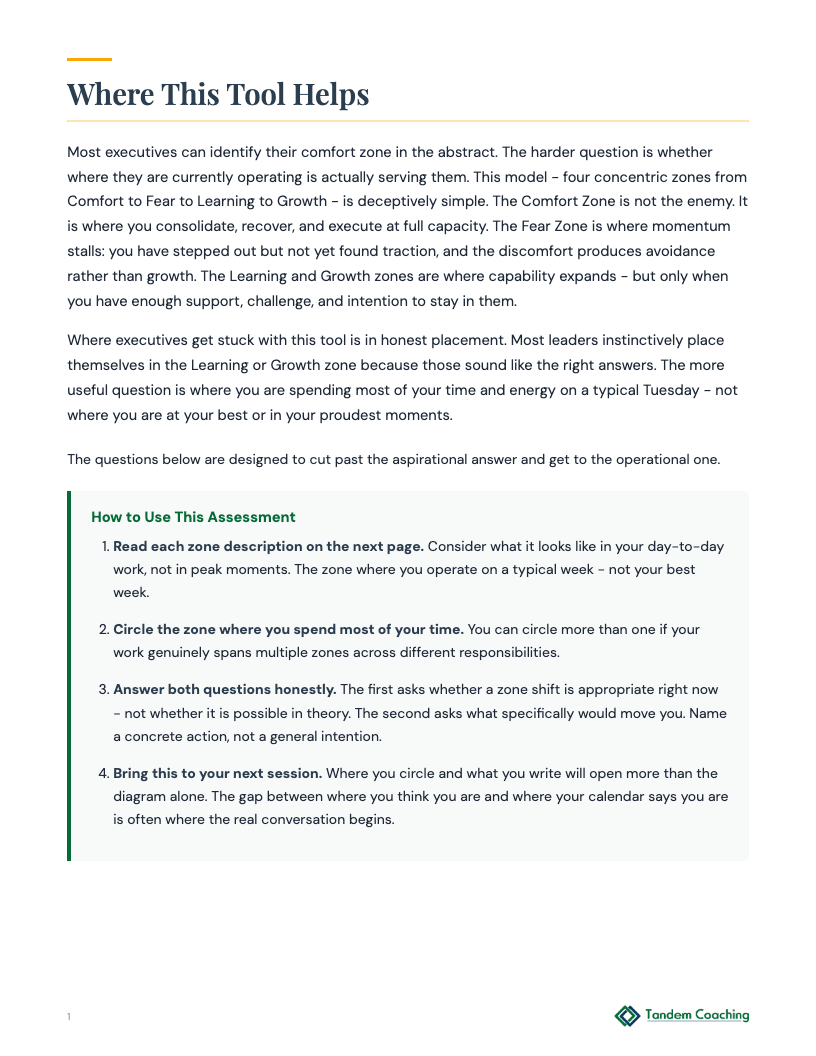
When to Use This Tool
A client is avoiding something important and keeps finding reasons not to move forward
A client wants to understand where they are holding themselves back
A client is ready to stretch but unsure what the next growth edge looks like
How to Introduce This Tool Plus
Looking at the four zones, where would you honestly place yourself right now — and what zone are you being pulled toward that you haven't fully stepped into yet?
Browse All Pages
Tool Classification
Domain
Executive
Type
Assessment
Phase
Discovery
Reflection
Details
15 min
Opener
As-needed
Topics
Mindset
Resilience
Identity
For the Coaching Practitioner
Plus
Coaching Scenarios
Plus
1 VP who places himself in the Learning Zone but whose calendar contradicts it ▶
Context
A VP of finance at a mid-size company has been in coaching for two months. He describes himself as someone who actively seeks challenge and is not afraid to step outside his comfort zone. In session, his calendar and his decisions tell a different story: he has declined two stretch assignments in the past quarter, delegated the most complex stakeholder negotiations to direct reports, and is continuing to do detailed work his role does not require. He uses the language of the Learning Zone while operating from the Comfort Zone.
How to Introduce
Use the tool's operational question as the framing. 'This assessment asks where you are spending most of your time and energy on a typical Tuesday - not where you are at your best. I want to use that question specifically because you've described yourself as someone who is comfortable with challenge. The tool has four zones, and the diagnostic question is whether where you place yourself matches where your actual decisions and calendar are placing you. Complete the assessment based on your last four weeks, not your general self-concept.' The calendar-versus-self-concept framing names the potential discrepancy without asserting it.
What to Watch For
Watch which zone he circles. If he circles Learning or Growth, the debrief should bring in calendar evidence before accepting the placement. Also watch what he writes in the two reflection questions: the first asks whether a zone shift is appropriate, and the second asks what specific objectives would move him. If the objectives he names in Question 2 are things he has already declined or delegated in the past quarter, the gap between stated intention and actual choice is the coaching material. Vague objectives ('get better at stakeholder navigation') without named situations are a signal that the tool has been completed aspirationally.
Debrief
Start with his zone placement. 'You've placed yourself in [zone he selected]. I want to compare that to what your calendar from the last four weeks shows. Walk me through the last stretch assignment or high-complexity situation you took on directly - not delegated, not declined.' If he struggles to name one, the placement is worth examining. Then: 'You wrote [his stated specific objective]. What has gotten in the way of that in the last month?' This tests whether the specific objective is genuinely his next growth edge or an aspirational placeholder that avoids engaging with the real pattern.
Flags
If he circles Learning or Growth and the two reflection questions are completed with genuine specificity - named situations, named relationships, named skills - and these match coaching observations of his actual behavior, the self-placement may be accurate. Severity: low. The tool is still useful as a calibration point, but the coaching work may be at a different layer than zone placement. If the tool produces no new information, use the post-tool prompts: 'Is the zone you're in a choice you're making deliberately, or a pattern that has formed without your attention?'
2 Director who has been in the Fear Zone for six months but doesn't have a name for what she's experiencing ▶
Context
A director of product design was promoted eight months ago into a newly created role with significant ambiguity about scope, authority, and reporting relationships. She has been working hard and making progress on some dimensions. In coaching sessions, she describes feeling chronically uncertain, second-guessing her decisions, experiencing high energy cost for work that used to feel natural, and doubting whether she is the right person for the role. She attributes this to the newness of the role. Her coach recognizes the description as the Fear Zone: new ground, stalled progress, discomfort producing avoidance rather than growth.
How to Introduce
The naming function of the tool is the entry point. 'What you've described over the last several sessions - the second-guessing, the energy cost, the doubt about whether you're the right person - matches a specific zone in this model. I want you to read through the four descriptions and tell me which one captures where you've been spending your time. The reason this matters is that the Fear Zone and the Learning Zone feel similar from the inside but require different responses. If you're in the Fear Zone, the intervention is different than if you're in the Learning Zone.' Giving the experience a name before she completes the assessment prepares her to recognize it accurately.
What to Watch For
Watch whether she circles Fear Zone or Learning Zone. Clients who are functioning in the Fear Zone often circle Learning Zone because Learning sounds better, or because they are genuinely making some forward progress. If she circles Learning, read the Fear Zone description aloud and ask whether any of it fits. The two questions are equally important: the first asks whether a zone shift is appropriate, and the second asks what specific objectives would move her. If she answers the first with 'yes' without knowing what the second looks like, the assessment has surfaced the right problem without yet pointing to a solution.
Debrief
Start with the zone she circled. 'What made you choose [zone] over [adjacent zone]?' If she chose Learning over Fear, explore the overlap: 'The Fear Zone description includes 'high energy cost for work that used to feel natural' and 'self-doubt about fit.' How much of that is present?' Once zone placement is accurate, move to the second question: 'You wrote [her specific objective]. What would it take to have that in place by the end of next month - not eventually, by the end of next month?' The time specificity tests whether the objective is concrete enough to pursue.
Flags
If she circles the Fear Zone and the reflection questions produce a clear picture of what would move her - specific stretch objectives, named support structures, a concrete timeline - the assessment has done its diagnostic work and the coaching can shift to action. Severity: low. But if both reflection questions produce vague or absent answers despite working through them in session, the Fear Zone experience may be connected to something more specific about this role transition - authority confusion, relationship with her manager, or a belief about whether the role is actually achievable - that the model alone won't surface. A more direct exploration of what she believes would have to be true for her to feel in the Learning Zone is worth pursuing.
3 High-performer who has been in the Comfort Zone so long she can't locate her next growth edge ▶
Context
A senior manager at a financial services company is technically excellent and widely regarded as a reliable, high-quality contributor. She has been in her current role for four years. Her performance reviews are consistently strong. She has not received a promotion in three years, and the conversation in coaching has been circling a feeling of plateau without locating what to do about it. She does not experience discomfort in her role. She also does not experience growth. She has described this as 'being good at what I do but not sure what's next.' Her coach wants to map where she is actually operating before moving to development planning.
How to Introduce
Position the assessment as a location tool before it becomes a direction tool. 'Before we get to what's next, I want to get clear on where you are now. This model has four zones, and the useful question isn't which zone sounds most ambitious - it's which one describes where you actually are on a typical Tuesday. Read through the descriptions and circle the one that fits your operational reality right now, not your aspiration. We'll use the second question - what would move you - as a starting point for the conversation about next steps.' The separation of location from aspiration prevents the tool from becoming a planning exercise before the diagnosis is clear.
What to Watch For
Watch whether she circles Comfort Zone or whether she circles Learning or Growth because those sound better. The Comfort Zone description - 'familiar tasks, reliable outcomes, low cognitive load, operating on autopilot' - is precise enough that a client genuinely in it usually recognizes it when she reads it. Watch the first reflection question: 'Do you feel that moving out of your current zone is appropriate for you right now?' Some clients in the Comfort Zone answer 'no' because they are comfortable - this is useful information about readiness. Others answer 'yes' but cannot fill in the second question. The gap between yes on Question 1 and blank on Question 2 is the coaching problem.
Debrief
Start with the second question - what specific objectives would move her. 'You've written [her answer]. Walk me through what the first month of actively pursuing that would look like in behavioral terms.' If the objective is a stretch assignment, that conversation is about how to get it on the table with her manager. If it is a skill, that conversation is about what development looks like in practice. If the second question is blank or vague despite the coaching conversation, ask the post-tool prompt directly: 'What would it cost you to stay where you are for another six months?' The cost question often surfaces motivation that the objective question doesn't.
Flags
If she circles the Comfort Zone and answers the zone-shift question with 'no' - if she explicitly indicates that moving out of the current zone is not appropriate right now - explore what is behind the 'no' before moving to development planning. Severity: low. 'Not appropriate right now' can mean genuinely intentional consolidation, or it can mean the discomfort of the Fear Zone is more aversive than the plateau she is describing. Both are worth naming. The distinction matters because the development planning conversation looks very different depending on which is true.
Tool Flow
Plus
Requires
- None - standalone tool
→
Produces
- current operating zone placement
- zone shift readiness assessment
- named concrete stretch objectives for next zone
Pairs Well With
Executive
Capability Doubt Evidence and Options
Use this worksheet to explore mindset and identity and turn the client’s observations into one optional next step.
Why it pairsOnce the assessment names which zone your client is avoiding, this worksheet pinpoints the imposter pattern blocking that specific zone shift.
LifeConfidence Evidence and Learning Notes
Use this worksheet to explore identity and mindset and turn the client’s observations into one optional next step.
Why it pairsWhen zone placement reveals a readiness gap, use this worksheet to build the evidence-backed strengths inventory that closes it.
LifePersonal Power Prompts
A client wants to use Personal Power Prompts as an optional reflection
Why it pairsAfter the assessment surfaces where your client is stuck, these prompts locate a contrasting experience of agency to anchor forward movement.
This tool is part of a coaching pathway
Step 1 of 6 in A client is avoiding something important and keeps finding reasons not to move forward
Continue with Relationship Boundaries Worksheet if that next job fits.
Next: Relationship Boundaries Worksheet → Explore all pathways →Related Articles


The Strength That Got You Promoted Is the One Holding You Back
Read article →
Finding Your Purpose: How a Coach Helps Tech Leaders Thrive
Read article →
Is Executive Coaching Right for You?
Read article →
5 Leadership Development Examples: Plans, SMART Goals, and More
Read article →