
Perceived Stress Scale (PSS-10)
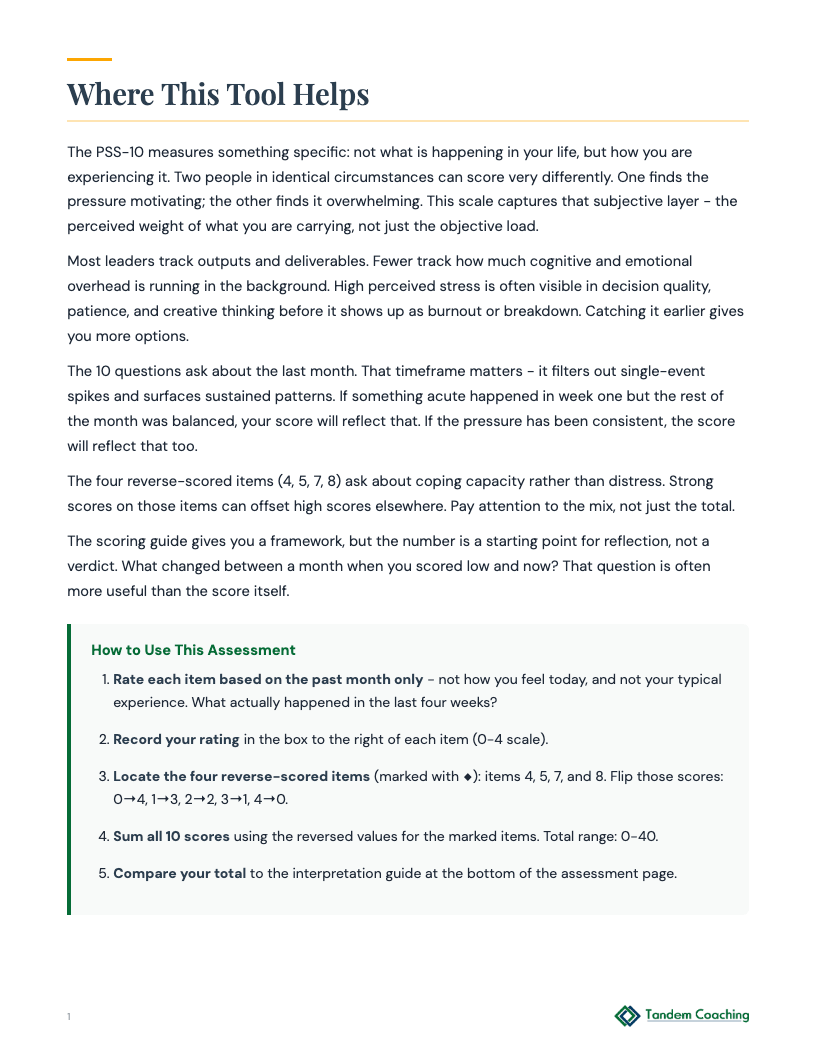
Reflect on the past month's perceived stress with the PSS-10 total and item responses, without diagnostic cutoffs.
Get This Tool
Free, print-ready PDF.
When to Use This Tool
A client wants a structured reflection on perceived stress during the past month
A client wants to compare item-level patterns over time without diagnostic categories
A client wants to discuss which experiences changed their sense of control or overload
How to Introduce This Tool Plus
The PSS total has no diagnostic cutoffs. Which individual responses or changes over time are most useful to explore in coaching?
Coaching Tool Disclaimer
This tool is designed for coaching contexts, not clinical use. If you or your client is in crisis, contact the 988 Suicide and Crisis Lifeline (call or text 988) or Crisis Text Line (text HOME to 741741).
Browse All Pages
Tool Classification
Domain
Wellness
Type
Assessment
Phase
Discovery
Details
5 min
Between sessions
Monthly
Topics
Resilience
Self-Care
For the Coaching Practitioner
Plus
Coaching Scenarios
Plus
1 High-performer treats sustained stress as the expected cost of ambition ▶
Context
A managing director reports sustained pressure but considers it an ordinary feature of the role. She wants a repeatable reflection on what feels controllable, unpredictable, or overloaded without being assigned a diagnostic label.
How to Introduce
Say: 'The PSS gives a 0-40 total but has no diagnostic cutoffs. We will look at your individual responses and changes over time, not label the score low, moderate, or high.'
What to Watch For
Notice gaps among individual items and whether the client's narrative matches those responses. Do not create a coping-capacity sub-score or infer a clinical state from the total.
Debrief
Ask which item surprised her, what changed during the month, and which controllable condition she wants to test before repeating the reflection.
Flags
The PSS is non-diagnostic and has no cutoffs. Severity: low. This level describes the coaching-boundary concern, not the PSS total. Response: use coaching for specific agreed experiments and refer symptoms, treatment, or clinical concerns to a licensed professional.
2 Leader under acute organizational pressure wants a baseline for reflection ▶
Context
A VP is eight months into a restructuring and notices shorter patience, worse sleep, and reduced recovery. He wants a structured picture of the past month.
How to Introduce
Frame it as perceived-stress reflection: 'This does not determine whether the restructuring is objectively hard or whether a condition is present. It records how often particular experiences occurred.'
What to Watch For
Use the total only as a reference. Focus on the specific responses, timing, and context. Do not assign a risk category from the number.
Debrief
Ask which response best captures the current experience and what, if anything, is available to change or discuss with another professional.
Flags
Severity: low. This level describes the coaching-boundary concern, not a cutoff or PSS total. Response: keep coaching focused on context and choices; use clinical, crisis, or emergency support for symptoms or safety concerns.
3 Client repeats the PSS and wants to understand change over time ▶
Context
A director has completed the PSS more than once and wants to compare periods without turning the number into a performance target.
How to Introduce
Say: 'We can compare totals and individual items over time, but there is no pass, fail, low, moderate, or high category.'
What to Watch For
Do not attribute a change to coaching without other evidence. A stable total can hide item-level movement, and a changed total can reflect context rather than a durable outcome.
Debrief
Compare item-level changes, identify relevant events or supports, and choose one observation to carry into the next period.
Flags
The measure is non-diagnostic. Severity: low. This level describes the coaching-boundary concern, not the PSS total. Response: do not promise score reduction or treat it as proof of coaching effectiveness.
4 Coaching client referred by HR is cautious about stress questions ▶
Context
A senior manager was referred after a performance conversation and worries that stress responses could be reported outside coaching.
How to Introduce
Clarify the agreement before using the tool: 'The PSS is non-diagnostic and has no cutoffs. We will decide together whether it is useful and what, if anything, may be shared under your coaching agreement.'
What to Watch For
Do not use the tool when confidentiality and reporting expectations are unclear. Avoid interpreting guarded responses as denial or score suppression.
Debrief
Ask whether the individual items reflected the month accurately and what the client wants to explore. Do not force an interpretation of the total.
Flags
Severity: moderate when confidentiality is unclear; this level does not interpret the PSS total. Pause and repair the agreement before using the scale. Clinical or safety concerns use the appropriate licensed, crisis, or emergency channel.
Tool Flow
Plus
Requires
- None - standalone tool
→
Produces
- PSS-10 total score from 0 to 40 without diagnostic cutoffs
- item-level perceived-stress observations
- month-over-month reflection baseline
Pairs Well With
ADHD
Optional Week Review
Use this worksheet to explore executive function and accountability and turn the client’s observations into one optional next step.
Why it pairsUse item-level PSS observations to choose which weekly energy or relationship pattern to watch next.
WellnessOptional Wellbeing Intentions
Use this worksheet to explore self care and values and turn the client’s observations into one optional next step.
Why it pairsUse this to explore a depleted self-care domain without treating the PSS total as a diagnostic category.
ADHDFeeling Context and Support Notes
Use this framework to structure a conversation about emotions and mindset while keeping interpretation with the client.
Why it pairsUse this when a client wants a real-time reflection tool for a specific stress response, independent of the PSS total.
Related Articles


Group vs Individual ADHD Coaching: Which Works?
Read article →
Change Management Certification: Compare Credentials and Choose
Read article →
Executive Function Strategies for ADHD Leaders: Working Memory, Impulse Control & Flexibility
Read article →Employee Development and Retention: Why Coaching the System Beats Training the Individual
Read article →