A coach-guided map to spot when you’re flat or overwhelmed and choose steadier regulation steps in between.
Free, print-ready PDF.
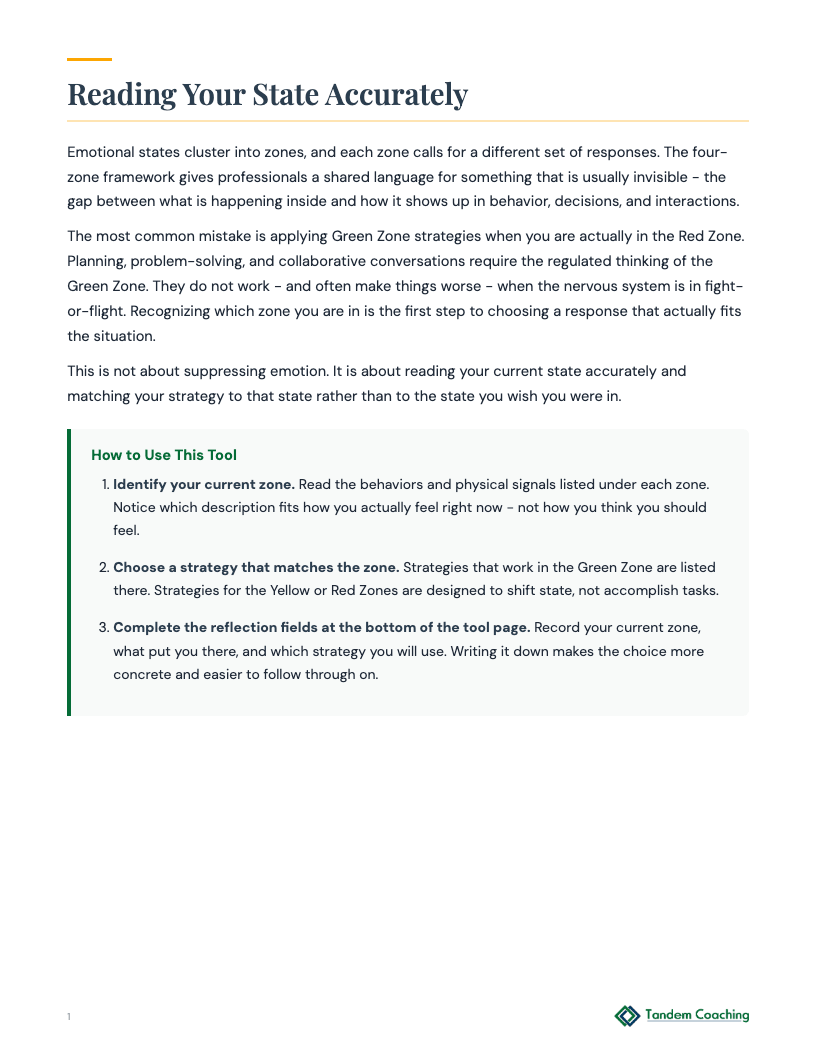
Some clients find it useful to map their emotional states into zones - from shut-down to flooded - and identify specific strategies for each zone rather than trying to apply one-size-fits-all coping - would exploring that framework be useful?
A VP of Sales consistently schedules his most cognitively demanding work — strategic planning, complex negotiations — for Friday afternoons when he is depleted. He does emotional conversations and difficult feedback conversations first thing Monday morning when he is energized. He reports that his calendar is built around what is urgent, not what requires what kind of thinking. His performance reviews describe him as 'inconsistent' without specifying why. He attributes this to the demands of the role, not to the mismatch between state and task.
This is not a scheduling conversation — lead with state before calendar. 'Most executives plan their days around task priority. This framework adds a second variable: which kind of task matches which kind of state. The framework identifies four zones — from low energy to overload — and what is possible in each. The question we're looking at is whether you are routinely asking yourself to do Green Zone work when you are in a Yellow or Blue Zone.' Resistance often sounds like 'I don't have control over my calendar.' The response: 'You have more control over which tasks you move than you think. But we need the map first.'
Watch whether he places himself in zones accurately or instinctively defaults to Green for every high-stakes task. Executives who conflate 'important work' with 'I must be in my best state' often don't track their actual state at all — they assume competence means readiness. Ask him to complete the in-the-moment reflection section about a specific recent meeting: which zone was he actually in, and what was the demand of that meeting? The gap between those two answers is where the work begins.
Start with the strategy list for his most frequently visited non-Green zone. 'Looking at the Blue Zone strategies — which of these is accessible in your actual workday, not in theory?' Then connect the zone to a specific scheduling consequence: 'If you were in the Yellow Zone going into last Tuesday's board prep session, which strategies from that list would have changed what you walked in with?' Make the framework behavioral, not conceptual.
If he identifies himself as consistently in the Yellow or Red Zone across most of his working week — not situationally but as his baseline operating state — the tool addresses symptom management rather than the structural problem. Severity: moderate. Note the pattern and explore what is driving the sustained elevated state. Sustained Yellow or Red Zone operation over weeks or months has organizational and health dimensions that go beyond regulation strategy selection.
A director of product management was promoted eight months ago and is struggling with her team's inconsistent engagement. In coaching she describes her pattern: when the team seems disengaged or flat, she pushes them with challenge and urgency to re-energize them. When they seem stressed, she escalates the challenge further — believing pressure produces performance. She has not yet developed a model for reading the team's state, and her default intervention (increased demand) works in some zones and backfires in others. Two senior team members have given her feedback that she 'reads the room wrong.'
Use the framework to create shared language before addressing her team-reading gap. 'Before we look at what's happening with your team, I want to introduce a framework you can use first on yourself — and then on the system you're managing. The zones model says each state has specific strategies that work in it and specific strategies that make it worse. Pushing a Yellow Zone team harder doesn't move them to Green — it moves them to Red.' This reframe disrupts the assumption that urgency is a universal performance driver without attacking her intent.
Watch whether she can apply zone language to specific team situations she describes — naming which zone the team appeared to be in during a particular meeting and what she did in response. If she consistently describes her team as either 'engaged' or 'not engaged' without zone differentiation, the framework hasn't landed yet. Ask: 'When you say they seemed flat last Thursday, which zone does that sound like — Blue or Red?' The distinction matters because the interventions differ entirely.
After she completes the framework for herself, move to application: 'Looking at the strategies in the Blue Zone column — these are what your team needed last Thursday. What did you do instead?' Then: 'From a manager's perspective, what is the equivalent of those strategies for a team — not for yourself, but for a group?' Let her generate the translation rather than providing it. The team-level equivalent of 'brief social connection' or 'change of scenery' often becomes a powerful coaching insight.
If her description of escalating challenge as a universal intervention is accompanied by feedback about psychological safety or team members avoiding transparency with her about their state, the zone-mismatch is producing a secondary problem. Severity: low to moderate. The framework work is appropriate, but note that if the team has learned to perform readiness rather than report it, her zone-reading problem becomes self-reinforcing and will require more than tool adoption to address.
A chief operating officer has a thorough pre-meeting preparation practice: he reviews agendas, pre-reads materials, and formulates his key points in advance. He does not have a practice of checking his state before entering important conversations. He has received feedback that he occasionally arrives in difficult conversations 'already defensive' or 'somewhere else entirely' — and that the tone of those conversations is set by his entry, not by what is said once inside them. He has no framework for understanding this pattern as a state problem.
Frame this as adding a single layer to a practice he already has. 'Your preparation practice is strong — you have the content side covered. What this framework adds is a check on the state side: which zone are you in before you walk into the room? A Green Zone entry and a Yellow Zone entry produce different conversations, regardless of how well you prepared the content.' The resistance here is often efficiency-based — executives with strong preparation practices treat state-checking as soft or redundant. Name it: 'This doesn't replace preparation. It takes 90 seconds before you open the door.'
Watch whether he can use the in-the-moment reflection section to name his zone before a specific upcoming conversation — not in retrospect, but in real time. Ask him to complete the reflection section just before a high-stakes meeting he has scheduled in the next two weeks and bring it to the following session. If he consistently reports being in the Green Zone regardless of circumstance, the self-assessment isn't landing accurately yet. Ask what body signals he noticed in the moments before the last difficult conversation that went sideways.
After reviewing a completed pre-conversation reflection, start with the 'Strategy I will use right now' field. 'On that day, what did you actually do with the 10 minutes before that meeting?' If the answer is more content preparation, the strategy selection step hasn't been applied yet. Then: 'If you had identified Yellow Zone entry on that day and selected one of these strategies, what would the conversation have looked like at the start?' Make the counterfactual concrete so the value of the pre-check becomes tangible.
If the pattern of arriving in difficult conversations 'already defensive' is consistent across coaching engagements and the client cannot identify what puts him in that state before important meetings, the pre-meeting trigger may be worth mapping with more specificity than the zones framework alone supports. Severity: low. Continue with the tool, but the trigger identification work may need a companion tool (Emotional Triggers Map) to get to the root of the pattern.
When I'm overwhelmed I blank on what actually helps me - I need a list I can reach for
WellnessA client is running at full capacity and starting to show signs of burnout
WellnessA client overwhelmed and needing a systematic way to understand and manage their stress
Step 1 of 6 in I swing between feeling flat and feeling overwhelmed and I don't know how to regulate in between
Next: Healthy Anger Expression Guide → Explore all pathways →