Measure your week by what mattered, not just what got done, using a proven weekly review that reduces “never enough” stress.
Free, print-ready PDF.
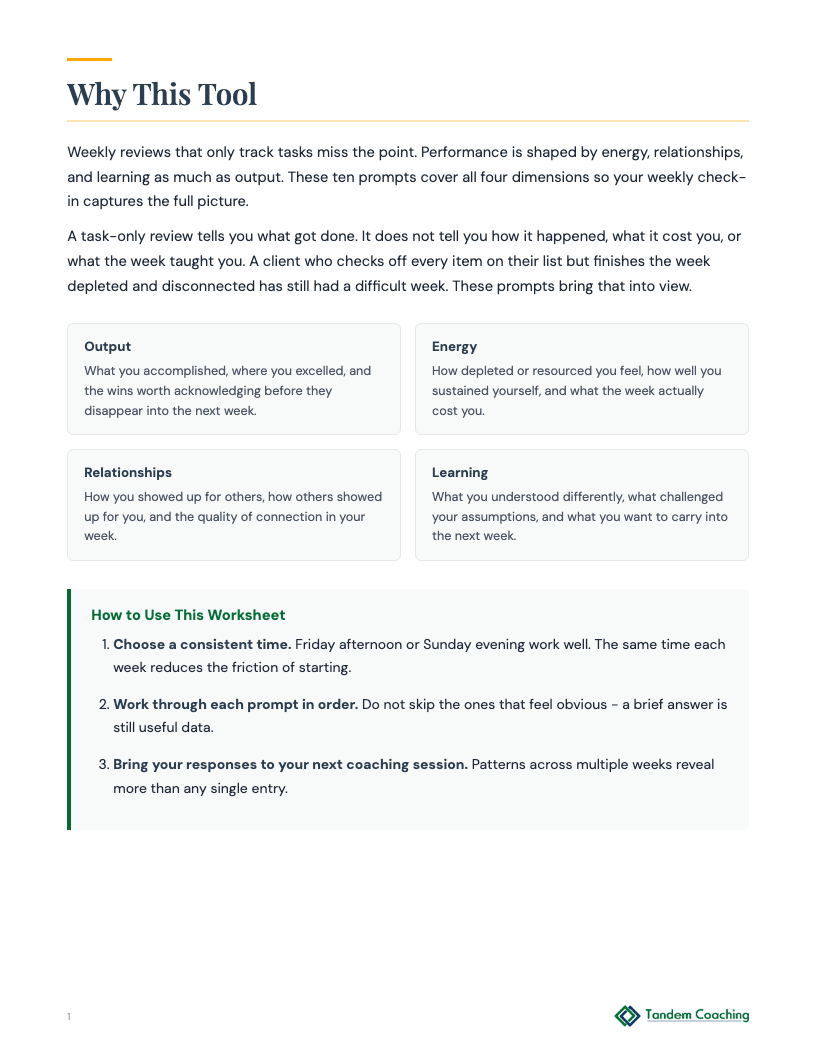
Some clients find that a weekly check-in covering energy, learning, gratitude, and relationships reveals patterns that task-only reviews miss - would building that kind of reflection practice into your week be useful?
A director completes deliverables at a consistent pace but ends every week convinced she underperformed. She reviews Fridays through a task lens only, and the gratitude, energy, and relational prompts feel irrelevant to her.
Frame the tool explicitly as a counter to the task-only review she already does. 'You already track what got done — this adds the other three dimensions that affect whether next week goes better or worse. Energy, learning, and relational data don't show up on a task list.' Clients in this pattern often skip prompts 2, 6, and 7 as soft. Name them directly and assign them first.
If prompt 5 (energy rating) is consistently 6-8 regardless of how the client describes her week — same rating after a week she calls exhausting as one she calls good — the calibration is off. Ask her to describe what a 3 looks like for her, then reanchor the scale from there. An energy rating that never moves is a sign the client is not using the scale honestly.
Start with prompts 9 and 10 together. Ask her to read 'what I want more of' and 'what I want less of' back-to-back, then ask: 'Are any of the things on the want-less list showing up on next week's calendar?' That question makes the reflection actionable immediately rather than staying retrospective.
If the log shows prompt 4 (self-care) is blank or contains entries like 'nothing' for multiple consecutive weeks, and the client does not flag this as concerning, the disconnection between her reported pace and her actual sustainability is worth addressing directly. Severity: low to moderate. The blank self-care column is data, not an oversight.
A team lead regularly enters the workweek still carrying unresolved tension from a late-Friday conversation or decision. He is not aware of the pattern — he attributes his Monday state to 'just not being a morning person.'
Position the Friday close as the key feature. 'Some clients find that completing this on Friday afternoon clears the emotional residue of the week rather than carrying it into the weekend. Whether that's true for you is worth testing.' Clients who resist the exercise because it 'feels like extra work' often have the most to gain from the closing ritual aspect specifically.
Watch prompt 8 (what challenged me) across three or four weeks. If the same type of situation — same kind of meeting, same person's behavior, same end-of-week dynamic — appears repeatedly in that column, the pattern has become visible even if the client hasn't named it. The trigger tracker may be a useful next step if the challenge entries are consistent.
Ask him to read his prompt 8 entries from the past three weeks and identify the common thread. Then ask: 'If nothing changes, will that same thing be in prompt 8 again next Friday?' That question shifts the conversation from retrospective observation to forward planning without requiring the coach to diagnose anything.
If the challenge entries in prompt 8 consistently name a specific peer or stakeholder, and the client's energy rating drops on weeks that include interaction with that person, there is a relational pattern the check-in is surfacing that deserves direct attention. Severity: low. The tool has done its job — what the data reveals now needs to be the coaching focus.
A director who was recently promoted to VP is working longer hours, taking fewer breaks, and describing most weeks as 'fine' when the data suggests otherwise. She has not built a sustainability practice at the new pace.
Frame this as a data-gathering practice for someone operating in new territory. 'Your previous role probably had a rhythm you knew how to manage. This one doesn't yet. Ten prompts a week for two months gives you a read on what this role actually costs you, which helps you build a sustainable pace rather than discovering the ceiling by hitting it.' Some clients at this level resist self-monitoring as soft — keep the framing analytical.
Watch for the energy rating (prompt 5) trending downward across consecutive weeks without the client naming it as a concern. A director who rates her energy 7, 6, 5, 4 over four weeks while describing each week as 'manageable' is calibrating against an increasingly depleted baseline. Ask about the number directly: 'You rated this week a 4. What would a 7 look like right now?'
After four weeks, start with prompt 4 (self-care) and ask her to read back what she wrote across all four entries. Then ask: 'What did you plan to do for self-care, versus what you actually did?' The gap between intention and execution in that column is often the most honest indicator of whether the new role is sustainable at its current pace.
If prompt 4 shows that self-care activities the client previously described as non-negotiable have disappeared from the log entirely, and this is accompanied by declining energy ratings and prompt 10 entries that name the same drains week after week, the sustainability conversation may need to become explicit rather than embedded in the tool debrief. Severity: moderate.
A senior engineer-turned-manager knows the research on gratitude and considers it valid. He has never maintained a consistent practice. His first attempt at the check-in produces prompt 2 entries that are vague or abstract rather than specific.
The specificity constraint is the part worth explaining explicitly. 'Prompt 2 only works if it's concrete — not "my team" but "the way Marcus handled the escalation on Tuesday." Abstract gratitude doesn't stick. Specific gratitude changes how you remember the week.' Clients who write generic entries often speed through the tool and miss its core value. Slowing down at prompt 2 specifically is worth naming.
If prompt 2 and prompt 7 (kindness received) are consistently abstract or identical across multiple weeks — 'grateful for my health,' 'received support from the team' — the client is filling in rather than reflecting. Ask him to name the most specific thing that happened this week, the one person, the one moment. The more concrete the entry, the more the tool works.
After two or three weeks, ask him to read back his prompt 2 entries and identify the one that feels most alive when he reads it. Then ask: 'What made that particular thing worth noting? What would you have missed if you hadn't written it down?' That question tends to shift the tool from a compliance exercise to a genuine practice.
If the client is completing all ten prompts quickly and consistently but cannot recall anything specific from any entry when asked in session, the practice is ritual without substance. Severity: low. Revisit the instructions and slow the completion down — quality of one entry is worth more than speed through all ten.
I swing between feeling flat and feeling overwhelmed and I don't know how to regulate in between
WellnessClient is depleted and struggling to make progress on professional goals despite high motivation
WellnessA client going through a difficult stretch and needs help noticing what's still working