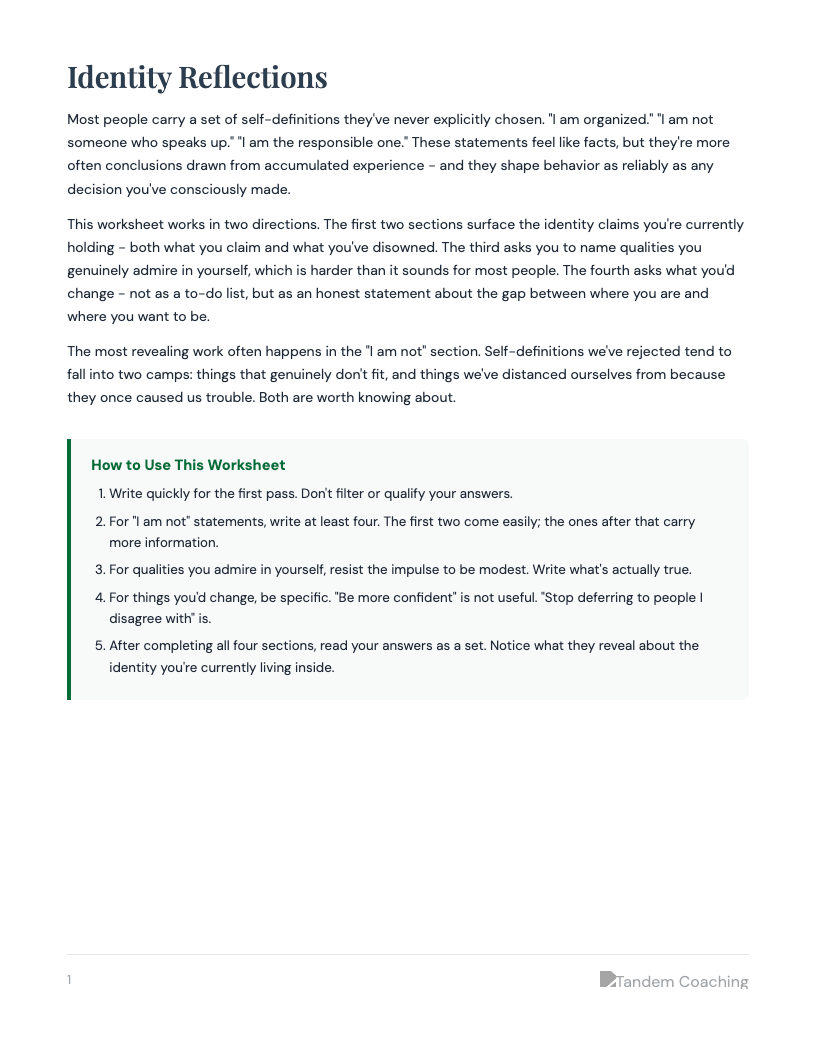
Identity Reflections
Examine self-descriptions at your own pace and keep only the language that feels accurate and useful.
Get This Tool
Free, print-ready PDF.
When to Use This Tool
A client unsure who they are outside of their roles and titles
Exploring the gap between how you see yourself and how others see you
Early-engagement identity work before setting goals
How to Introduce This Tool Plus
Which self-description still feels accurate, which feels uncertain, and what would you rather leave unexplored today?
Coaching Tool Disclaimer
This tool is designed for coaching contexts, not clinical use. If you or your client is in crisis, contact the 988 Suicide and Crisis Lifeline (call or text 988) or Crisis Text Line (text HOME to 741741).
Browse All Pages
Tool Classification
Domain
Life Coaching
Type
Worksheet
Phase
Discovery
Details
15 min
Mid session
Topics
Identity
For the Coaching Practitioner
Plus
Coaching Scenarios
Plus
1 Executive whose identity is entirely tied to her title ▶
Context
A VP who has been with the same company for twelve years is considering whether to leave. Outside of her role, she cannot describe who she is. Her 'I am' statements are all role-based: good at strategy, trusted by the board, reliable under pressure.
How to Introduce
Frame this as an identity audit, not a self-assessment exercise. 'Before we look at what you want next, let's separate what you do from who you are — these four prompts help make that distinction visible.' Clients like this often write role descriptors in the 'I am' section and leave the 'I am not' section blank or shallow. Name that tendency upfront: 'The second list is usually more revealing.'
What to Watch For
The 'I am not' section done in under two minutes, or filled with socially acceptable rejections ('not dishonest,' 'not careless'), signals performance rather than honest examination. Look for what the client actively avoids being associated with — 'not vulnerable,' 'not someone who asks for help' — those rejections carry the weight of the exercise.
Debrief
Start with the 'I am not' list and ask her to read it aloud. Then ask: 'Is there anything on that list that you've rejected because it was true at some point?' That question tends to open something. Move to the changes prompt last — it is the most honest signal of what the coaching work actually needs to address.
Flags
Coaching scope: do not diagnose, interpret symptoms, or recommend treatment. Adapt or stop for distress and use licensed health or emergency support when appropriate.
2 Mid-career professional questioning direction after a major setback ▶
Context
A manager was passed over for promotion he expected and is now questioning whether he is in the right field. He describes himself as 'not sure who I am anymore' outside the context of the promotion decision.
How to Introduce
Position this as a calibration, not a crisis response. 'This isn't about figuring out your next move — it's about identifying what's actually stable in how you see yourself, which is useful before you make any decisions.' Some clients in this state resist the 'I am' prompts because any positive claim feels hollow right now. Normalize writing from the pre-setback self.
What to Watch For
Watch for the changes section being disproportionately long relative to the 'I am' and qualities sections. If the client can name ten things he wants to change and struggles to name four things he genuinely is or admires in himself, the negative pull is dominating the self-concept. That imbalance is information, not a problem to solve immediately.
Debrief
Start with the qualities section — what does he admire in himself. Ask him to pick the one quality that has been most present, even during the setback. Then compare that to the changes section. The gap between the two often shows whether he is working from self-awareness or from the setback narrative.
Flags
Coaching scope: do not diagnose, interpret symptoms, or recommend treatment. Adapt or stop for distress and use licensed health or emergency support when appropriate.
3 Early-career client setting up her first coaching engagement ▶
Context
A 28-year-old individual contributor is entering coaching for the first time, with a vague sense that she wants to 'figure out what she really wants.' She has no specific problem to work on and limited self-observation vocabulary.
How to Introduce
Use this as the entry point into the engagement. 'Before we set any goals, I want to understand how you see yourself — not what you want to become, but what you actually think is true about who you are right now.' The four prompts give structure to clients who might otherwise flounder in open-ended self-reflection.
What to Watch For
Completion speed is reflective here. If the client finishes all four prompts in under eight minutes, the answers are likely surface-level. The 'write quickly on the first pass' instruction is genuine — but the more useful material usually emerges after the first pass. Ask her to read what she wrote, sit with it for two minutes, and add anything that surfaced after.
Debrief
After she reads her responses, ask: 'Read your 'I am' list and your changes list together. What do those two lists in combination tell you about where most of your energy goes?' That question tends to reveal whether the client is working from a foundation of self-knowledge or trying to build a new self-concept from scratch.
Flags
Coaching scope: do not diagnose, interpret symptoms, or recommend treatment. Adapt or stop for distress and use licensed health or emergency support when appropriate.
4 Leader preparing for a 360-feedback process ▶
Context
A director is about to receive 360-feedback from peers and direct reports. He wants to have a clear self-assessment in place before seeing the external data so he can compare his self-perception to others' perception.
How to Introduce
Frame this as a baseline before the data arrives. 'Before you see what others said, let's capture how you see yourself — the gaps between these two pictures are usually where the most useful coaching work is.' The 'I am not' list is particularly useful as a pre-360 exercise: the identities he actively rejects are often the ones that appear in feedback.
What to Watch For
If the qualities section contains only leadership competencies ('decisive,' 'strategic') with no relational or personal qualities, and the changes section also focuses exclusively on professional skills, the client may be framing this as a performance exercise rather than a genuine self-inquiry. The 360 results will often puncture that framing.
Debrief
After the 360 data arrives, use both documents together. Start with what aligned: what did he predict that the data confirmed? Then move to the gaps. 'Your 'I am not' list has nothing about tone or approachability — but that came up in multiple 360 responses. What would it have taken to notice that yourself?' That question is usually the most productive entry point.
Flags
Coaching scope: do not diagnose, interpret symptoms, or recommend treatment. Adapt or stop for distress and use licensed health or emergency support when appropriate.
Tool Flow
Plus
Requires
- None - standalone tool
→
Produces
- four claimed identity statements
- four rejected identity statements
- named self-admired qualities
- three desired self-changes
Pairs Well With
Life
Optional Life Experience Ideas
Use this planner to organize creativity and identity into a client-owned sequence of possible next steps.
Why it pairsOnce you have the client's claimed identity, use this to turn those self-descriptions into experiences they can actually live out.
LifeSMART Goal Planner
A client wants to use SMART Goal Planner as an optional reflection
Why it pairsUse this to convert a claimed identity statement into a specific goal with a deadline, before it fades into abstraction.
LifeWork-Purpose Context Map
Use this framework to structure a conversation about values and identity while keeping interpretation with the client.
Why it pairsAfter naming what the client claims and rejects about themselves, Ikigai reveals whether their current work actually sits inside that identity.
This tool is part of a coaching pathway
Step 1 of 6 in A client unsure who they are outside of their roles and titles
Continue with Motivation Depth Drill if that next job fits.
Next: Motivation Depth Drill → Explore all pathways →Related Articles


Leadership Development Goals That Actually Work: Framework and Examples
Read article →
Life Coach Certification Online: What to Know Before You Enroll
Read article →
Setting and Achieving Meaningful Goals: A Coaching Approach for Leaders
Read article →
Executive Coaching Cost: What You’ll Pay by Credential Level, Engagement Type & Pricing Model
Read article →