SMART Goal Planner
Turn vague life goals into specific, doable SMART plans with clear next steps. Coach-tested prompts help you define what “done” means so you can act.
Get This Tool
Free, print-ready PDF.
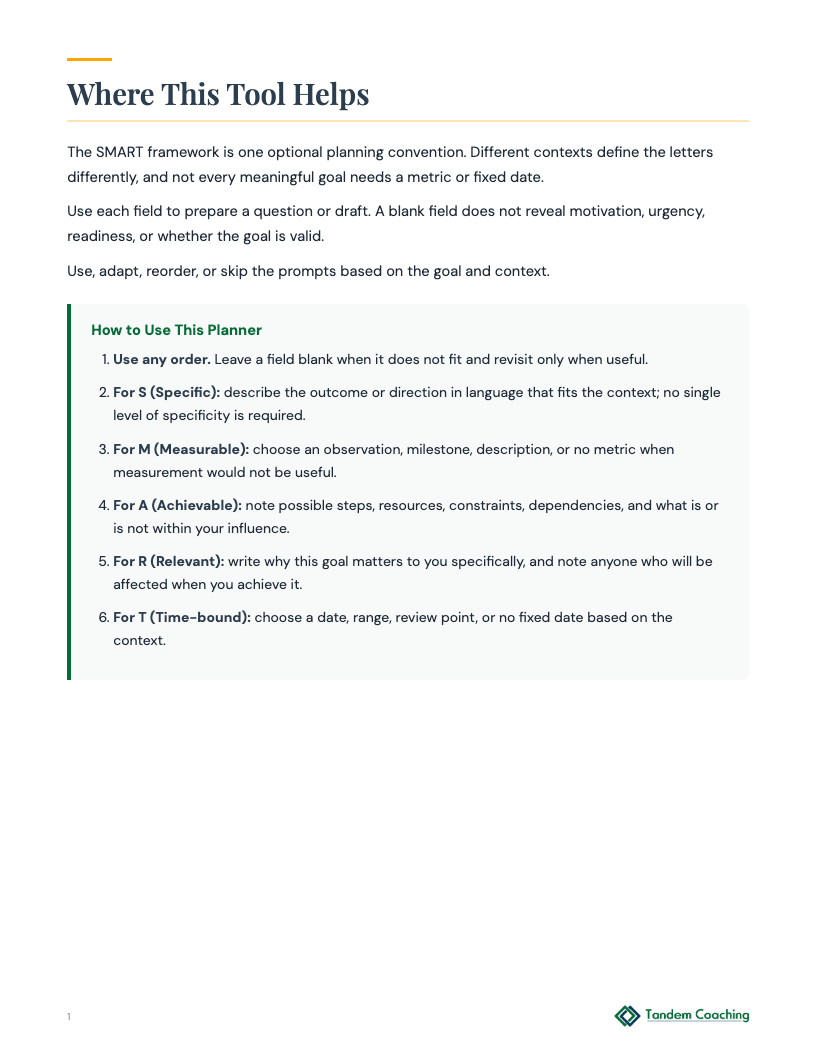
When to Use This Tool
A client wants to use SMART Goal Planner as an optional reflection
A client wants to record context without inferring a cause, identity, or diagnosis
A client wants to prepare one question or optional next step
How to Introduce This Tool Plus
What did you notice, what remains uncertain, and which question or optional next step feels useful?
Browse All Pages
Tool Classification
Domain
Life Coaching
Type
Framework
Phase
Goal Setting
Details
30 min
Mid session
As-needed
Topics
Accountability
Identity
Mindset
For the Coaching Practitioner
Plus
Coaching Scenarios
Plus
1 The client with a goal they cannot make concrete enough to act on ▶
Context
A client brings a situation related to SMART Goal Planner and wants an optional, practical coaching reflection. Confirm the client's own words, context, goal, privacy needs, and preferred scope before using the tool.
How to Introduce
Offer the tool as optional. Explain what it does, distinguish it from nearby tools, and confirm the client's language, access needs, and consent.
What to Watch For
Keep observations client-owned. Do not infer a diagnosis, hidden motive, fixed identity, cause, treatment, measurement, or correct decision from an answer, selection, blank, or rating.
Debrief
Ask what the client noticed, what remains uncertain, and whether one small experiment, additional question, or qualified referral would be useful.
Flags
Not therapy, diagnosis, medical, legal, financial, or employment advice. Adapt or stop for distress or risk; use qualified or emergency support when appropriate.
2 The client who fills the easy SMART letters and leaves the hard ones blank ▶
Context
A client brings a situation related to SMART Goal Planner and wants an optional, practical coaching reflection. Confirm the client's own words, context, goal, privacy needs, and preferred scope before using the tool.
How to Introduce
Offer the tool as optional. Explain what it does, distinguish it from nearby tools, and confirm the client's language, access needs, and consent.
What to Watch For
Keep observations client-owned. Do not infer a diagnosis, hidden motive, fixed identity, cause, treatment, measurement, or correct decision from an answer, selection, blank, or rating.
Debrief
Ask what the client noticed, what remains uncertain, and whether one small experiment, additional question, or qualified referral would be useful.
Flags
Not therapy, diagnosis, medical, legal, financial, or employment advice. Adapt or stop for distress or risk; use qualified or emergency support when appropriate.
3 The client who has a SMART-formatted goal but has never asked whether it is the right goal ▶
Context
A client brings a situation related to SMART Goal Planner and wants an optional, practical coaching reflection. Confirm the client's own words, context, goal, privacy needs, and preferred scope before using the tool.
How to Introduce
Offer the tool as optional. Explain what it does, distinguish it from nearby tools, and confirm the client's language, access needs, and consent.
What to Watch For
Keep observations client-owned. Do not infer a diagnosis, hidden motive, fixed identity, cause, treatment, measurement, or correct decision from an answer, selection, blank, or rating.
Debrief
Ask what the client noticed, what remains uncertain, and whether one small experiment, additional question, or qualified referral would be useful.
Flags
Not therapy, diagnosis, medical, legal, financial, or employment advice. Adapt or stop for distress or risk; use qualified or emergency support when appropriate.
Tool Flow
Plus
Requires
- None - standalone tool
→
Produces
- client-owned observations
- context and uncertainty notes
- an optional question or next step
Pairs Well With
Life
Goal Meaning and Outcome Notes
Use this worksheet to explore accountability and mindset and turn the client’s observations into one optional next step.
Why it pairsChoose this worksheet for a different angle on accountability and identity; use it only if that separate job fits the client.
LifeSWOT Analysis (Guided)
A client wants to use SWOT Analysis (Guided) as an optional reflection
Why it pairsChoose this framework for a different angle on identity and mindset; use it only if that separate job fits the client.
LifeYes / No / Maybe Reflection
A client wants to use Yes / No / Maybe Reflection as an optional reflection
Why it pairsChoose this assessment for a different angle on accountability and mindset; use it only if that separate job fits the client.
Related Articles

Why Smart Leaders Keep Solving the Wrong Problem
Read article →
5 Leadership Development Examples: Plans, SMART Goals, and More
Read article →
Benefits of Leadership Development Programs - Unveiled for Corporates
Read article →
5 Keys to Well-Formed Outcomes in Executive Coaching
Read article →