For high achievers who feel empty despite success, Ikigai clarifies what’s missing and maps work to values using a proven Japanese purpose framework.
Free, print-ready PDF.
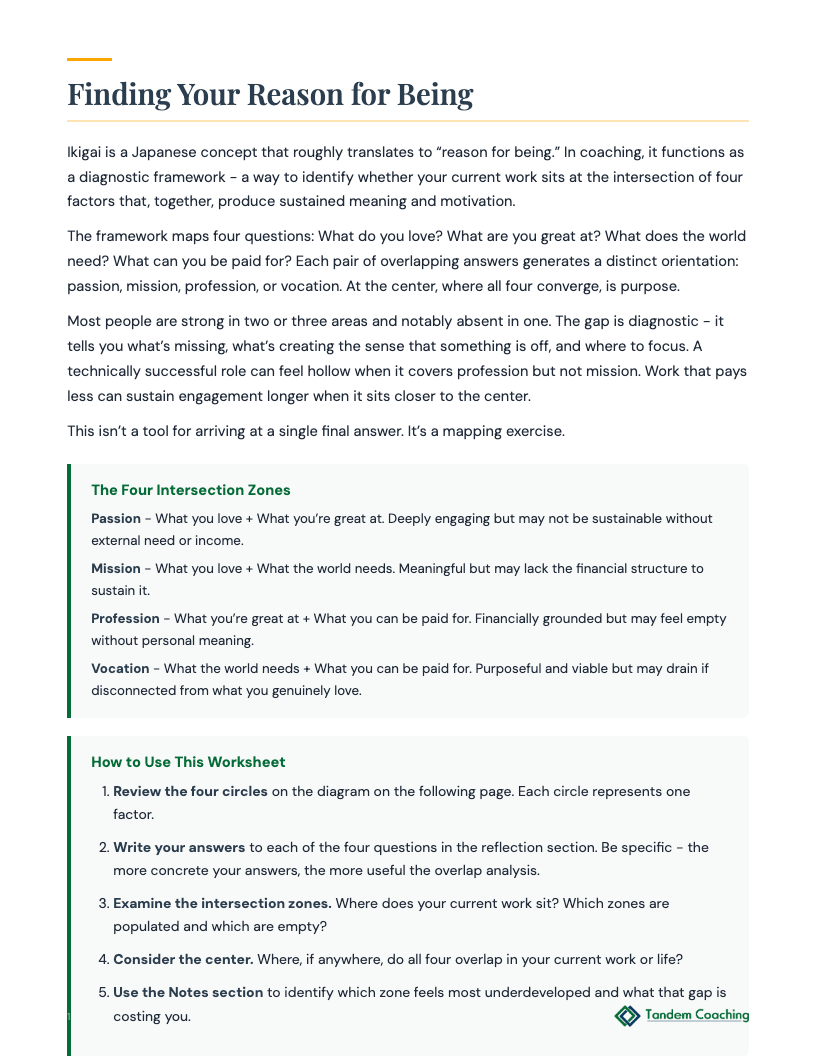
The Ikigai framework maps four overlapping circles - what you love, what you're great at, what the world needs, and what you can be paid for - would exploring where those circles intersect be a useful lens for what you're working through?
A VP of Strategy at a mid-size company who came to coaching saying they want to 'get more intentional about the next chapter.' They're articulate, self-aware on the surface, and have done personal development work before. They fill in the Ikigai diagram in under ten minutes with polished, coherent answers that all point neatly to the center.
Frame this as a calibration exercise, not a discovery exercise. 'You've thought about this before - I can tell. Use this to check whether what you wrote three years ago still holds, or whether the answers are inherited from a version of yourself that no longer runs the show.' The resistance pattern here is fluency masquerading as insight. Clients who have done self-development work before will produce answers that sound right because they've rehearsed them. This tool works here because the four-circle structure forces the overlaps to be explicit - and overlaps are harder to rehearse than individual answers.
Speed and symmetry are the signals. If all four circles have roughly equal detail and the intersection zones read like a LinkedIn summary, the client is working from a cached self-concept rather than current reality. Genuine engagement produces uneven answers - one circle fills quickly, another requires long pauses or crossed-out attempts. If the 'Where Are You Now?' section matches the center of the diagram perfectly, the client has reverse-engineered the answer from what they think purpose should look like. Look for any tension between the circles - that tension is the real material.
Start with the intersection zones, not the four circles. Read back what they wrote in 'Where Are You Now?' and ask: 'If I asked your partner or closest colleague where your work sits on this diagram, would they point to the same spot?' This moves the exercise from self-report to external validation. Then go to the weakest zone: 'You identified [zone] as weakest. When did it become the weakest - was it always, or did something shift?' The question that typically opens this up: 'Which of these four answers would have been different five years ago?'
If every answer is polished and the client shows no uncertainty at any point, and they resist the 'five years ago' reframe, the exercise may be serving as identity maintenance rather than exploration. Severity: moderate. The client may not be ready to update their self-concept in this engagement. Response: don't push the tool further in this session. Instead, note which specific answer they were most certain about - that's often the one most overdue for re-examination. Return to it in a later session with behavioral evidence.
A Director of Product who was promoted from Senior Product Manager eight months ago. They sought coaching because they feel 'less energized' than they expected after getting the role they'd been working toward. Their calendar is now 80% stakeholder management and hiring. They haven't shipped a feature themselves in months.
Position this as a drift detector rather than a purpose-finding exercise. 'You already know what you love and what you're good at - you built a career on it. This maps whether the promotion moved you closer to or further from the center.' This client will likely resist the 'What can you be paid for?' circle because they know the honest answer (management, politics, alignment) doesn't match their 'What do you love?' answer (building, shipping, craft). Name that before they encounter it: 'Some people find that the promotion changed which circles overlap. That's not a failure of the role or of you - it's information about what the trade-off actually costs.'
The diagnostic pattern is a clean split between the top pair and the bottom pair of circles. 'What you love' and 'What you're great at' will describe the old role (hands-on product work, technical decisions, user research). 'What you can be paid for' will describe the current role (team leadership, roadmap prioritization, executive communication). The intersection zones will have gaps - Passion still points backward, Profession points to the new role, and the center will be either blank or contain a vague aspiration. If the client writes the same answers in all four circles by reframing management as 'what I love,' they're performing acceptance of the promotion rather than examining the trade-off.
Go directly to the gap between Passion and Profession zones. Read both back and ask: 'These describe two different jobs. Which one do you wake up wanting to do?' Then move to the center: 'You left the center blank [or wrote something general]. What would need to be true about your current role for all four circles to actually overlap?' The question that creates movement: 'If you could design a version of this director role that kept you in the center of this diagram, what would you subtract from your current calendar first?'
If the client writes the old role's activities in every circle and cannot place anything from the current role in 'What you love,' the coaching may be heading toward a conversation about whether the promotion was the right move. Severity: low. This is common in the first year of any promotion that shifts from individual contribution to management. Response: continue with the tool's output, but note that the gap may narrow as the client develops competence in the new role. Track whether the gap persists across sessions before treating it as a misalignment signal.
A CTO and co-founder of a Series B startup who came to coaching after their board asked them to consider hiring a VP of Engineering to take over day-to-day technical leadership. They say they want to 'figure out what my role should be going forward.' What sits underneath that: whether they still belong in this company they built.
Frame this as a current-state map, not a future-planning tool. 'Before we talk about role design, let's see where you actually are right now. Not where you want to be or where the board wants you - where you are.' The resistance will show up in the 'What can you be paid for?' circle. Technical founders often define their economic value through what they built, not what they do now. The tool works here because it separates contribution (what the world needs from you) from compensation (what the market pays for) - and for a founder, those two things may have diverged without anyone naming it.
Watch the 'What are you great at?' circle carefully. If the client lists only technical skills (architecture, systems design, code quality), they're describing a version of themselves the company may have outgrown. If they include leadership-adjacent skills (hiring judgment, technical strategy, translating between engineering and business), they're already building a bridge to the next version of their role. The 'What does the world need?' circle is where founders tend to conflate their company's mission with their personal contribution - 'the world needs better developer tools' is the company's mission, not their personal answer. Genuine engagement means separating those.
Start with the 'What does the world need?' section. Ask: 'Is this what the world needs from the company, or from you personally?' Most founders haven't made that distinction. Then look at where Profession and Vocation intersect: 'If the board's suggestion goes through and you hire that VP of Engineering, which of these intersection zones changes?' The question that tends to open the real conversation: 'Which of these four circles did you fill out thinking about who you were when you started the company, and which did you fill out thinking about who you are now?'
If the client cannot place any current activity in the center of the diagram and responds to the exercise with anger or dismissal toward the board's suggestion, the coaching conversation may be about grief - loss of a founding identity - rather than role design. Severity: moderate. Response: stay with the Ikigai output but shift the debrief from role planning to identity exploration. 'What does it mean for you if the thing you built no longer needs the version of you that built it?' If the client's emotional response intensifies or they shut down entirely, consider whether this is a session to pause the tool and work with what's in the room.
A Chief Impact Officer at a social enterprise who came to coaching after a reorganization eliminated two of their direct reports. They describe themselves as deeply purpose-driven and frame everything through the company's mission. When asked what they personally want from coaching, they redirect to organizational outcomes.
Use the tool to test whether the client's sense of meaning is self-generated or organizationally sourced. 'This maps your personal version of these four circles - not your role's version, not the company's version. Some of the answers might overlap with your organization's mission, but I want you to write what's true for you independent of where you work.' The resistance here is subtle: the client genuinely believes their personal purpose and the organization's purpose are identical. They're not deflecting - they've fused the two. The tool surfaces this because 'What does the world need?' will read like the company's impact report unless you explicitly separate them.
Read the 'What does the world need?' answer first. If it mirrors the organization's mission statement, look at the other three circles. If 'What you love' also describes organizational activities (not personal ones), and 'What you're great at' lists role competencies rather than personal strengths, the entire diagram is a map of the client's relationship with their employer, not with themselves. Genuine engagement produces at least one circle that has nothing to do with work. If all four are work-centric, the client may not have a reference point for personal identity outside the role.
Start with: 'Read me your answer to What you love.' Then: 'If this organization disappeared tomorrow - not a layoff, the entire company just ceased to exist - which of these answers would still be true?' This question is uncomfortable for mission-fused clients, and the discomfort is the data. Don't soften it. Then move to the intersection zones: 'Your Mission zone says [X]. Is that your mission, or is that the company's mission that you've adopted?' The sequence matters - start with the personal question before introducing the organizational comparison.
If the client cannot generate a single answer in any circle that exists independent of their current organization, identity fusion with the role is significant. Severity: moderate to high, depending on whether the client recognizes the pattern or defends it. If they defend it ('My purpose IS the organization's purpose - that's why I chose this work'), the coaching conversation needs to shift before going further with purpose-oriented tools. Response: pause the exercise. Name the observation without diagnosing it: 'I notice every answer on this page connects back to [organization]. I'm curious what your answers would have looked like before you joined.' If the client cannot access a pre-organizational identity, consider whether this engagement needs a referral to a therapist who works with identity and enmeshment.
A CFO at a healthcare company who also serves on two nonprofit boards and teaches an MBA finance course as adjunct faculty. They came to coaching to 'get more focused' because they feel stretched across too many commitments. They expect the Ikigai exercise to confirm they should drop the side activities and concentrate on the CFO role.
Present this as a sorting exercise, not a pruning exercise. 'Before we decide what to cut, let's map where each of your commitments actually sits in these four circles. You might find that the thing you planned to drop is the thing holding the whole picture together.' The resistance pattern: this client has already decided the answer (focus on the CFO job, drop the extras) and wants the tool to validate that decision. They'll try to fill in the diagram from the CFO role only and treat the other commitments as distractions. Redirect: 'Include everything - the boards, the teaching, the CFO work. Write answers that reflect all of it, not just the primary role.'
The diagnostic moment is in the intersection zones. If 'What you love' and 'What are you great at' pull toward the teaching or board work, while 'What can you be paid for' anchors to the CFO role, the client will see the split in the diagram before they say it out loud. Watch their face when they try to fill in the center - if the center describes the nonprofit or teaching work rather than the CFO role, the surprise is visible. Performative completion here looks like forcing the CFO role into the center by inflating its overlap with 'What you love' using abstract language ('strategic impact,' 'organizational leadership').
Go to the center of the diagram first. 'What did you put in the center?' If it's not the CFO role, sit with that. Don't rush to interpret or action-plan. Then: 'You came in planning to cut the boards and teaching. Looking at this diagram, where does cutting those activities move you?' This reframes the question from time management to purpose management. The question that opens the real conversation: 'What if the problem isn't that you're spread too thin, but that the role you're spending the most time on is the one least connected to your center?'
If the client's Ikigai center clearly points away from their primary income source and toward a lower-paid or unpaid commitment, the coaching conversation may be heading toward a career pivot rather than a time management fix. Severity: low. This is a discovery, not a crisis. Response: let the client sit with the data. Do not suggest they quit the CFO role or restructure their career in this session. The tool's output is week-one data. Revisit it in session three or four to see whether the pattern holds after the initial surprise fades. If the client becomes anxious about the financial implications, ground the conversation: 'The diagram maps meaning, not decisions. We're not making changes today - we're reading the map.'
A client feels stuck in their career but isn't sure what they actually want
CareerA client knows their current job well but has never clearly named what career they actually want
LifeA client feels successful but unfulfilled and wants to understand why