Turn vague “time is slipping away” feelings into a clear, values-based list of experiences, prioritized with a proven coaching framework.
Free, print-ready PDF.
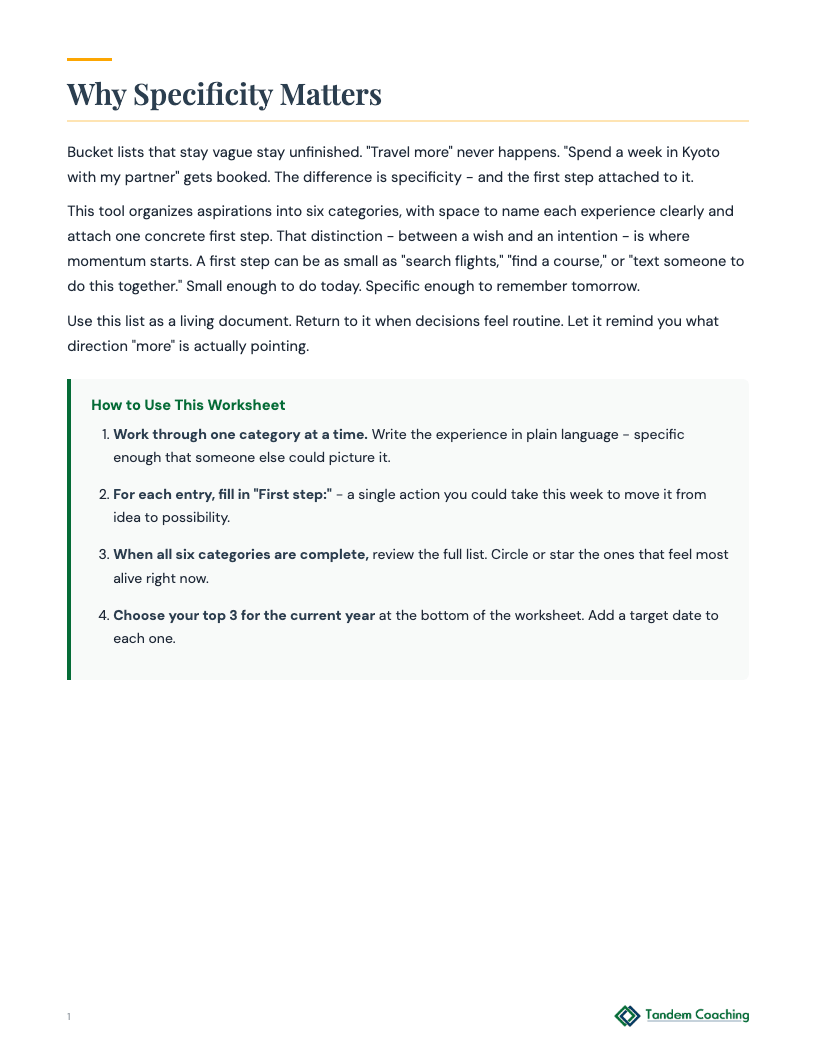
Some clients find it worth pausing to ask: what do I actually want to do or experience - not eventually, but this year? There's a structured way to work through that across a few life areas if that sounds useful.
Your client is 47, professionally successful, and aware in a general way that their life has narrowed. They work, they travel for work, they return home. They have not taken a real vacation in four years. Their social circle has contracted to colleagues. Their health practices have eroded. They know this. They mention it the way people mention things they have accommodated: with mild concern rather than urgency. They have not taken stock of what has been displaced because to do so would require naming what they actually want - which they have not done. The Life Experience Bucket List is useful here because it surfaces desire across six categories simultaneously, most of which have received no attention.
Frame this as a simple inventory, not a life assessment. 'The worksheet has six categories. Just list what comes to mind for each - not what seems reasonable, not what you have time for, just what you'd want if the constraints were off. The list itself is the useful thing.' The resistance pattern: high-functioning clients with narrow lives sometimes complete the worksheet by listing acceptable aspirations in each category rather than actual desires. They know how to perform goal-setting. Watch for Travel entries that read like corporate travel ('visit Tokyo for the conference I keep missing') rather than genuine aspiration.
Watch the Relationships category especially. Clients whose social circle has contracted to colleagues often have difficulty naming relationships they want to invest in or build - not because they have no relational desires but because they have not thought about relationships as something to tend actively. If the Relationships category is sparse or vague ('spend more time with family'), ask directly: 'Who specifically, and what would spending more time with them look like?' Also watch whether the Top 3 For the Year selections span multiple categories or cluster in one. Clustering in Career when Career has been the consumed-everything category signals that the work is still directing the priorities.
After the list is complete, ask: 'When you look at these six categories side by side, which one shows the most distance between the entries here and what is actually in your life right now?' That question identifies the category with the largest gap. Then look at the Top 3: 'Is the year going to be different in any visible way if these three happen - and if they don't?' The second half of the question is often where the stakes become real. The first step field matters more than the experience itself - if the first step is vague, the entry is an aspiration, not a plan.
If the client's life narrowing is connected to a relationship loss, a grief they have not processed, or a sense that what they want does not matter, the bucket list surfaces the deficit but the underlying loss needs direct attention. Severity: low. Response: complete the worksheet, but note whether the Relationships category produced entries that seemed emotionally loaded - a name that surfaced then was crossed out, a category left unusually blank.
Your client left a senior role eight months ago. They had good reasons - burnout, misalignment, a leadership change they did not respect. They have rested. They are not rested anymore; they are adrift. They have been networking, exploring options, talking to contacts. The problem is that they are evaluating opportunities without knowing what they want them to produce. Every option looks acceptable and none of them looks right. The worksheet is not a career planning tool - it is an inventory of what the client actually wants across their life, which is different from what the client will find professionally acceptable.
Frame this as a starting point, not a decision framework. 'The worksheet doesn't answer the question of what to do next. What it does is tell you what you want from the next period of your life across all six areas - so that when an opportunity comes up, you have something to compare it against.' The resistance pattern: clients in professional transition sometimes use a life inventory to defer the harder career question. Watch whether the client engages the worksheet with genuine curiosity or whether they immediately try to map it to their job search.
Watch the Career and Creative categories for this client. Career entries during a transition are often either too specific ('a VP role at a company with a strong culture and a clear mandate') or too vague ('meaningful work'). The useful Career entry is somewhere in the middle: naming the kind of problem they want to work on, the kind of environment they want to work in, or the kind of output they want to produce. Also watch whether Learning entries connect to genuine intellectual desire or professional development that is really career-positioning in disguise. And watch whether the Top 3 For the Year selections contain anything non-career - their presence or absence tells you something about whether the client has mentally exited their professional identity or is still inside it.
Read the Top 3 For the Year aloud and ask: 'If you were evaluating an opportunity right now and none of these three were possible in that role, what would that tell you?' That question links the bucket list back to the decision the client is facing without making the worksheet a decision tool. Then ask: 'Which of the six categories surprised you - either because you had more to say than you expected, or because you had nothing?' Surprise is usually where the most useful data is.
If the client's bucket list is heavily back-loaded - most entries are framed as 'someday' rather than connected to any near-term first step - the worksheet may have produced aspiration inventory rather than intention. Severity: low. Response: before closing, work through one entry with the client all the way to a specific first step with a date. That converts one item from aspiration to plan and models what the rest of the list could become.
Your client has been deferring. When the project is done, they will travel. When the role is stable, they will take up the thing they have been wanting to learn. When the team is in a better place, they will spend more time on their relationships. The deferral condition always advances - the project ends and another begins, the role stabilizes and the next challenge appears. The client is not unhappy. They are aware that they are consistently trading present experience for future readiness, and that future readiness has not arrived in the three years they have been waiting for it. The worksheet externalizes the deferred list and adds a first step to each item.
Frame this as making the deferred list visible, not critiquing the deferral. 'You have a list of things you're waiting to do until conditions allow. The worksheet just puts them on paper so we can see what's actually on it.' The resistance pattern: clients who defer systematically sometimes complete a bucket list with entries that are already condition-free ('go for a walk before the work day starts') rather than the things they actually mean when they say 'when the time is right.' The real list - the experiences connected to active deferral - takes some working to surface.
Watch the First Step field carefully for this client. If every first step includes a condition ('once the current project wraps...', 'when I have a free weekend...'), the worksheet has reproduced the deferral pattern in writing rather than breaking it. A first step that can be taken this week does not require conditions. Also watch the Top 3 For the Year selection: if the three items selected are the least threatening rather than the most wanted, the client is managing the exercise rather than using it.
After the Top 3 are selected, ask: 'What is the earliest possible date the first step for each of these could happen - not a realistic estimate, the earliest possible?' That question confronts the deferral pattern directly. If the answer for all three is 'months from now,' ask: 'What would it cost to do one of these this month?' That question surfaces the actual trade-off rather than the assumed impossibility. The client who can name the cost of doing it now has moved from vague deferral to a real decision.
If the client's deferral pattern is connected to a belief that their own wants are less legitimate than their professional obligations - that wanting is somehow selfish or indulgent - the bucket list is appropriate but the belief is the larger coaching question. Severity: low. Response: complete the worksheet and note whether the client minimized or apologized for any entries while writing them. That minimization, named directly, is usually the opening for the belief conversation.
A client feels pulled in a direction they haven't fully articulated yet
LifeA client who's overwhelmed by complexity and needs a visual way to see the whole picture
LifeI have vague dreams but struggle to make them concrete enough to act on