Health & Fitness Goals
Establish a clear health baseline and measurable fitness goals using coach-guided prompts so you can track progress with confidence.
Get This Tool
Free, print-ready PDF.
When to Use This Tool
Client wants to improve their health but has not established a clear baseline to measure against
Client makes health commitments but has not identified the barriers that have stopped them before
Client's health goals are aspirational but disconnected from specific habits and accountability structures
How to Introduce This Tool Plus
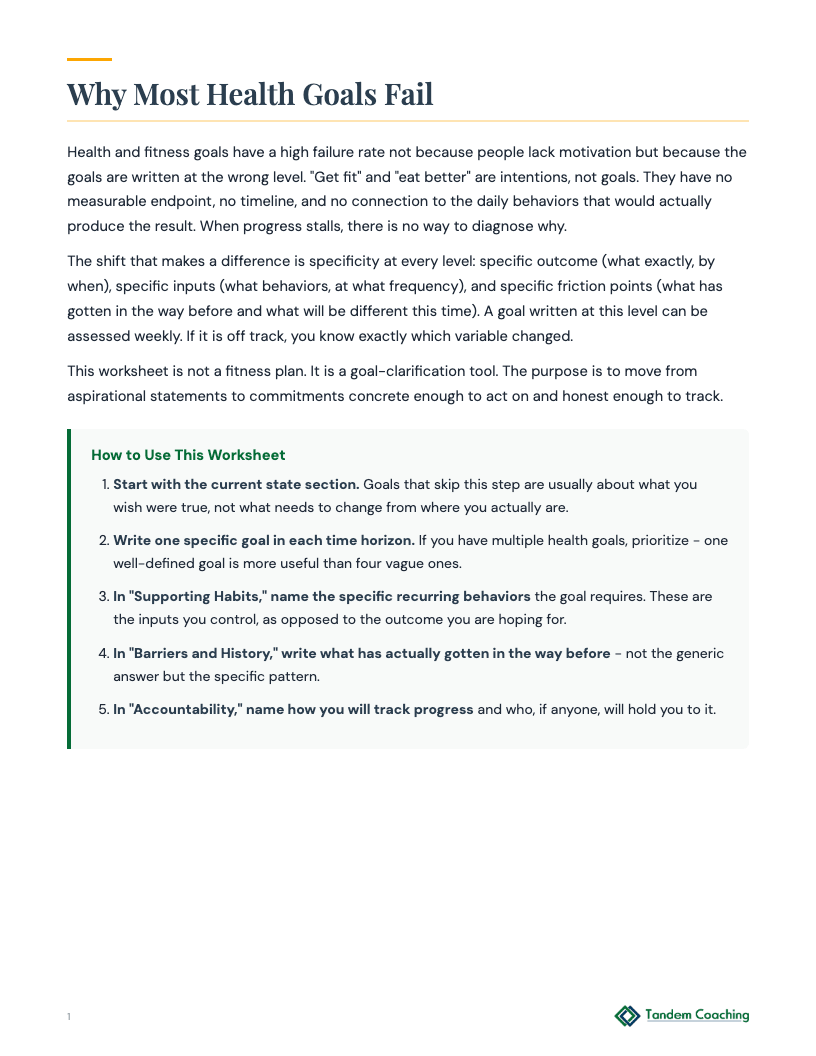
This worksheet captures your health baseline, short and long-term goals, the habits that will support them, what's gotten in the way before, and who keeps you accountable - would completing it before our next session help us focus on what will actually move the needle?
Coaching Tool Disclaimer
This tool is designed for coaching contexts, not clinical use. If you or your client is in crisis, contact the 988 Suicide and Crisis Lifeline (call or text 988) or Crisis Text Line (text HOME to 741741).
Browse All Pages
Tool Classification
Domain
Life Coaching
Type
Worksheet
Phase
Discovery
Goal Setting
Details
30 min
Between sessions
As-needed
Topics
Self-Care
Habits
Accountability
For the Coaching Practitioner
Plus
Coaching Scenarios
Plus
1 The client setting fitness goals without knowing their current baseline ▶
Context
Client announces ambitious fitness goals — 'I want to get back into shape,' 'I want to run a half-marathon' — without any concrete picture of where they are starting. Goals without baselines cannot be tracked, and more importantly, they cannot be made realistic. The tool's baseline section is the entry point that transforms aspiration into a plan that might actually hold.
How to Introduce
Frame this as measurement before planning. 'Before we figure out where you're going, we need to know where you're starting. The baseline section is the most important part — without it, any goal we set is guesswork.' Clients with strong aspiration energy often resist this because measuring the current state means confronting a reality that may be worse than the goal requires. Name that: 'I know it feels easier to focus on the goal. The baseline is what makes the goal achievable rather than motivating.'
What to Watch For
Watch for baseline sections left vague or blank — 'I exercise occasionally,' 'I could eat better.' A client who cannot or will not name their actual baseline (current weight, how many times they exercise per week, what they typically eat) is working from an idealized picture of themselves rather than an accurate one. Also watch for discrepancies between the baseline and the goal: a client who describes a low-activity baseline setting a high-intensity goal within a short timeframe has a timeline problem that needs to be addressed before the goal is written.
Debrief
Start with the gap between the baseline and the short-term goal. Ask the client to describe concretely what needs to change in their daily habits to close that gap. If they cannot describe the daily change, the goal is still aspirational. Then move to the barriers field: 'Which of these barriers has stopped you before, and what was different about the times when it didn't?' That question separates real barriers from anticipated ones.
Flags
- Moderate
Client's described baseline includes a significant health history — recent surgery, chronic condition, injury — that has not been cleared by a medical professional for the type of exercise the goal requires.
Response: Do not build a fitness goal plan without medical clearance for this client. Name it directly: 'Before we design a fitness plan, I want to make sure you've talked to your doctor about [specific condition] and what's safe to start with.' This is not coaching caution — it is responsible goal-setting.
2 The client with recurring fitness commitments that never survive the first setback ▶
Context
Client has a history of committing to fitness goals enthusiastically, maintaining them for two to four weeks, and then abandoning them after a disruption — travel, illness, a busy work period. The pattern has repeated enough times that the client has started to doubt their own reliability. The tool's barrier identification section is the lever that changes this pattern.
How to Introduce
Frame this as barrier engineering rather than goal renewal. 'You've set fitness goals before. What I want to do differently this time is build the barriers into the plan before we start, rather than discovering them after the first disruption.' Some clients resist this because planning for failure feels pessimistic. Name the resistance directly: 'Naming what has derailed you before is not giving up — it is the difference between a plan that breaks at the first obstacle and one that bends.'
What to Watch For
The barriers field is the most diagnostic part of this worksheet for this client. Watch for generic barriers ('too busy,' 'no time') versus specific ones ('I stop exercising when I travel more than once a month, which happens four months a year'). The specific barrier is addressable; the generic one is not. Also watch for the accountability field — a client who cannot name a specific accountability mechanism they have not already tried is likely to default to self-accountability, which has not worked.
Debrief
Start with the pattern: 'You've mentioned this has happened before. Looking at the barriers you wrote, which one is most responsible for the previous stops?' Then: 'What would have had to be in place for that barrier not to stop you?' This sequence moves from diagnosis to design. The long-term goal is usually fine — the short-term goal and the barrier plan need to be rebuilt.
Flags
- Moderate
Client describes the fitness failures with disproportionate shame — 'I'm weak,' 'I have no self-discipline,' 'I always quit.' The self-critical framing is more intense than the situation warrants and has become an identity statement.
Response: Pause the goal-setting work and name what you are hearing: 'You're describing a pattern of stopping as a character flaw. I'd like to separate what you've done from who you are before we build the next goal.' The shame pattern is likely to sabotage any new goal set without examining it.
3 The client building fitness goals that are decoupled from daily life ▶
Context
Client's fitness goals exist on paper and in intention but do not connect to their actual schedule, habits, or environment. They are planning for an ideal life rather than their real one — the gym they will join is the one across town, the meal prep happens on a Sunday they do not have. The habits section of this tool forces the connection between aspiration and daily structure.
How to Introduce
Frame this as an integration exercise, not goal refinement. 'Let's test whether these goals fit into your actual life — not the life you want to have, but the one you're actually living this month. The habits section will tell us whether the goal is realistic as written.' Clients resist this because examining real constraints feels limiting. Name it: 'I'm not trying to shrink your goal. I'm trying to make sure the plan is attached to your real week so it survives contact with it.'
What to Watch For
In the habits field, watch for habits that require a version of the client's schedule that does not currently exist — 'I'll wake up at 5am,' 'I'll cook on weeknights,' 'I'll go to the gym before work.' These are all possible, but each requires a significant behavior change in addition to the fitness goal itself. Stacking multiple new habits simultaneously without acknowledging that is a recipe for collapse. Ask how many behavior changes are implicit in the plan.
Debrief
After reviewing the habits field, ask: 'Which of these habits is already partially in place?' Start with the strongest existing habit and build the goal structure around it rather than requiring all new behavior. Then: 'What would your schedule actually allow for in the next two weeks without changing anything else?' The answer is the real starting point.
Flags
- Low
Client's described daily schedule — work hours, family commitments, commute — leaves fewer than 30 minutes of unscheduled time per day. The fitness plan they have written requires 45-60 minutes. Something in the plan is not real.
Response: Name the math without judgment: 'Looking at your typical day, where does [time required] fit in?' The client may have identified time they have not yet named, or the goal may need to be redesigned. Either way, the gap needs to be visible before the plan is set.
Tool Flow
Plus
Requires
- None - standalone tool
→
Produces
- written current health baseline
- short and long-term health goals with measures
- specific supporting habit list
- named accountability structure
Pairs Well With
ADHD
Optional Week Review
Use this worksheet to explore executive function and accountability and turn the client’s observations into one optional next step.
Why it pairsThe habit list your client built becomes testable once they log daily intentions and energy against it each week, showing where commitment and reality diverge.
WellnessWeekly Well-Being Context Log
A client wants to use Weekly Well-Being Context Log as an optional reflection
Why it pairsYour client's specific supporting habits slot directly into the tracker's 7-day log, generating real data on which habits actually move the health baseline they just wrote.
Wellness30-Day Self-Care Challenge
I want to build a self-care routine but I need something to tell me what to do each day
Why it pairsWhen a client has goals but no momentum yet, 30 days of prompted daily action builds the behavioral pattern their habit list assumes but can't create alone.
Related Articles

ICF Core Competencies: Managing Client Focus, Session Time, and Relationship Completion
Read article →
Setting and Achieving Meaningful Goals: A Coaching Approach for Leaders
Read article →
The GROW Model in Coaching: A Practitioner’s Guide to Sessions That Actually Move Forward
Read article →
You Have the Title but Not the Room
Read article →