30-Day Self-Care Challenge
Daily, coach-designed self-care prompts for 30 days that remove guesswork and help you build a sustainable routine.
Get This Tool
Free, print-ready PDF.
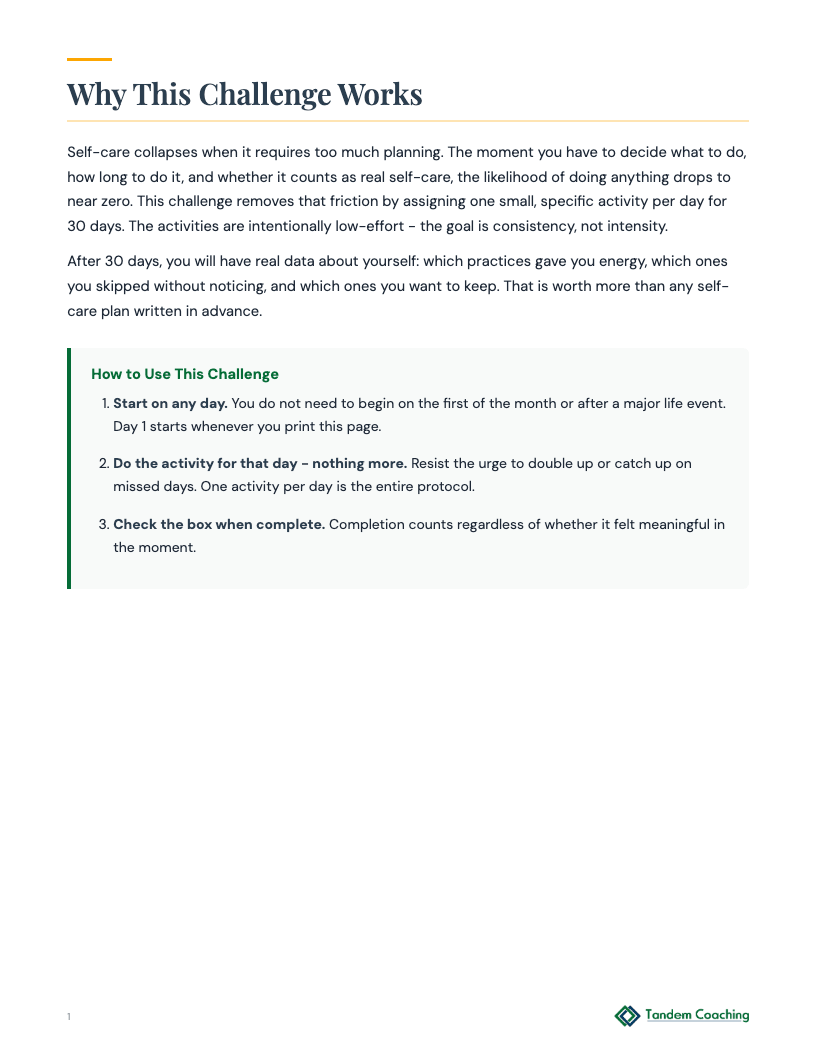
When to Use This Tool
I want to build a self-care routine but I need something to tell me what to do each day
I keep saying I'll start taking care of myself but never follow through without structure
I want a low-stakes way to experiment with self-care activities I've been avoiding
How to Introduce This Tool Plus
Some clients find that a structured 30-day challenge with pre-assigned activities removes the decision fatigue around self-care - would trying something like that be useful?
Browse All Pages
Tool Classification
Domain
Wellness
Type
Checklist
Phase
Action
Details
5 min
Between sessions
Topics
Self-Care
Habits
Accountability
For the Coaching Practitioner
Plus
Coaching Scenarios
Plus
1 A client who skips days and resets the calendar rather than accepting gaps and continuing ▶
Context
A manager who starts the 30-day challenge with strong initial engagement, misses two consecutive days around day eight, and resets to day one. He repeats this cycle twice before arriving at a session still on 'day one.' His interpretation is that the challenge requires consecutive completion. The reset behavior suggests an all-or-nothing relationship with consistency.
How to Introduce
Address the reset rule directly. 'The challenge is designed for continuity, not perfection. Missing two days doesn't invalidate the days before them. When you reset, you lose the accumulated data about which activities you found useful - that data is the point of the 30 days, not the streak.' The resistance is identity: he's someone who finishes things correctly or starts over. Name the cost: 'The reset is more expensive than the missed days. You've now done weeks of the early challenge without reaching the activities later in the calendar.'
What to Watch For
Watch how he describes the days he did complete before the first gap. If he can recall which activities he found useful and which felt forced, the data is retrievable even after a reset. Also watch whether the reset behavior is specific to this tool or a broader pattern - clients with all-or-nothing thinking often describe similar restart cycles with other habits, fitness programs, or diets. If the pattern is broader, it's worth naming.
Debrief
Start with what he observed before the first gap. 'Before day eight, what were you noticing? Were any of the activities more useful than others?' That retrieves the early data. Then: 'Given what you learned in those first eight days, what would happen if you continued from where you are rather than starting over?' The question that creates movement: 'If you treated this challenge as a sampling exercise rather than a pass/fail test, what would day nine look like?'
Flags
A client with a consistent restart pattern across multiple domains may be managing perfectionism or avoidance through the restart ritual - the restart feels like action while preventing arrival at the harder later stages of any commitment. If this is a clear pattern, name it as a coaching topic: 'The restarts are consistent. What do you notice about what happens just before you reset?' Severity: low. Response: continue with the challenge from the current day, not from day one, and flag the perfectionism-restart loop explicitly.
2 A professional who completes the challenge compliantly but never reflects on which activities resonated ▶
Context
A director who uses the 30-day calendar as a compliance exercise: she does the daily activity, marks it done, and moves on. At the end of the 30 days, she cannot identify which activities she found genuinely useful versus which felt like box-checking. The challenge was completed without any observational layer. The coaching value of the tool - understanding what self-care actually works for her - hasn't been captured.
How to Introduce
Add the observational requirement before she completes the remaining days. 'You've been doing the activities. The next part is adding a brief note after each one: useful, neutral, or not for me. Not a journal entry - one to three words. The calendar alone tells you what you did. The notes tell you what to keep.' That addition takes thirty seconds per day and transforms the calendar from a compliance tracker into a self-knowledge exercise. The resistance is time: she's already checked the box and notes feel like extra work.
What to Watch For
Watch whether she can recall any specific activities from the days she's already completed. If she can name two or three that felt genuinely useful, the observational layer is already partially present even without notes. If she genuinely cannot recall any distinctions - all thirty activities felt the same - the compliance pattern is strong. Also watch whether the activities she describes as 'useful' are ones she already did regularly before the challenge or genuinely new discoveries.
Debrief
Start with the completed days. 'Looking back at what you've done - which three activities would you keep doing after day 30, and which three felt like they didn't fit you?' If she can answer: 'Those answers are the actual value of the 30 days - you've now tested what self-care works for you.' If she can't: 'What would you need to notice today and for the remaining days to be able to answer that question at the end?' The question that creates movement: 'If this challenge pointed you toward two or three practices to carry forward, what would it take for you to build those into your regular week?'
Flags
A director who completes structured activities without observing her own response may have a compliance-over-reflection pattern in other areas of her development work - she does the assignments without extracting the learning. If this appears across multiple tools, name the pattern: 'You complete the activities well. The observational step is where most of the value is, and that's the step you're skipping.' Severity: low. Response: add the notes requirement for the remaining days and close the challenge with a reflection on what the 30 days revealed.
3 A professional who finishes the challenge and wants to continue but doesn't know how to transition from prescribed to self-directed ▶
Context
A manager who completed the 30-day challenge and found significant value in it - several activities genuinely improved her mood and energy. She wants to continue but the challenge has ended and she doesn't know how to build on it without the pre-assigned calendar structure. She needs support transitioning from following a prescribed program to designing her own ongoing self-care practice.
How to Introduce
Reframe the transition as the graduation step. 'The 30-day calendar was a sampling menu. You've now tasted everything and know what you liked. The next phase is designing your own practice from what you discovered.' That framing positions the challenge's end as the beginning of something more durable, not a loss of structure. The resistance is uncertainty: the prescribed calendar was comfortable because she didn't have to decide. Name the competence she's built: 'You know more about what works for you after 30 days than most people know after years of vague self-care intentions.'
What to Watch For
Watch which activities she identifies as keepers - specifically whether she can distinguish between activities she found useful and activities she thinks she should continue. 'Should' choices have poor follow-through; genuine-fit choices have better outcomes. Also watch whether she can name the frequency and context for each keeper: 'morning,' 'after work,' 'weekends' produces a real schedule; 'whenever I can' does not.
Debrief
Start with the keepers. 'From the 30 days, which three activities made a noticeable difference to your energy or mood?' Then: 'For each of those three, what's the natural frequency - daily, three times a week, weekly?' Then build the minimum viable practice: 'If you could only keep two and actually do them consistently, which two would you choose?' The question that creates movement: 'What day this week would you schedule the first one - not intend to do it, but put it on the calendar?'
Flags
A client who has successfully completed the challenge and found genuine value in specific activities has done the hard part. The coaching work at this point is primarily about translating the 30-day discovery into a durable, self-directed practice. If she resists designing her own practice because 'it feels less real without the structure,' explore what makes external structure feel more legitimate than self-directed commitment. Severity: low. Response: build the minimum viable self-care practice from the challenge's best discoveries and schedule it before the session ends.
Tool Flow
Plus
Requires
- None - standalone tool
→
Produces
- 30-day self-care activity completion record
- personal data on energy-generating practices
Pairs Well With
Wellness
Weekly Well-Being Context Log
A client wants to use Weekly Well-Being Context Log as an optional reflection
Why it pairsUse this after the challenge to move from prompted completion to self-directed tracking of which practices actually shift mood.
WellnessWeekly Well-Being Practices Check-In
A client wants to use Weekly Well-Being Practices Check-In as an optional reflection
Why it pairsOnce the challenge ends, this narrows 30 days of prompted variety down to the eight behaviors worth sustaining consistently.
ADHDOptional Week Review
Use this worksheet to explore executive function and accountability and turn the client’s observations into one optional next step.
Why it pairsUse this to add the intention-and-reflection loop the challenge lacks, so the client learns why certain days worked better.
Related Articles


Do You Have to Tell Clients You Use AI? Standard 2.5 in Practice
Read article →10 Leadership Development Activities That Build Better Leaders
Read article →
When Your Client Is Already Using AI: Coaching Through the Disruption
Read article →
Boosting Your Confidence and Self-Esteem Through Coaching
Read article →