Escaping the Comfort Zone

A practical coaching tool for when you know your next step but keep stalling, using proven prompts to cut through excuses and act.

Worksheet · 15 min · Print-ready PDF · Free download

Get This Tool

Free PDF - professionally formatted, ready to print or fill digitally

Preview Worksheet · 15 min
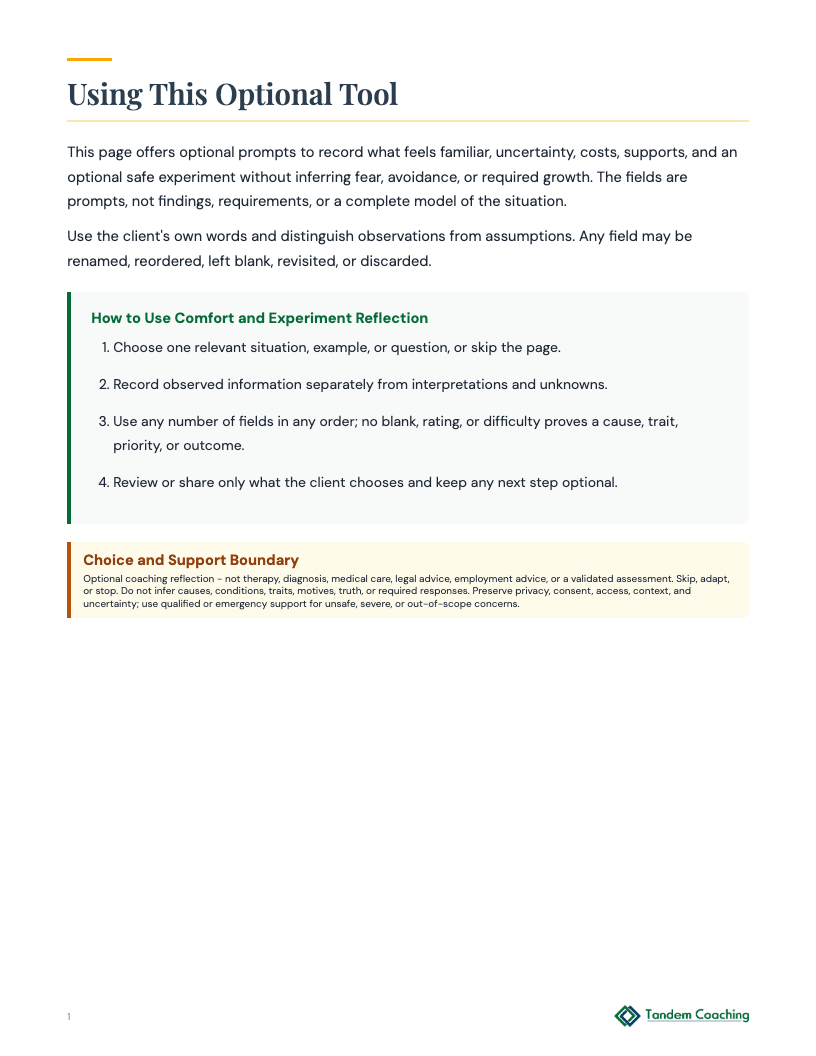
Escaping the Comfort Zone - preview
When to Use This Tool
Client knows what they want to do next but keeps finding reasons to stay where they are
Client is conflating genuine risk with discomfort from unfamiliarity
Client wants to identify one concrete first step out of a pattern of avoidance
How to Introduce This Tool Plus

There's a four-question sequence that moves from what feels comfortable, to what's blocking movement, to what you'd do without the block, to one small step you could take today — would it be useful to work through those in order?

Browse All Pages
Interactive Preview Worksheet · 15 min
Tool Classification
Domain
Life Coaching
Type
Worksheet
Phase
Discovery Action
Details
15 min Mid session As-needed
Topics
Mindset Resilience Identity

For the Coaching Practitioner

Plus
Coaching Scenarios Plus
1 Director who intellectualizes the case for change without taking action
Context

A director of communications at a mid-size technology firm has been discussing a career transition — from internal communications into external consulting — for eight months across coaching sessions. She articulates the case for the move clearly, has done research on the market, and has a network that could support the transition. She has not taken a single external-facing step. In sessions she analyzes, refines, and updates the plan. Her coach has observed that she treats planning as progress and has not yet examined what she is protecting by staying.

How to Introduce

This is a four-question sequence, and the sequence matters. Don't introduce the tool as a planning exercise — she already has too much planning. 'What this worksheet does is start with what's actually comfortable right now — not what you wish were comfortable, what actually is — and then work through what's holding you there, what you'd do without that hold, and one concrete step you could take in the next 24 hours. The structure is simple. The instruction for Question 3 is to answer as if the block genuinely doesn't exist. Not 'I would try to' — 'I would.' That distinction is important.' Frame simplicity as precision, not superficiality.

What to Watch For

Watch Question 3 closely: 'What would I do if I was not afraid?' Clients who are intellectualizing will answer with plans and conditions — 'I would probably look into whether my network would support a retainer model.' That is still avoidance. The question asks for behavior, not contingency analysis. If her answer to Question 3 reads more like a business case than a description of action, note it: 'That sounds like an answer to the conditions under which you'd act, not the actions you'd take.' Also watch Question 4 — the step should be small enough to do today. 'Finalize my consulting positioning' is not a step. 'Email one person in my network to set up a call' is.

Debrief

Start with Question 2 (what is holding me back) and compare it to what she wrote in Question 3 (what I'd do without it). 'The gap between these two answers is the work. If the block in Question 2 were cut in half — not eliminated, just reduced — which part of Question 3 becomes accessible?' Then move to Question 4: 'What's the smallest version of this step? The one that requires the least pre-conditions?' Let her name it. Then make it concrete: when, how, to whom.

Flags

If the answers to Questions 1 through 3 are articulate and detailed but Question 4 produces a vague or condition-laden response ('I'll find the right moment to reach out'), the avoidance is operating specifically at the action threshold. Severity: low. The tool has surfaced the exact point of stall. The next coaching step is not another worksheet — it is a direct conversation about what will happen the moment she takes that step and why that is more uncomfortable than continuing to plan.

2 New leader whose comfort zone has become an invisible liability
Context

A manager promoted to director six months ago is receiving feedback that he 'doesn't push back enough' in cross-functional meetings and 'defers too quickly to senior leaders.' In his previous role, staying deferential and heads-down was appropriate and rewarded. He has not updated his operating model to match the expectations of the new role. He does not experience his deferential pattern as avoidance — he experiences it as professionalism. He is genuinely unaware that what felt comfortable in his previous role has become a limitation in the current one.

How to Introduce

The reframe needed before introducing the tool: comfort zones shift meaning across roles. 'What worked well in your previous role — staying focused, not overstepping, letting senior leaders lead — isn't wrong. But the role has changed, and so has what the organization is expecting from you. The comfort zone you're in right now was built for a different set of responsibilities. This worksheet maps what feels comfortable now, what's holding you where you are, and what you'd do in these meetings if the old model didn't apply.' Positioning the old model as context-specific rather than personally limiting reduces defensiveness.

What to Watch For

Watch Question 1 closely: 'What feels comfortable in my life right now?' If he lists task-oriented behaviors (completing deliverables, managing his team, individual contributions) and the cross-functional setting is conspicuously absent from his comfort list — or named as uncomfortable — that absence is the diagnostic data. Question 2 ('What is holding me back?') often reveals whether the block is about capability ('I don't know what I'm supposed to say in those meetings') or identity ('It's not my place to push back on the SVP'). Those require different responses.

Debrief

Compare the comfort list in Question 1 to the specific meeting settings where the feedback is occurring. 'None of the things you listed as comfortable include cross-functional executive meetings. That makes sense — you haven't operated there before. Question 4 asks for one step you could take today. What would be the smallest version of showing up differently in one of those meetings — not a major reversal, one move?' Frame the step as an experiment, not a permanent identity shift. Experiments feel safer and are more likely to be tried.

Flags

If his answer to Question 2 ('What is holding me back?') includes beliefs about his legitimacy or authority to speak — 'I haven't earned the right to push back at that level yet' — the block is identity-based rather than skill-based. Severity: low. The worksheet is appropriate, but a direct conversation about what authority actually looks like in the new role, and who has granted it, may need to happen alongside the comfort zone work.

3 Experienced professional who mistakes domain mastery for growth
Context

A senior manager at a consulting firm has spent 12 years building deep expertise in change management. He is respected, technically excellent, and consistently delivers strong client results. In coaching, he reports feeling 'flat' and disengaged from his work for the first time in his career. He attributes this to the difficulty of current client situations and the pace of work. His coach suspects the flatness is connected to a different dynamic: he has not genuinely been challenged in two to three years. Everything he does now draws from established competence. He does not yet see his comfort zone as the source of the disengagement.

How to Introduce

This requires a reframe before the worksheet lands. 'The disengagement you're describing is a signal, not a defect. One thing it sometimes signals is that the challenge level has dropped below what actually engages you — that you're operating almost entirely in established competence without much edge. This worksheet asks four simple questions, and the third one is the diagnostic: What would you do if you weren't afraid? That question is most interesting for someone in your position, because the answer might surprise you — it might not be about the work itself.' Curiosity about the answer to Question 3 is the hook for someone who is intellectually oriented.

What to Watch For

Watch Question 3 for what emerges beyond professional domain — whether he describes moving into a new practice area, teaching, a different kind of client work, or something outside consulting entirely. The most diagnostic Question 3 answers often reveal an aspiration the client has been treating as impractical rather than genuinely examining. Also watch whether Question 2 ('What is holding me back?') produces practical objections (time, income, risk to reputation) or belief-level ones ('I've built this identity for 12 years — I don't know who I am without it'). The second is a different coaching conversation.

Debrief

Start with Question 3 and the gap from Question 2. 'If we set aside the practical obstacles in Question 2 — not forever, just temporarily — and took Question 3 as a genuine description of what you want: what would it take to get from here to the first version of that?' Then connect to the flatness he started with: 'Is the disengagement you've been describing connected to not having a Question 3 that you're working toward?' This links the symptom to the cause, which is where the motivation for change lives.

Flags

If his answer to Question 2 is dominated by identity-level concerns — 'I don't know what I'd be if I left this domain,' 'I've built everything around this expertise' — and these are accompanied by broader descriptions of flatness that extend to his personal life and sense of purpose, the comfort zone conversation may be the surface layer of a deeper career or identity transition. Severity: low to moderate. The worksheet is appropriate as a starting point, but be prepared to move into a values and purpose conversation if the answers point there.

Tool Flow Plus
Requires
  • None - standalone tool
Produces
  • named avoidance pattern and blocking belief
  • fear-free scenario described in concrete terms
  • one specific next step committed to today

Pairs Well With

Life

Growth Mindset

Client talks about wanting to grow but responds to setbacks with fixed patterns of self-protection

30 min Assessment
Executive

Growth Zones Assessment

A client is avoiding something important and keeps finding reasons not to move forward

15 min Assessment
ADHD

Shame and Inner Critic Guide

A client consistently moves from mistakes to global self-condemnation rather than specific accountability

15 min Framework

Related Articles

The Risk Your Boss Wants You to Take (That Your Training Says Don't)

The Risk Your Boss Wants You to Take (That Your Training Says Don't)

Read article →
Executive Job Automation Risk: The PURPOSE AUDIT™ Framework

Executive Job Automation Risk: The PURPOSE AUDIT™ Framework

Read article →
How to Find an Executive Coach: 8 Steps That Work

How to Find an Executive Coach: 8 Steps That Work

Read article →
Benefits of Leadership Development Programs - Unveiled for Corporates

Benefits of Leadership Development Programs - Unveiled for Corporates

Read article →
What Risk Means to You Is Not What It Means to Your Peers

What Risk Means to You Is Not What It Means to Your Peers

Read article →
Exploring Different Types of Coaching: Finding the Right Fit for Your Needs

Exploring Different Types of Coaching: Finding the Right Fit for Your Needs

Read article →