Map how thoughts, feelings, and actions reinforce your stuck reactions using a proven CBT cognitive triangle framework.
Free, print-ready PDF.
There's a situation where you keep responding the same way — what's the thought that usually comes just before the emotion?
A director of operations describes a recurring pattern: when a direct report or peer pushes back on a decision in a meeting, she experiences what she calls a 'trigger' — her voice sharpens, she becomes more directive, and she sometimes dismisses the challenge in front of others. She later regrets it. She attributes the behavior to stress and thinks she needs 'better stress management.' She has not examined what happens between the pushback and the response.
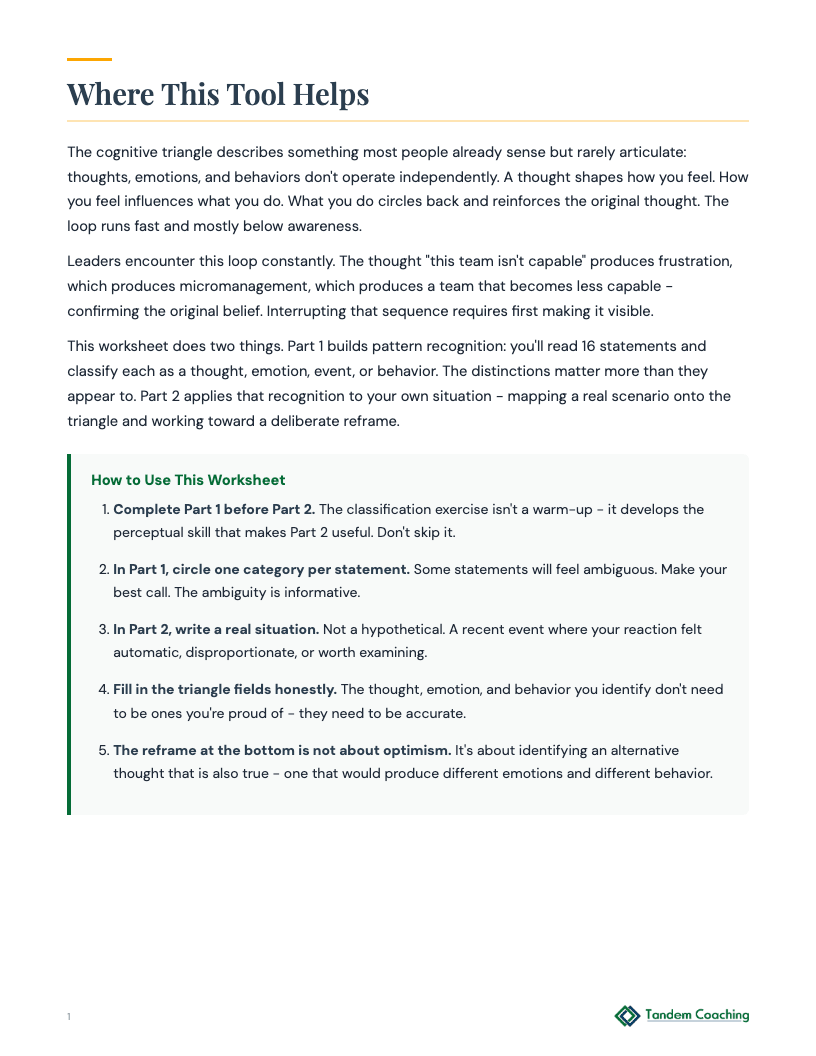
Position this as a gap analysis rather than a self-examination exercise. 'What you're calling a trigger is actually a sequence — thought, feeling, behavior happening faster than you can track. This worksheet slows that sequence down for a specific situation so we can see where the intervention point is. Because 'manage stress better' won't help if we can't identify where the chain actually breaks.' The classification exercise first: 'Before we look at your specific situation, let's categorize a few examples so the framework is clear.' This reduces resistance by making the first step educational.
Watch whether the client can identify the thought that precedes the feeling — or whether she goes directly from situation to feeling. Clients who experience triggers as sudden often report that there is no thought, just a feeling. In most cases, the thought is there but operates in under a second. If she can't locate a thought, ask: 'What would you have had to believe about the pushback for the feeling to make sense?' That question often surfaces the thought retroactively. Also watch whether the behavior she identifies is the public behavior (voice sharpening) or the internal one (a decision to stop listening). Both are in the triangle; the internal one is usually the earlier intervention point.
Start at the top of the triangle and move around it clockwise: Thoughts → Feelings → Behaviors. At each node, ask her to read what she wrote, then ask: 'At this point in the sequence, what would have to be different for the next node to be different?' The question at the Thoughts node — 'what would you have had to be thinking for the feeling to be different?' — is usually the most productive. Most clients can change their behavior through will, briefly; they cannot change feelings through will alone. Changing the thought is the only durable intervention point.
If the pushback situations the client describes consistently involve specific individuals — the same direct report, the same peer — and the pattern doesn't appear in other conflict situations, the dynamic may be relationship-specific rather than a general stress-response pattern. Severity: low. The cognitive triangle work remains useful, but the specificity suggests there may be a relationship dimension worth examining separately.
A VP of Engineering is scheduled to present his division's annual technology roadmap to the board in six weeks. He has given this presentation before. Over the past week he has rescheduled three preparation sessions with his team, begun adding slides in a way that his chief of staff has flagged as counterproductive, and described a persistent sense of dread when he thinks about the presentation. He says he 'just needs to get through it' but isn't preparing effectively.
Use the triangle to map what's actually happening, not what he thinks is happening. 'You've identified the behavior — avoiding preparation and over-adding slides. What we don't know yet is what thought is driving it. Because the behavior you're describing makes perfect sense as a response to a specific thought, but 'just getting through it' won't address the thought.' Run the classification exercise first using a neutral work scenario to establish the framework before applying it to the board presentation.
In anxiety-driven avoidance, the thought often involves a specific feared outcome — being asked a question he can't answer, losing credibility with a specific board member, being seen as technically superficial. If the thought he identifies is vague ('it'll go badly'), push for specificity: 'What specifically are you imagining when you feel the dread? Who's in the room, what's happening?' Specificity usually produces a much more workable thought. Also watch the behavior node — over-adding slides and rescheduling preparation are in the same behavior cluster. Both are anxiety-management behaviors that feel like preparation but aren't.
After mapping the current triangle, ask him to build a second triangle for a presentation that went well. This is not a positive-thinking exercise — it's a comparison. The difference between the Thoughts nodes of the two triangles is the target. 'What were you thinking before the presentation you just described as going well?' Then: 'What would you have to believe about this board presentation to feel more like the first triangle than the second?'
If the dread is disproportionate to the stakes as described — if this is a routine annual presentation he has given before and the anxiety is significantly interfering with preparation — consider whether performance anxiety is a more persistent pattern across high-visibility situations. Severity: low. The cognitive triangle work is appropriate, but if this pattern appears consistently across presentations, keynotes, and high-visibility meetings, it may warrant a more sustained exploration.
A senior manager was passed over for a director promotion and was given feedback that focused on his leadership presence. He believes the feedback was politically motivated and has described the organization's decision-making as unfair. Six months later, he is meeting his targets but contributing less in cross-functional work, skipping optional development programs, and responding to organizational communications with a level of detachment his manager has noted. He says he is 'realistic' about where he stands.
Frame this as a maintenance exercise for the manager himself, not as an organizational problem-solving tool. 'Your current way of relating to the organization is producing a set of behaviors. I want to look at whether those behaviors are serving your goals — not whether the organization's decision was fair, but whether your response to it is working for you.' This framing is important: it doesn't challenge his assessment of the organization but shifts the focus to what he can control.
In resentment cycles, the thought node contains a narrative about fairness and control, and the behavior node contains withdrawal or passive resistance. Watch whether the feelings node he identifies is primarily about the organization ('frustrated with them') or primarily about himself ('diminished,' 'invisible'). The feelings he's having about himself — not the organization — are usually the more productive coaching target. Also watch whether he can generate an alternative thought, or whether every alternative thought he considers feels like capitulation.
Start with the behavior node. 'These behaviors — skipping development programs, contributing less in cross-functional work — what do they produce for you? What's the result six months from now if this is the pattern?' Then move to the thought: 'What would you have to believe about this situation to produce different behaviors — not to agree with the decision, but to act differently?' The distinction between 'agreeing with the decision' and 'choosing a different response' is often the pivot that makes the triangle work accessible to clients in resentment cycles.
If the client's narrative about the unfair decision has become a central organizing principle — if it surfaces unprompted in multiple sessions, if it's the lens through which he interprets current interactions with leadership — consider whether the resentment is calcifying in a way that will require direct naming. Severity: moderate. The cognitive triangle work is appropriate and helpful, but the pattern may need to be addressed more directly than the tool allows on its own.
Client describes feeling 'bad' or 'off' but cannot name the emotion with any specificity
LifeClient has strong self-knowledge but struggles to act on what they know
LifeA client whose self-talk is distorted in ways they can't see clearly from the inside