Inner Critic Identification Worksheet
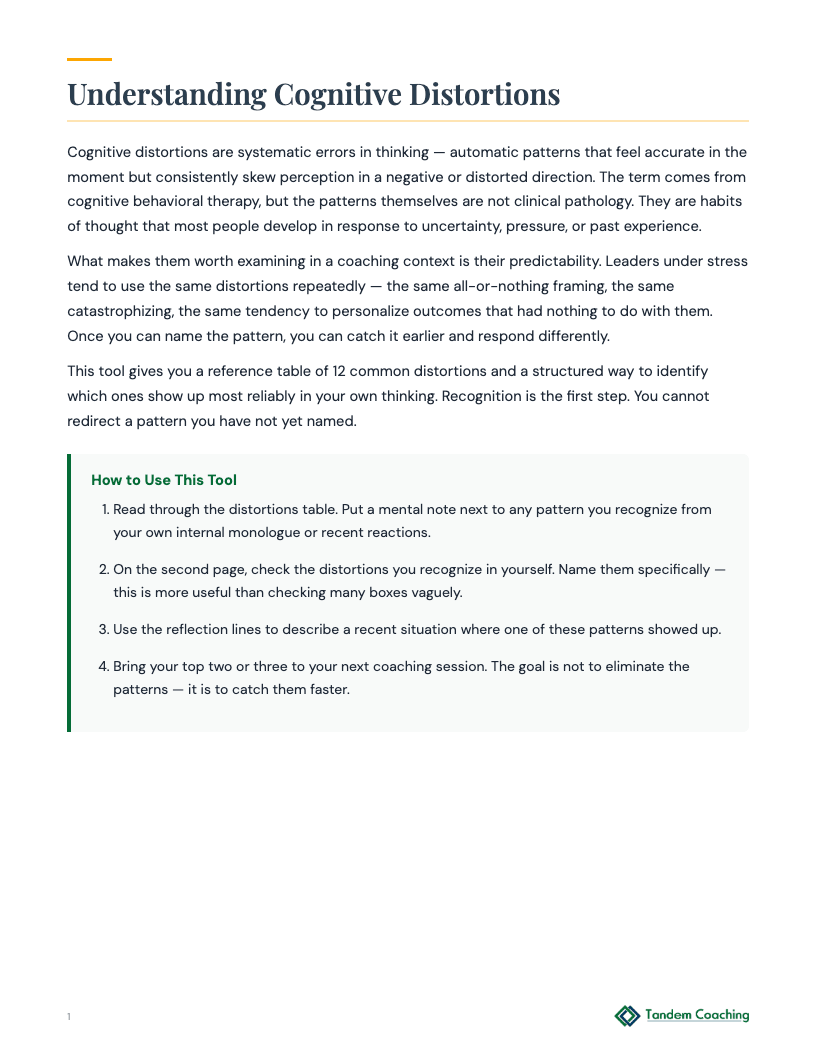
Spot distorted self-talk patterns you miss from the inside using guided prompts grounded in cognitive-behavioral coaching.
Get This Tool
Free, print-ready PDF.
When to Use This Tool
A client whose self-talk is distorted in ways they can't see clearly from the inside
Someone who catastrophizes or over-generalizes under pressure and wants to interrupt the pattern
A professional who recognizes their thinking goes sideways in certain situations but doesn't know which distortion is driving it
How to Introduce This Tool Plus
The reference page names 12 distortions — read through them first before the worksheet. Which two or three feel most familiar, like you've lived them recently?
Coaching Tool Disclaimer
This tool is designed for coaching contexts, not clinical use. If you or your client is in crisis, contact the 988 Suicide and Crisis Lifeline (call or text 988) or Crisis Text Line (text HOME to 741741).
Browse All Pages
Tool Classification
Domain
Life Coaching
Type
Framework
Phase
Discovery
Reflection
Details
30 min
Between sessions
As-needed
Topics
Mindset
Emotions
For the Coaching Practitioner
Plus
Coaching Scenarios
Plus
1 Senior manager whose thinking under board pressure distorts in ways she recognizes after, not during ▶
Context
A senior manager at a nonprofit organization presents quarterly to the board and leads a high-stakes funding renewal process annually. After a recent board meeting, she described to her coach that she had left the meeting convinced the board was disappointed, had already decided not to renew, and that her performance was the primary cause. A review of the meeting notes showed no evidence of any of these conclusions - feedback was mixed but largely positive. She recognized the gap afterward but could not identify what happened to her thinking during the meeting.
How to Introduce
Check in before introducing the tool. 'Before we work through this together, I want to name that what we're about to look at is how thinking patterns operate under pressure - and some of what the tool surfaces can feel uncomfortable to recognize in yourself. This is a reference table of twelve specific patterns, and we'll work through it together. You're not being asked to accept a diagnosis - you're being asked to recognize whether any of these descriptions match what happens for you. Take a moment before we start if you want to. The table is descriptive, not evaluative. We'll identify which patterns showed up in the board meeting specifically and work from there.' The check-in step is mandatory for this tool; completing it before proceeding is non-negotiable.
What to Watch For
Watch the six-checkbox page carefully. The patterns most consistent with what she described - post-meeting conviction without evidence - are Jumping to Conclusions (predicting negative outcomes without data), Emotional Reasoning (the meeting felt bad, therefore it was bad), and Disqualifying the Positive (the positive feedback didn't register). Watch whether she checks these specific three or whether she distributes her recognition more broadly. If she checks six or more patterns, explore whether she is being expansive in her self-assessment or whether all six are genuinely active under pressure. In the reflection section, watch whether her written examples are specific to the board meeting situation or general.
Debrief
After completing the checkboxes, start with Jumping to Conclusions and Emotional Reasoning if she checked both. 'You've checked these two. Walk me through what you remember thinking in the last fifteen minutes of the board meeting - not your conclusions after, what you were telling yourself while you were still in the room.' The real-time reconstruction tests whether the distortion operated during the event or in retrospect. Then: 'The meeting notes showed mixed but largely positive feedback. What would it have taken for that evidence to reach you in the room?' The question tests whether the distortion is about attention or about interpretation - two different intervention targets.
Flags
If she checks nine or more of the twelve patterns and describes them all as regularly active - not just under board pressure - and the reflection section produces distress that goes beyond the tool's scope, the pattern may be more pervasive than situational stress would account for. Severity: moderate. Proceed with the session, but note that the scale of recognition warrants a direct conversation at the end: 'You've recognized a lot of these patterns. Some of what you've described sounds like it goes beyond the board meeting. Is this level of thinking distortion something you experience broadly, or specifically under high-stakes conditions?' If the answer is broadly, a referral conversation may be appropriate.
2 Director who catastrophizes project setbacks but minimizes personal wins using the same logic ▶
Context
A director of program delivery at a consulting firm operates under consistent project pressure. His coach has observed a specific pairing across eight sessions: when a project milestone is missed or a client raises a concern, his internal narrative rapidly escalates to worst-case scenarios - the client will exit, the firm will lose the account, his reputation will not recover. When a project succeeds or a client expresses satisfaction, his narrative immediately deflates the evidence - the client is being polite, the milestone was easier than usual, the team did the actual work. He is applying the same distorted logic in opposite directions, which he has not noticed.
How to Introduce
Frame the tool as a dual-direction diagnostic. 'This reference table identifies twelve patterns. Most people assume these patterns only operate in one direction - toward the negative. But two of the patterns in this table - Catastrophizing and Minimization - can operate in opposite directions simultaneously, producing a situation where bad news gets amplified and good news gets deflated. I want you to go through the table with both directions in mind: which patterns show up when things go wrong, and which ones show up when things go right. The six-checkbox page asks you to identify which patterns you recognize. Mark them, and then in the reflection section, give me one example from a project setback and one from a project success.' The dual-direction framing is specific to this client's pattern.
What to Watch For
Watch whether he checks Catastrophizing and Minimization or Minimization only. If he checks only Catastrophizing, the Minimization of positive evidence hasn't been recognized yet. If he checks both, the reflection section is the test: watch whether the examples he gives for each pattern are equally specific. Clients who catastrophize and minimize often give rich, detailed examples of the catastrophizing scenarios and thin or reluctant examples of minimization - because the positive experiences feel less available as evidence. The pre-session prompt in the tool asks what they want to work on first; his answer to that question tells you which direction he considers the priority.
Debrief
Start with the two patterns if he checked both. 'You've checked both Catastrophizing and Minimization. Read me your example for each one.' Then: 'These two are operating in opposite directions - amplifying bad and deflating good. What would it mean for your evaluation of your own performance if both of these were running simultaneously and you hadn't noticed?' The question names the systemic implication without requiring him to accept it immediately. Then: 'The client satisfaction message from last week - the one you attributed to politeness. If a colleague showed you an identical message about their work, would you also conclude it was politeness?' The third-person reversal test often produces a different answer than direct self-assessment.
Flags
If he checks Catastrophizing but does not check Minimization despite multiple coaching observations of deflating positive evidence, the Minimization pattern may be harder for him to recognize than the catastrophizing - possibly because catastrophizing feels like concern (responsible) while minimization feels like humility (admirable). Severity: low. Complete the session with what he has identified. In a subsequent session, introduce the observation directly: 'You've named catastrophizing in negative situations. I've noticed something on the positive side that I want to name - specifically in the client satisfaction message and the Q3 results. Can we look at what happened to that evidence in your thinking?'
3 High-performer who intellectually understands cognitive distortions but doesn't recognize them as his own ▶
Context
A VP of strategy at a financial services firm has read widely in the areas of cognitive behavioral frameworks and behavioral economics. He can explain cognitive distortions accurately and discuss their mechanisms with some sophistication. In coaching sessions, when his coach has offered observations about his thinking patterns, he has agreed conceptually while maintaining that his own conclusions are warranted by the actual evidence. His coach has identified at least three instances in the past quarter where his conclusions about organizational dynamics or his own standing were significantly more negative than the data supported. He has rationalized each one as an accurate read of a complex situation.
How to Introduce
Use his existing knowledge as the starting point and the tool as a recognition challenge. 'You know this framework well - you can describe these patterns accurately. What I want to test is whether knowing them at the conceptual level gives you access to recognizing them in your own thinking in real time. This table asks you to mark the patterns you recognize in yourself specifically. I want you to use a narrow time window - the past month, not your general tendencies - and to mark only the patterns where you can name a specific instance. If you know the pattern exists in general but can't name an instance from the past month, don't mark it. The specificity constraint is where this tool does something different from what you've already read.' The specificity constraint is the resistance lever for a client who may use intellectual fluency to avoid personal recognition.
What to Watch For
Watch the number of patterns he marks under the specificity constraint. A client with genuine conceptual knowledge who has never examined his own patterns under this constraint often marks fewer than expected - the constraint forces him past general recognition into specific instances, which requires more access. If he marks many patterns but the reflection section examples are general rather than tied to specific incidents from the past month, the specificity constraint has not been honored. The pre-session prompt is particularly important for this client: 'Which of these patterns do you most want to work on' - if his answer is a pattern not supported by the coaching observations, explore the gap.
Debrief
Start with the reflection section. 'Read me the specific instance you named for [pattern most consistent with coaching observations]. Walk me through the thinking sequence - what was the evidence you were working from and what was the conclusion you reached?' If he has named a genuine instance, the debrief can work with it directly. If the instance is thin or hypothetical, name it: 'That instance sounds more like a category of situation than a specific event. Can you name a date in the past month and a specific situation?' Then: 'The analysis you did on the reorganization two months ago - which of the twelve patterns, if any, were operating in how you read the signals there?' Naming a specific coaching-observed instance as the test case bypasses the general-pattern protection.
Flags
If he marks zero or one pattern under the specificity constraint and is confident none of the others apply to his thinking in the past month - despite coaching observations of distorted conclusions in at least three situations - the tool has not penetrated the rationalization. Severity: low to moderate. A direct observation is more useful than more worksheet work: 'You've marked one pattern and excluded the others. I want to put three situations from our last quarter of sessions on the table and ask you to tell me which patterns, if any, were operating. Not in general - in these three specific instances.' The concrete challenge may produce more movement than the self-directed tool.
Tool Flow
Plus
Requires
- None - standalone tool
→
Produces
- personal cognitive distortion profile with marked patterns
- recent examples for each recognized distortion
- two to three highest-cost patterns prioritized for work
Pairs Well With
Wellness
Event, Interpretation, and Options Log
Use this worksheet to explore mindset and emotions and turn the client’s observations into one optional next step.
Why it pairsNaming the highest-cost patterns first gives the planner's thought inventory a concrete target instead of a general sweep.
LifeEmotion Vocabulary Wheel
Client describes feeling 'bad' or 'off' but cannot name the emotion with any specificity
Why it pairsThe distortion profile shows the cognitive shape of the critic - this adds the specific emotion that typically fires it.
LifeSelf-Talk Evidence and Alternatives
Use this worksheet to explore mindset and identity and turn the client’s observations into one optional next step.
Why it pairsUse this after prioritizing patterns to rewrite one real incident, moving from abstract distortion label to a usable response script.
This tool is part of a coaching pathway
Step 1 of 6 in A client whose self-talk is distorted in ways they can't see clearly from the inside
Continue with Conflict Resolution Planner if that next job fits.
Next: Conflict Resolution Planner → Explore all pathways →Related Articles


Life Coach Certification Online: What to Know Before You Enroll
Read article →Human Performance Under Pressure: What Organizational Coaching Addresses
Read article →
Need a Career Transition Coach? Read This Guide First
Read article →
Will AI Replace Coaches? An Honest Answer From Two MCCs
Read article →