Emotion Vocabulary Wheel
Use a four-part emotion vocabulary wheel as an optional word-finding aid, then record your own context without inferring a cause.
Get This Tool
Free, print-ready PDF.
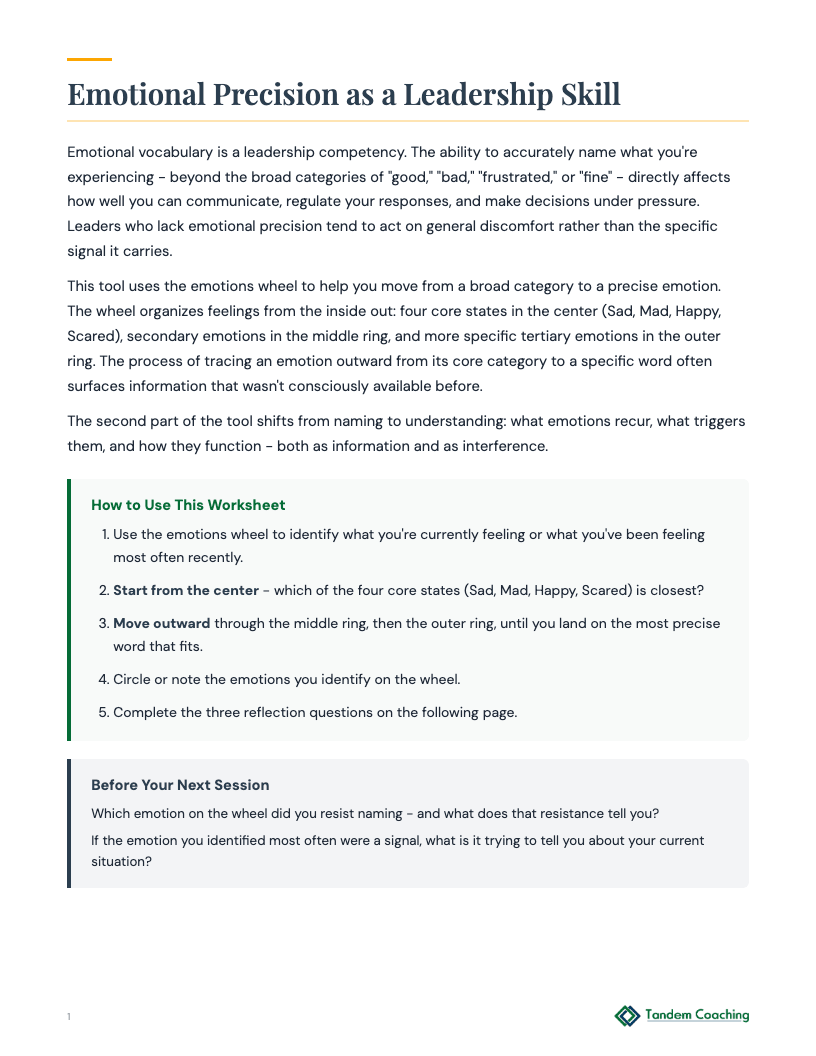
When to Use This Tool
Client describes feeling 'bad' or 'off' but cannot name the emotion with any specificity
Client's emotional vocabulary is limited to a few broad categories that don't capture nuance
Client wants to understand their emotional patterns but has no framework to organize them
How to Introduce This Tool Plus
Which word feels close enough to start, and what context did you notice around it without inferring a cause?
Coaching Tool Disclaimer
This tool is designed for coaching contexts, not clinical use. If you or your client is in crisis, contact the 988 Suicide and Crisis Lifeline (call or text 988) or Crisis Text Line (text HOME to 741741).
Browse All Pages
Tool Classification
Domain
Life Coaching
Type
Assessment
Phase
Discovery
Reflection
Details
15 min
Opener
As-needed
Topics
Emotions
Self-Care
Mindset
For the Coaching Practitioner
Plus
Coaching Scenarios
Plus
1 The analytically dominant executive who describes every emotional state as 'stressed' ▶
Context
A 46-year-old VP of engineering at a software company comes to coaching sessions well-prepared, process-oriented, and precise about technical matters. When asked about his emotional state, he uses three words interchangeably: stressed, fine, frustrated. He is not being evasive — his emotional vocabulary is genuinely limited to high-level categories. The Wheel of Emotions gives him a taxonomy built for this problem: it starts with his broad labels and maps them outward to increasingly specific emotional territory.
How to Introduce
The engineering framing is an asset here. 'You work with precision every day — you know there's a difference between a 404 and a 503, even though to a non-technical user they both just mean 'the site is down.' This wheel does the same thing with emotions. It starts with broad categories and lets you get more specific.' Position this as vocabulary acquisition, not emotional processing. The resistance to watch for is dismissiveness — he may complete it quickly and return to problem-solving mode. Name it directly: 'I want you to sit with the outer ring for a minute. Don't choose the first word that seems close — look for the one that's actually accurate.'
What to Watch For
Watch for him to consistently select middle-ring terms (annoyed, anxious, content) rather than outer-ring specifics (contemptuous, apprehensive, serene). The middle ring is close enough to feel accurate but not specific enough to be reflective. Also watch for him to locate his emotion in the 'Bad' quadrant (the broad outer ring) and stop there without differentiating further — that's the emotional equivalent of saying 'the site is down' without a status code. The coaching value comes from the outer ring.
Debrief
Start with his selection. 'Walk me through where you landed and why.' Then: 'What's the difference between [the word he chose] and [a neighboring word on the wheel]? Are both accurate, or is one more accurate?' That granularity question is what the wheel is for. Then ask: 'When in the last week did you feel this specifically? What was happening?' The word becomes a handle for a real moment, which becomes a conversation about what's actually driving his state.
Flags
Coaching scope: do not diagnose, interpret symptoms, or recommend treatment. Adapt or stop for distress and use licensed health or emergency support when appropriate.
2 The client processing a demotion who says she's 'over it' but clearly isn't ▶
Context
A 41-year-old director of marketing at a retail company was passed over for a VP promotion six months ago. A peer she'd mentored got the role. She came to coaching three weeks after the announcement, initially for 'leadership development.' She says she's moved on. Her affect in sessions tells a different story — she becomes terse when the peer's name comes up, trails off when talking about her future goals, and described her emotional state last session as 'honestly fine.' The Wheel of Emotions is a non-confrontational way to open the actual emotional territory.
How to Introduce
Don't connect this directly to the demotion scenario in the introduction — let the wheel do that work. Frame it as a general check-in tool. 'Before we pick up where we left off, I want to do a quick emotional mapping — there's a wheel that has four broad emotional categories with increasingly specific terms. I find it gives us a more accurate starting point than 'how are you feeling?' Would you be open to trying it?' The low-threat framing is intentional. She said she's over it — the wheel should let her either confirm that or discover it isn't true without being confronted.
What to Watch For
Watch for her to locate her emotion in the 'Bad' quadrant, specifically in the grief/disgust cluster rather than the anger cluster — that distinction matters. Clients who have been passed over sometimes experience what reads as anger but is actually closer to humiliated or betrayed. Watch for outer-ring words like 'disrespected,' 'inferior,' or 'abandoned' — if those appear, they are primary material. Also watch for incongruence between what she circles and how she explains it: a client who circles 'content' while her voice is flat is a client performing emotional okayness.
Debrief
Start with her selection and stay close to the specifics. 'You landed on [word]. What does that one feel like in your body right now?' Then: 'Six months ago, right after [the announcement] — if you'd had this wheel then, where would you have pointed?' That's often where the real answer is. Don't rush to the career coaching agenda. The wheel has surfaced material that needs time. Close with: 'What do you want to do with what just came up?' That returns agency to her without steamrolling.
Flags
Coaching scope: do not diagnose, interpret symptoms, or recommend treatment. Adapt or stop for distress and use licensed health or emergency support when appropriate.
3 The client who has emotions but no framework for organizing them into useful signal ▶
Context
A 29-year-old product designer at a startup is emotionally expressive, reflective, and self-aware by most measures. She's talked freely in coaching sessions about how she feels. The problem is that her descriptions of emotional states are vivid but undifferentiated — she cycles through 'overwhelmed,' 'excited,' 'anxious,' and 'meh' without noticing that the same word covers very different experiences in different contexts. The Wheel of Emotions isn't about access — she has plenty — it's about organizing what's already there into useful signal.
How to Introduce
Frame this as organization rather than excavation. 'You're actually already good at noticing your emotional states — what I want to try is a tool that helps sort them. Because right now 'anxious' is doing a lot of work for you, and I think some of those anxious states are actually different things with different causes.' Position the outer ring as the useful level of specificity. 'Once you can distinguish between apprehensive and worried and uneasy, the question of what to do with the emotion gets a lot clearer.'
What to Watch For
Watch for her to notice that the same emotional label she's been using covers states in different quadrants on the wheel. If 'anxious' is landing near both apprehensive (anticipatory, forward-looking) and overwhelmed (capacity-based), those are two different problems with different solutions. That discovery — 'I've been calling these the same thing and they're not' — is the value this tool delivers for emotionally fluent clients. Also watch for recurring outer-ring words across multiple situations — if 'pressured' keeps coming up across different contexts, that's a pattern worth naming.
Debrief
Start with what surprised her. 'Which word on the wheel surprised you when you selected it — because it felt accurate in a way that your usual label doesn't?' Then go to the pattern: 'In the last week, you've used [their recurring label] in three different contexts. If you used this wheel instead, would all three land in the same spot?' Help her see that precision in emotional labeling is what makes it actionable: 'Once you know it's apprehensive and not overwhelmed, what does that tell you about what you actually need?'
Flags
Coaching scope: do not diagnose, interpret symptoms, or recommend treatment. Adapt or stop for distress and use licensed health or emergency support when appropriate.
Tool Flow
Plus
Requires
- None - standalone tool
→
Produces
- precise emotion labels from 3-ring wheel
- identified recurring emotional patterns
- named triggers for dominant emotions
Pairs Well With
Wellness
Optional Sensory Attention Walk
Use this worksheet to explore self care and mindset and turn the client’s observations into one optional next step.
Why it pairsUse the walk after naming the dominant emotion so the before-and-after comparison measures a shift from a specific, labeled state.
LifeForgiveness Reflection
Client acknowledges a resentment they are carrying but has not examined what it is costing them
Why it pairsOnce the client has exact emotion labels, the forgiveness reflection can examine what carrying each named feeling is costing them.
LifeOptional Daily Reflection
Use this tracker to notice patterns in accountability and self care over time before drawing conclusions.
Why it pairsUse the journal after the wheel so stressor entries carry precise emotion names, making week-over-week patterns visible sooner.
This tool is part of a coaching pathway
Step 1 of 6 in Client describes feeling 'bad' or 'off' but cannot name the emotion with any specificity
Continue with Emotional Regulation Toolkit if that next job fits.
Next: Emotional Regulation Toolkit → Explore all pathways →Related Articles


The Risk Your Boss Wants You to Take (That Your Training Says Don't)
Read article →
Organize Your Success – ADHD Coaching to Master Organizational Skills
Read article →
Power Dynamics: Reading the Decision Architecture Around Your Client
Read article →
The Coaching Stance: What Changes When You Stop Facilitating and Start Coaching
Read article →