Measure how self-awareness translates into confident action with a structured scale that pinpoints gaps and tracks progress over time.
Free, print-ready PDF.
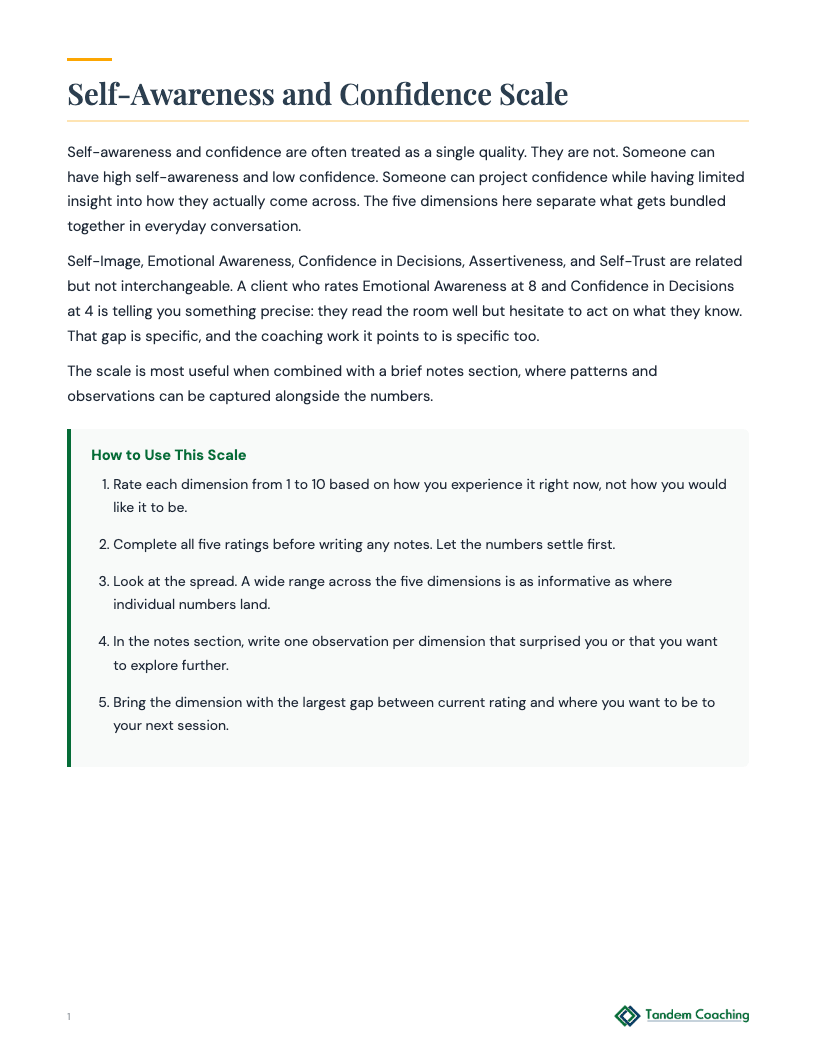
There's a five-dimension scale that separates knowing yourself from trusting yourself to act on what you know. Would it be useful to see where that gap is for you right now?
A principal software engineer just promoted to engineering manager at a fast-growing startup. No formal management experience. Team of six senior developers, two of whom were also candidates for the role. Client feels technically competent but questions every people decision.
Frame this as a baseline before leadership skill building begins. 'Before we design your first 90 days as a manager, let's see where you're starting from.' Expect resistance to rating Assertiveness and Self-Trust - technical people often conflate confidence with arrogance. Emphasize this measures current state, not permanent capacity.
Technical leaders often rate Self-Image high (they know their technical strengths) but Assertiveness and Self-Trust low. Watch for the client rushing through Emotional Awareness - they may not have vocabulary for workplace emotions beyond frustration. If all ratings cluster between 6-8, they're avoiding the extremes.
Start with the highest and lowest scores. Ask: 'What makes Self-Image an 8 while Assertiveness is a 4?' Then focus on the gap: 'You know your strengths clearly but struggle to act on that knowledge with your team. What's different about technical decisions versus people decisions?' This usually surfaces the real issue.
If Self-Image is 8+ but both Assertiveness and Self-Trust are below 4, the client may have imposter syndrome about the leadership role specifically. Severity: moderate. The technical competence isn't transferring to leadership confidence, which can create decision paralysis in people management situations.
VP of Sales at a mid-size company. Recent 360 feedback indicated they dominate meetings and don't listen to input. Client believes they're being decisive and efficient. HR suggested coaching after two direct reports mentioned the behavior in exit interviews.
Present this as a calibration tool, not a performance review. 'You rate yourself, then we'll compare that to what others are seeing. The gaps tell us where to focus.' Expect the client to rate Assertiveness and Confidence in Decisions high. They likely see the feedback as others being too sensitive or slow.
Watch for ratings that don't match the 360 feedback. If they rate Emotional Awareness high but can't see how their behavior affects others, they're confusing self-justification with self-awareness. Look for defensive explanations in the Notes section - 'I have to be direct because...' indicates they're not engaging with the feedback.
Start with Emotional Awareness and Assertiveness scores. Ask: 'You rated Emotional Awareness as 7. Walk me through what you noticed about others' reactions in your last team meeting.' If they can't give specific examples, the rating is aspirational. Then: 'What's the difference between assertiveness and aggression in your role?'
If they rate all dimensions 7+ despite clear feedback about interpersonal issues, this suggests limited self-awareness masked as confidence. Severity: moderate. The client may need direct feedback about the gap between self-perception and impact before coaching on behavior change can be effective.
Senior Marketing Manager at a Fortune 500 company. Offered Director role twice in 18 months, declined both times citing 'not ready yet.' Strong performance reviews, respected by peers. Client says they want the promotion but keep finding reasons to delay.
Frame this as exploring the gap between wanting something and taking it. 'You know you're qualified - your manager knows it, HR knows it. Let's see what's happening between knowing and doing.' Don't assume it's confidence - sometimes high self-awareness creates paralysis when someone sees all the risks clearly.
Look for a pattern where Self-Image and Emotional Awareness are high but Self-Trust and Confidence in Decisions are significantly lower. This suggests they can analyze themselves and situations clearly but struggle to act on that analysis. If the Notes section has lots of qualifications or 'but' statements, they're overthinking.
Start with the gap between awareness dimensions and action dimensions. 'You rated Self-Image as 8 but Self-Trust as 5. You know your capabilities but don't trust yourself to use them. What's that about?' Then ask: 'What would have to be true for Self-Trust to move from 5 to 7?'
If Self-Image is high but Self-Trust is below 4, and this pattern has persisted across multiple opportunities, the client may have perfectionism or fear of failure that coaching alone won't resolve. Severity: low to moderate. Continue coaching but explore whether the avoidance serves a function they're not naming.
First-time CEO at a family business, promoted from COO after founder's retirement. Board includes family members and outside investors. Client feels confident about operations but second-guesses every strategic decision. Board meetings feel adversarial.
Position this as separating operational confidence from strategic confidence. 'You've proven you can run the business day-to-day. Now we need to see where you stand on the CEO-specific challenges.' Expect them to want to focus on board management tactics rather than their own confidence patterns.
New CEOs often show a split pattern - high ratings on familiar dimensions (likely Self-Image if they were a strong COO) but low on Confidence in Decisions and Self-Trust for strategic choices. Watch for them rating based on their COO experience rather than CEO reality. If they avoid rating certain dimensions, note which ones.
Focus on the decision confidence gap. 'You rated Confidence in Decisions as 4. What's different about the decisions you're making now versus six months ago as COO?' Then explore: 'When you're in a board meeting and someone challenges your strategy, what happens to your confidence in that moment?'
If multiple dimensions are below 5 and the client mentions feeling like they don't belong in the CEO role, this may indicate imposter syndrome complicated by family business dynamics. Severity: moderate. The role transition may be triggering identity issues that need direct attention before strategic coaching can be effective.
Client notices the internal commentary but has never examined what it assumes or whether it's accurate
LifeClient is aware of self-critical thinking but has not identified which specific patterns are most active
LifeClient states what they want but has not explored the deeper emotional driver underneath it