Work-Life Balance Assessment
Identify what’s driving work to crowd out life, with a structured assessment that maps your time, stress, and priorities into clear patterns.
Get This Tool
Free, print-ready PDF.
When to Use This Tool
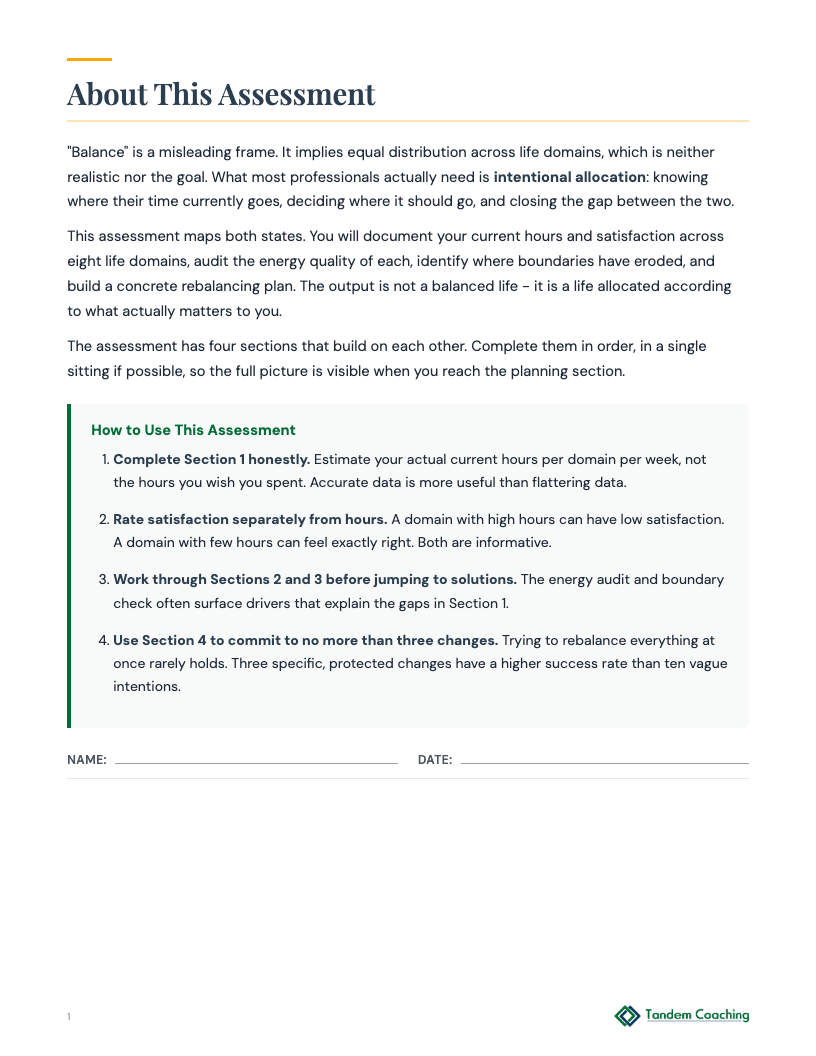
A client feels like work is consuming everything else and wants to understand the pattern
A client says they want balance but hasn't looked honestly at where their time goes
A client wants to set clearer boundaries but doesn't know where to start
How to Introduce This Tool Plus
When you compared your time allocation to your energy audit, what did you notice — are you spending the most time in the domains that give you the most energy, or in the ones that drain you?
Browse All Pages
Tool Classification
Domain
Career
Type
Assessment
Phase
Discovery
Action
Details
30 min
Between sessions
Monthly
Topics
Self-Care
Time Management
For the Coaching Practitioner
Plus
Coaching Scenarios
Plus
1 The department head who works from 7am to 9pm and calls it dedication ▶
Context
A 43-year-old director of operations at a regional healthcare system works long hours by any measure. He frames this as commitment to the mission. His spouse has said the same thing for three years in different ways. He came to coaching because 'I want to be more strategic' — not because he wants to work less. He hasn't named a balance problem. The Work-Life Balance Assessment includes both a time allocation map and an energy audit, and the energy column is what will open the real question: is the time he's spending in work actually producing return at the rate he assumes?
How to Introduce
Frame this around the strategic goal he named, not around balance. 'You said you want to think more strategically and have more impact. One of the most useful things we can do to get there is map where your time and energy are actually going — because if the highest-leverage thinking gets squeezed out by operational load, strategy doesn't happen.' The energy audit section is the one to highlight: 'Not just where your hours go, but which domains give you energy and which drain it. Those are often not the same domains.'
What to Watch For
Watch for the energy audit to reveal that work is consuming his hours but not his top energy states. If Work/Career receives 60% of his time allocation but scores low on the energy return side, the narrative of 'dedicated professional' becomes more complicated. Also watch for the boundary erosion section — he may have difficulty naming the moments when work overflows into other domains because the overflow has become invisible to him. If he can't name a typical non-work evening, that's a data point.
Debrief
Start with the time-energy comparison. 'You spent most of your hours on work. Where on the energy scale did those work hours land — high, neutral, or draining?' If there's a mismatch, name it: 'You're spending most of your time in the domain that isn't actually giving you the most energy. That's worth examining from a sustainability standpoint.' Then bring in the strategic framing: 'If you could reallocate three hours a week from draining work activities to the domains that give you energy, what would you put back in?' The question connects to his stated goal without making it a wellness lecture.
Flags
- Moderate
Client's time allocation map shows near-zero hours in every non-work domain and he experiences no distress about this — he describes it as 'that's just what this job requires right now' where 'right now' has been true for five or more years. The absence of distress about extreme imbalance may indicate that the personal domains have been so fully evacuated that he no longer notices their absence.
Response: Continue with adjustment — don't challenge the time allocation directly. Ask about a specific non-work memory: 'What was the last thing you did on a weekend that had nothing to do with work, and how long ago was that?' The specificity test either confirms that balance still exists in some form or surfaces the full extent of the erosion.
2 The client who wants better boundaries but keeps explaining why they can't have them ▶
Context
A 37-year-old in-house counsel at a financial services company has been trying to set better boundaries for two years. She reads articles about it. She sets intentions. She responds to the 10pm partner email anyway. She came to coaching because she 'can't stop overworking.' The Work-Life Balance Assessment produces three outputs she hasn't produced before: an honest time map, an energy audit showing which domains drain versus restore her, and three specific time-rebalancing commitments — the last section is where the real test lives.
How to Introduce
Frame this as diagnosis before prescription. 'You've tried setting limits before and they haven't held. Before we talk about what to do differently, I want to understand the actual pattern — where your time goes, what it costs you in energy, and where the boundaries are actually breaking down.' The energy audit section is important: if she rates certain work activities as high-energy (which is plausible for driven lawyers), the boundary-setting conversation changes. The goal isn't to work less in general — it's to protect the domains that are being starved.
What to Watch For
Watch for the boundary erosion section to reveal that the erosion isn't random — it typically happens at specific times (evening, weekend) triggered by specific patterns (partner emails, Slack notifications, anxiety about missing something). If those triggers are identifiable, boundary interventions can be targeted. Also watch for her three time-rebalancing commitments to be vague or unenforceable ('I'll try to leave by 6 more often'). Specificity in the commitment column is what makes this tool actionable rather than aspirational.
Debrief
Start with the energy audit. 'Which domains give you energy when you're actually in them?' Then: 'How many hours did you spend in those domains last week?' The arithmetic is the point. Then move to commitments: 'You wrote [her commitment]. I want to make it more specific. What day? What time? What would it take for that not to happen?' The three commitments should be specific enough that you can check them at the next session by name. Vague commitments are a way of appearing to agree without actually committing.
Flags
- Moderate
Client's three time-rebalancing commitments are identical or nearly identical to commitments she reported making three or more times previously in the coaching engagement, and she acknowledges she hasn't followed through on any of them. Repeated intention without action is a pattern that behavior-level coaching interventions may not resolve.
Response: Pause commitment-making. 'Before we make another commitment, I want to understand what got in the way of the last three.' If the barrier is consistently internal — anxiety, guilt, identity — the work may need to go deeper than time management. Explore what she believes would happen if she did enforce a boundary, and who or what she would be disappointing.
3 The early-career professional who has been told by a mentor to 'get your balance sorted' ▶
Context
A 26-year-old associate at a consulting firm came to coaching because a senior manager she respects told her she 'seems like she's running on empty' and suggested she talk to someone about work-life balance. She took the advice seriously but isn't sure she actually has a balance problem — she's young, she loves the work, and she's accepted the long hours as normal for her career stage. The Work-Life Balance Assessment will give her a map that either confirms her self-assessment or surfaces something her mentor saw that she hasn't.
How to Introduce
Frame this as a baseline rather than a diagnosis. 'Your mentor noticed something. Let's see what the data says before we decide whether there's a problem to solve or not.' That framing respects her self-perception without dismissing the mentor's observation. Be clear about what the tool does: 'It maps where your hours go, which domains give you energy versus drain you, and where your limits are being crossed. The goal is a picture, not a verdict.' She should complete the assessment honestly rather than trying to produce a particular result.
What to Watch For
Watch for her to conflate 'not noticing the problem' with 'there is no problem.' High-functioning people in early careers often don't yet have enough baseline to recognize sustained depletion — it's been their normal since they started. The energy audit is the diagnostic tool here: if she rates Health and Social domains high but has allocated minimal time to them, the gap is the signal. Also watch for the boundary erosion section: young professionals often don't recognize erosion because they've never experienced a boundary being held in this environment.
Debrief
Start with what she notices, not what you notice. 'Looking at this completed sheet — what does it tell you?' Give her the space to identify the pattern herself. If she doesn't see what her mentor saw, ask: 'Your mentor said you seem like you're running on empty. Is there anything on this sheet that might be what they were looking at?' That question invites her to look through another perspective without telling her what to conclude. Close with: 'Whether or not you think this is a problem right now — what would you want to be true about this picture in three years?'
Flags
- Low
Client's Health domain shows a very low current score with no identified future commitment to change it, combined with a comment like 'that's just how consulting is' or 'everyone here is like this.' Peer normalization of a harmful pattern is a cultural pressure, not a fact — and it's worth naming as such without catastrophizing.
Response: Continue — plant a seed rather than confront. 'The fact that it's common in your environment doesn't make it not a cost. What's your plan for your Health domain five years from now, assuming things stay this way?' That question introduces future-self accountability without lecturing about current behavior.
Tool Flow
Plus
Requires
- None - standalone tool
→
Produces
- time allocation map across eight life domains
- energy audit identifying draining versus energizing domains
- boundary erosion patterns and named triggers
- three specific time rebalancing commitments
Pairs Well With
Executive
Energy Context Reflection
A client wants to use Energy Context Reflection as an optional reflection
Why it pairsOnce you have the domain map, Energy Audit adds activity-level ratings that explain why certain areas feel so costly.
CareerMonthly Budget Planner
I earn decent money but never know where it goes by end of month
Why it pairsWhen overwork patterns surface, use this to check whether financial pressure is the hidden driver keeping your client stuck there.
CareerProductivity System Design
A client who's tried multiple productivity systems and none of them stick past the first week
Why it pairsOnce you have the time map and boundary triggers, use this to translate them into a schedule and concrete work boundaries.
Related Articles


AI Governance for Executives: 5 Domains You Must Know | 2026
Read article →
When Executive Coaching Does Not Work
Read article →
Executive Network Audit for AI-Era Career Changes
Read article →
Executive Job Automation Risk: The PURPOSE AUDIT™ Framework
Read article →