Productivity System Design
Design a productivity system that fits your role and habits, so it sticks beyond week one. Built from patterns proven across busy careers.
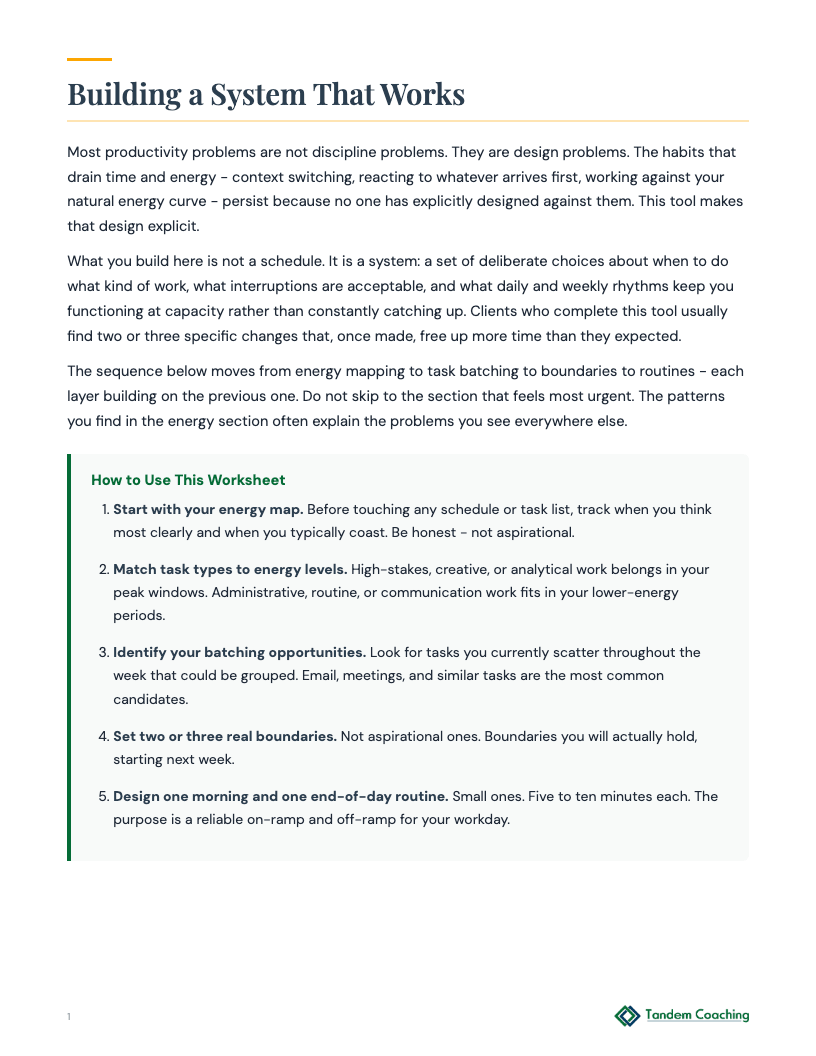
Get This Tool
Free, print-ready PDF.
When to Use This Tool
A client who's tried multiple productivity systems and none of them stick past the first week
Someone who's busy all day but ends it feeling like nothing important got done
A professional who keeps reactive mode from crowding out the work that actually matters
How to Introduce This Tool Plus
Before building a new system, it helps to understand what's failed before. What have you tried, and what specifically broke down — was it the design of the system or how you used it?
Browse All Pages
Tool Classification
Domain
Career
Type
Planner
Phase
Goal Setting
Action
Details
45+ min
Between sessions
As-needed
Topics
Time Management
Habits
For the Coaching Practitioner
Plus
Coaching Scenarios
Plus
1 A professional who designs a system that matches her aspirational self rather than her actual energy patterns ▶
Context
A manager who believes she is most productive in the morning and designs her system accordingly - deep work blocks scheduled at 6am, email after lunch, team meetings in the afternoon. In practice, she rarely starts before 8am and her actual peak performance window is late morning through early afternoon. The system looks good on paper and fails in execution because it was built for a self-image rather than observed reality.
How to Introduce
Before she designs, ask for data. 'Before we map the ideal system, let's figure out what your actual energy looks like. Over the past two weeks, at what times of day did you produce your best work? Not when you planned to - when it actually happened?' That question surfaces the difference between aspirational and actual rhythms. The resistance is embarrassment: the actual pattern may feel less disciplined than the aspired one. Name it as useful: 'A system built on what's real will outperform one built on what you wish were true.'
What to Watch For
Watch the energy mapping section specifically. If her high-energy time slots match neatly with conventional wisdom (early morning) without reference to her actual experience, she's filling in an ideal rather than observing a reality. Also watch the task batching section: clients who over-schedule deep work in low-energy windows often leave execution gaps that they attribute to motivation rather than to system design.
Debrief
Start with the energy map. 'Walk me through what you wrote for peak energy. Tell me about a specific day in the last two weeks that matched this.' If she can't name a specific day: 'What does a peak-energy window actually look like when it happens - what time, what conditions?' Then look at the task assignments: 'Are your deep work tasks in the high-energy slots, or in the slots where you thought energy should be?' The question that creates movement: 'If you built this system entirely around when energy is actually high rather than when it should be, what would change?'
Flags
A manager whose self-designed productivity system consistently fails in execution may have a deeper belief that discipline should override physiology - that she should be able to produce at the times she's 'supposed to' work. If this belief is explicit, it's worth addressing directly: it produces systems that fail and self-blame when they do. Severity: low. Response: complete the system redesign based on observed data and name the self-image versus reality distinction as a coaching theme.
2 A professional whose system collapses because he hasn't designed for interruptions ▶
Context
A team lead in an open office who has designed a productivity system with clean time blocks for focused work. The system fails daily because his role involves frequent interruptions - team questions, manager requests, peer coordination - that aren't represented in the design. He interprets the daily failure as personal discipline failure rather than system design failure.
How to Introduce
Reframe before he starts redesigning. 'Before we rebuild, I want to understand something: how many interruptions do you get on an average day, and how long does each one take?' Once he estimates: 'So roughly X hours of your day are taken by interruptions you didn't plan for. That's not a discipline problem - that's an unaccounted-for reality in your current system. The design needs to include that.' The resistance is that naming interruptions feels like accepting defeat. Name the alternative: 'Pretending the interruptions don't exist produces a plan that fails every day.'
What to Watch For
Watch whether the boundaries section of the tool includes any structures for managing interruptions - a defined response window, a closed-door hour, a team protocol for questions. If the boundaries section only addresses personal habits ('no phone before 9am') without addressing how he'll handle the external demands that break his system, the redesign will fail for the same reasons the original did. Also watch his task batching: if deep work is scheduled in blocks where interruptions are most likely, the design hasn't accounted for his environment.
Debrief
Start with the interruption estimate. 'You said roughly X hours of interruptions per day. Does your system design include those?' Then look at the deep work blocks: 'When are interruptions most likely in your environment? And when are your deep work blocks scheduled?' If they overlap: 'What would you need to change to protect those blocks - not about discipline, but about structural design?' The question that creates movement: 'What boundary or signal could you establish that your team could follow, so they know when you're available and when you're not?'
Flags
A team lead whose productivity system cannot account for team interruptions may have an underlying availability expectation problem - his team or his manager has implicit expectations about response time that his system can't meet. If the interruption volume is genuinely incompatible with the role's deep work requirements, this may be a scope or expectations conversation with leadership, not a personal system problem. Severity: low. Response: complete the redesign accounting for interruptions, and flag whether the volume suggests a role-scope conversation.
3 A professional who designs a great system on Sunday night and abandons it by Tuesday ▶
Context
A consultant who spends significant time on Sunday evenings designing her week - task assignments, energy blocks, batching strategies, boundaries. The design is thoughtful and specific. By Tuesday, the system is irrelevant: she's operating on the fly, the structure has dissolved, and she's waiting for next Sunday to try again. The pattern has repeated for months. The weekly review section of the tool exists precisely to address this, but she's been skipping it.
How to Introduce
Name the pattern before designing. 'You've done the Sunday system before. It works for Monday and breaks down by Tuesday. Before we rebuild, let's diagnose what breaks it - because rebuilding without that diagnosis produces the same cycle.' That framing makes the exercise diagnostic rather than aspirational. The resistance is optimism: she believes this cycle will be different. 'It might be. But let's make sure we're changing something structurally, not just recommitting to the same design.'
What to Watch For
Watch whether she includes the weekly review as a built-in element of the system design. Clients who design on Sunday but never review mid-week have no mechanism to catch drift before it becomes abandonment. Also watch whether she assigns specific recovery protocols - when the system breaks down on Tuesday, what happens? A system without a reset protocol collapses completely; a system with one degrades gracefully.
Debrief
Start with Tuesday. 'Walk me through the last time the system dissolved. What specifically happened between Sunday night and Tuesday morning?' Then: 'Looking at the system you've designed today, what's the first thing that will break under that same pressure?' Then build the recovery: 'What's the protocol for when that happens - not to restart the whole system, just to get back on track?' The question that creates movement: 'If you had a five-minute Tuesday check-in built into this system, what would it ask you to do?'
Flags
A consultant who rebuilds her system weekly without examining why the previous one failed is in a planning loop: the design work feels productive and provides the same satisfaction as execution without carrying the same risk. If this is a recognizable pattern, name it: 'Building the system has become the activity. Using it is the work.' Severity: low. Response: continue with the redesign and make the weekly review and recovery protocol non-negotiable elements before she leaves the session.
Tool Flow
Plus
Requires
- current time usage patterns
- named productivity failure modes
→
Produces
- energy-matched work schedule
- task batching plan by type
- three stated work boundaries
- morning and end-of-day routines
Pairs Well With
Career
Productivity Practices Review
A client feels busy all day but doesn't feel productive at the end of it
Why it pairsThe assessment's eight-dimension ratings and blocker plan give the system design the named failure modes and skill gaps it needs to build around.
CareerWeekly Time Use Review
A client wants to use Weekly Time Use Review as an optional reflection
Why it pairsA week of actual time logs fills the system design's required input on current usage patterns so the energy-matched schedule reflects reality, not intention.
LifeDaily Action Context Note
Use this tracker to notice patterns in accountability and habits over time before drawing conclusions.
Why it pairsOnce the batching plan and work boundaries are set, the checklist translates those system decisions into a daily habit the client can actually execute and track.
This tool is part of a coaching pathway
Step 2 of 6 in A client feels busy all day but doesn't feel productive at the end of it
Use after Productivity Practices Review. Then continue with DBT DEAR MAN Skill if that next job fits.
Next: DBT DEAR MAN Skill → Explore all pathways →Related Articles


GTD for Executives: Adapt David Allen's System for Leadership
Read article →
30-Day Executive Productivity Transformation Guide
Read article →
Jensen Huang AI Jobs Framework: What He Got Right & What He Misses
Read article →
Managing Stress and Anxiety: Coaching Strategies for Leaders’ Well-Being
Read article →