
Monthly Budget Planner
See exactly where your pay goes each month with a structured planner built on proven budgeting basics, so you can stop guessing and start saving.
Get This Tool
Free, print-ready PDF.
When to Use This Tool
I earn decent money but never know where it goes by end of month
I want to get a real picture of my monthly spending so I can make intentional choices
Budgeting feels overwhelming so I keep avoiding it
How to Introduce This Tool Plus
Some clients find it grounding to track exactly what came in and went out each month before making any financial goals - would mapping that picture be a useful starting point?
Browse All Pages
Tool Classification
Domain
Career
Type
Planner
Phase
Action
Review
Details
30 min
Between sessions
Monthly
Topics
Finances
Accountability
Time Management
For the Coaching Practitioner
Plus
Coaching Scenarios
Plus
1 The client who earns well, feels broke, and has never examined where the money actually goes ▶
Context
A 38-year-old senior product manager at a tech company earns $165,000 a year and consistently reaches the end of the month with less than $500 in her checking account. She has a vague sense that she spends 'too much on food and travel,' but she has never compared what she planned to spend against what she actually spent in any category. She came to coaching to work on career satisfaction, and money came up when she described feeling financially stuck despite a salary she knows is objectively good. The Monthly Budget Planner produces the comparison she's never made — planned versus actual — and identifies the largest gap between intention and behavior. For this client, the gap is almost always more specific than she expects, which changes the intervention from 'spend less' to 'spend less on one thing.'
How to Introduce
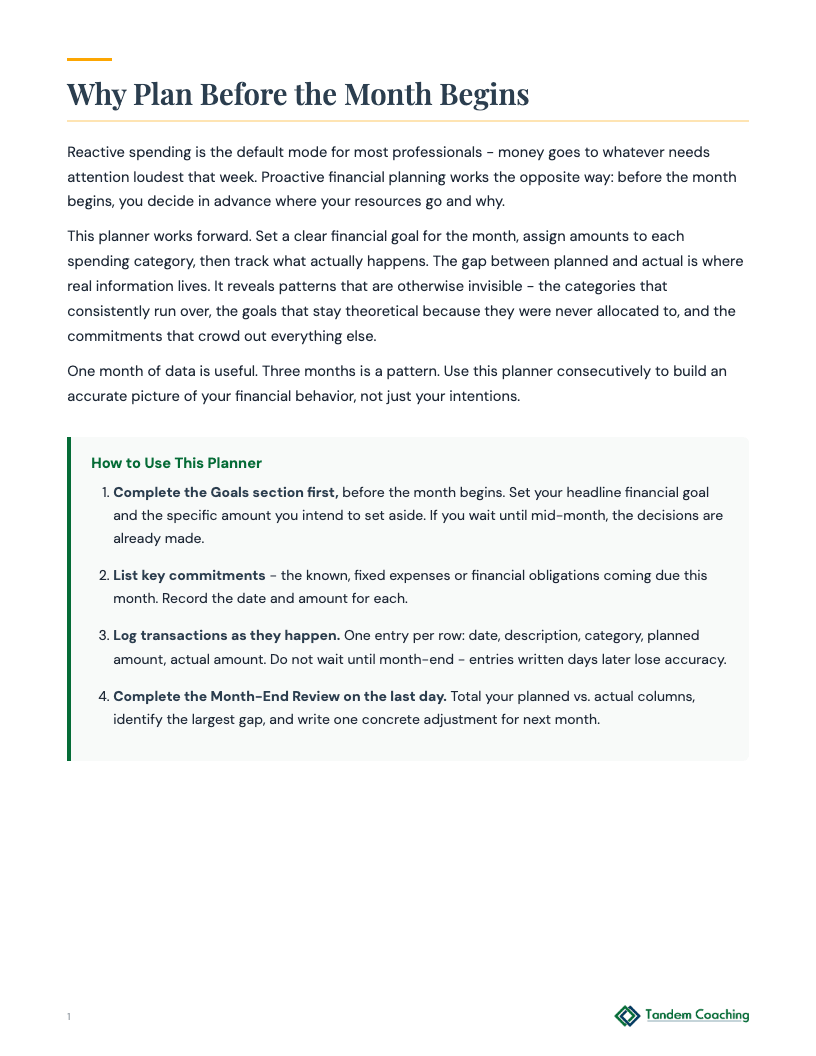
Frame this as finding the gap, not building a budget. 'You said you feel broke at the end of the month despite a good salary. The planner is going to tell us why — not through an audit of your values or your priorities, but through the arithmetic of last month's actual spending versus what you'd planned, or thought you were spending, in each category. Complete this with your bank and credit card statements for last month, not from memory. Memory smooths the numbers. The statements don't.' Name the output explicitly: 'When you bring this back, I want to look at three numbers: total planned versus total actual, the single category with the largest gap, and the one thing you'd change about next month's spending if you were being intentional. Those three numbers are what we'll work with.'
What to Watch For
Watch for the planned column to be aspirational rather than realistic — if she plans $200 for restaurants in a month where her statements show $650, the gap is real information, but the planned number was never a real plan. Push to understand whether the planned column reflects a genuine intention or a wish. Also watch for the largest gap to fall in a category she has strong emotional attachment to — travel, dining, or experience purchases — because the coaching conversation about that gap is different from one about a utility overage. The question isn't whether the spending is wrong; it's whether it's conscious.
Debrief
Start with the comparison: 'What is the total gap between what you planned and what you actually spent last month?' Let the number land. Then: 'Which single category has the largest gap?' Let her name it without interpretation. Then: 'Is that gap a surprise, or did you already know it was there?' That question distinguishes between unknown spending and known spending she hasn't addressed. Close with the concrete adjustment: 'You wrote one concrete change for next month. Read it to me. Is that a change you'd make because you want to, or because you think you should?' The distinction between values-driven adjustment and compliance-driven adjustment predicts whether it sticks.
Flags
- Moderate
Client's actual spending in several categories falls below her planned amounts — she has been spending less than she thought, yet still ends the month with almost nothing. The discrepancy suggests income is lower than she stated, there are large irregular purchases not captured in the monthly categories (annual subscriptions, medical bills, car repairs), or there is a debt service load that isn't visible in the planner's categories.
Response: Name the math problem. 'Your actuals are under your planned amounts in most categories, but you're still ending the month short. The planner as structured doesn't explain the gap. Before we draw conclusions, I want to look at two things: irregular expenses that don't show up monthly — annual payments, one-time costs, debt minimum payments — and whether the income number at the top matches what's actually depositing. One of those is almost always where the missing money is.' This may be a better fit for the Debt Tracker or a fuller spending overview tool if debt service is the hidden driver.
2 The couple navigating a single income after a spouse leaves the workforce to care for a child ▶
Context
A 34-year-old elementary school teacher came to coaching alone, though her husband recently left his job to care for their infant. Their household income dropped by 40% six weeks ago. They have not rebuilt their budget around the new income. She is spending from habit — the grocery store, the subscriptions, the occasional dinner out — at roughly the same rate as when they had two incomes. She is not in debt yet, but her checking account balance is declining each month. She came to coaching to work on managing the life transition, and financial stress emerged as the primary current stressor. The Monthly Budget Planner produces the first household budget built around actual current income, not the income they no longer have.
How to Introduce
Frame this as recalibration, not austerity. 'Your household income changed six weeks ago. Your spending hasn't adjusted yet — which is completely normal when the income change is sudden. The planner is going to give you the first picture of what the budget looks like under the new income: what comes in, what goes out by category, and what the gap is between the current spending pattern and what the new income can sustain. We're not building a punishment budget — we're building a picture. The adjustment decisions come after we know what we're actually looking at.' Complete this in session for the first month rather than as homework: she will need to estimate some categories rather than pull statements for all of them.
What to Watch For
Watch for her to minimize the gap — to round down actuals or assign optimistic category amounts — because seeing the real gap may feel threatening or like a confirmation of a decision she and her husband made together. The planner is most useful when the numbers are honest, and a coaching conversation is needed to establish that honesty is the point. Also watch for the 'one concrete adjustment' section to produce something symbolic rather than structural — cutting one streaming service when the actual gap is $800/month. If the gap is large, name it: the adjustment section needs to match the scale of the problem, not just identify the smallest comfortable change.
Debrief
Start with the income line: 'What does the household actually bring in each month right now?' Then build through the categories to the total. Then: 'What's the monthly gap between what comes in and what went out last month?' Let her sit with it. Then: 'That gap is the number we're working with. It doesn't mean the decision to shift to a single income was wrong — it means there's an arithmetic adjustment that has to happen. What category, if you changed it, would close the most of that gap?' Push for the structural adjustment, not just the symbolic one. Close with: 'What's one thing you want to protect — one category you don't want to cut even if you cut other things — and why?'
Flags
- Moderate
The monthly gap between income and spending is large enough that category-level adjustments alone cannot close it — the problem is structural (income too low for current fixed costs, or fixed costs like rent or mortgage are too high relative to current income). The Monthly Budget Planner can identify the gap but cannot address it.
Response: Name the scope. 'The gap you're looking at is larger than discretionary spending cuts can close. The fixed costs — rent, mortgage, loan payments — are consuming more of the new income than the budget can sustain through category trimming. That's a different kind of conversation than 'where do we reduce.' It raises questions about income timeline, fixed cost restructuring, or bridging from savings — none of which this planner is designed to address. It may be worth involving a financial advisor or looking at a broader financial plan before returning to this tool for monthly tracking.'
3 The client who budgets every month, sticks to it for two weeks, and stops ▶
Context
A 31-year-old project coordinator at a consulting firm has tried to budget five times in the past three years. Each attempt follows the same pattern: she builds a detailed spreadsheet, tracks spending for 10-14 days, then stops. She doesn't know why she stops. She came to coaching to work on discipline and follow-through, citing the budgeting pattern as evidence that she 'lacks follow-through in general.' The Monthly Budget Planner is introduced not as another budgeting attempt but as a simplified, single-month tool specifically designed to produce three outputs — planned versus actual, one gap, one adjustment — rather than an ongoing system. The goal is one complete month, not a new habit.
How to Introduce
Frame this as a single-month audit, not a new system. 'You've tried to build a budgeting system five times and stopped each time around day ten. I don't want to build a sixth system — I want to complete one month and see what the data shows. The planner produces three things: a comparison of planned versus actual, the largest gap, and one concrete change for next month. That's it. We're not building a spreadsheet you maintain forever. We're taking a picture of one month.' Name the constraint explicitly: 'The reason most budgeting attempts fail around day ten is that the system becomes the goal rather than the information. This tool doesn't require maintenance — it requires one honest month, then we look at what it shows.'
What to Watch For
Watch for her to begin adding categories, sub-categories, or tracking mechanisms beyond the planner's structure — if she starts elaborating the tool, she's heading toward the same pattern that caused the previous five attempts to collapse under their own complexity. Hold the boundary: the planner has the categories it has, and this month's job is to fill them in, not improve the system. Also watch for her to frame stopping at day ten as a character flaw rather than a design problem. The previous systems were probably too complex for one person to maintain alongside a full-time job. That's a design issue, not a discipline issue.
Debrief
Start with completion: 'You finished a full month. That's the first time that's happened in three years. What made this one completable?' Let her name what was different. Then go to the three outputs: 'What's the largest gap between planned and actual? What's the one adjustment you're making next month?' Keep the debrief short and the outputs concrete. Then: 'You came to coaching saying you lack follow-through in general. You just completed something you've never completed before. What does that tell you about the follow-through question?' That reframe challenges the self-diagnosis without dismissing the real pattern. Close with: 'What would next month's planner tell you that this month's didn't?'
Flags
- Low
Client completes the full month accurately but the debrief reveals she found the process anxiety-producing throughout — checking her bank app felt threatening, filling in the actuals felt shameful, and she completed it through willpower rather than engagement. The data is useful but the process was aversive, which means it won't repeat.
Response: Acknowledge the effort before the data. 'You did something that was genuinely uncomfortable, and you finished it. That tells me something important: the issue isn't discipline — it's that the content carries an emotional charge for you that most budgeting tools aren't designed around. Before we look at what the numbers show, I want to understand: what specifically felt threatening about checking the actuals? The answer to that question may be more useful for the long-term pattern than the category gap is.'
Tool Flow
Plus
Requires
- None - standalone tool
→
Produces
- monthly planned versus actual spending record
- largest category spending gap identified
- one concrete financial adjustment for next month
Pairs Well With
Career
Personal Money Context Snapshot
Use this tracker to notice patterns in finances and career transition over time before drawing conclusions.
Why it pairsOnce the planner surfaces the biggest spending gap, the tracker converts that finding into a runway number your client can use to weigh a career or life decision.
CareerDebt Context and Payment Notes
Use this tracker to notice patterns in finances and accountability over time before drawing conclusions.
Why it pairsAfter the planner identifies the concrete adjustment for next month, this directs that freed-up amount toward a prioritized payoff sequence rather than leaving the decision vague.
LifePersonal Financial Context and Questions
Use this worksheet to explore finances and accountability and turn the client’s observations into one optional next step.
Why it pairsThe gap and adjustment the planner surfaces give your client the grounded numbers they need to set tiered goals with realistic amounts and deadlines.
Related Articles


Is Hiring an Executive Coach Worth It? Let's Find Out!
Read article →
Executive Career Reinvention: When Starting Over Makes Sense
Read article →
Executive Career Decision Framework | TRANSITION BRIDGE™ Criteria
Read article →
AI Governance for Executives: 5 Domains You Must Know | 2026
Read article →