Window of Tolerance Worksheet
Map your stress reactions using the evidence-based Window of Tolerance model to understand and regulate your nervous system under pressure.
Get This Tool
Free, print-ready PDF.
When to Use This Tool
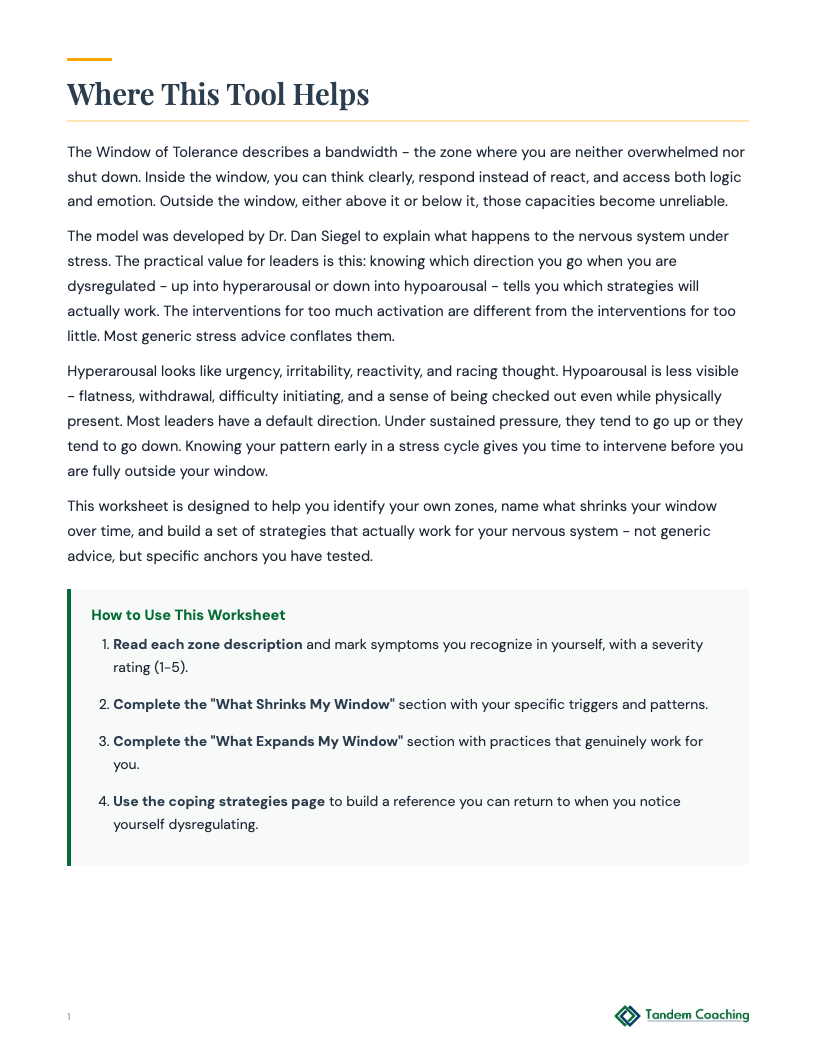
A client goes reactive under pressure and wants to understand their nervous system better
Someone identifying whether they tend to go up into hyperarousal or down into shutdown
Building a personal regulation toolkit matched to their specific direction of dysregulation
How to Introduce This Tool Plus
When stress pushes you outside your window — do you tend to go up, into urgency and reactivity, or down, into flatness and withdrawal? What does each direction cost you?
Coaching Tool Disclaimer
This tool is designed for coaching contexts, not clinical use. If you or your client is in crisis, contact the 988 Suicide and Crisis Lifeline (call or text 988) or Crisis Text Line (text HOME to 741741).
Browse All Pages
Tool Classification
Domain
Wellness
Type
Worksheet
Phase
Discovery
Action
Details
30 min
Mid session
Topics
Resilience
Emotions
Self-Care
For the Coaching Practitioner
Plus
Coaching Scenarios
Plus
1 Leader who reads all stress as a performance signal and cannot distinguish zones ▶
Context
A COO interprets every activated state as useful energy and every low-energy state as a productivity problem. He has no framework for distinguishing between arousal that is functional and arousal that has exceeded his capacity. His team describes him as unpredictable — sometimes incisive, sometimes explosive, with no visible pattern from the outside.
How to Introduce
Lead with the three-zone model before asking him to map his own experience. 'The model describes three states: a functional zone where you can think, communicate, and make decisions effectively; a too-activated zone where the system is running faster than it can process; and a too-little zone where activation has dropped below what's needed. Most high performers spend significant time in all three without a vocabulary for which one they're in.' Some clients in this profile resist the model because any zone below optimal feels like failure. Hold the framing as descriptive, not evaluative.
What to Watch For
Watch how he describes the hyperarousal zone. Clients who run hot tend to populate the hyperarousal section with symptoms they observe in others ('rage,' 'impulsivity') while minimizing their own entries or using softer language ('energized,' 'direct'). If his self-report and his team's 360 feedback are in different zones, the gap is the coaching question. Ask him to fill out the hyperarousal section twice: once from his own perspective, once from his team's likely perspective.
Debrief
After he has populated his personal symptom profile, start with the window itself: 'When you're in the window — what does that actually feel like? What's present that isn't present when you're outside it?' That question surfaces what he's aiming for, not just what he wants to avoid. Then move to the regulation strategies: 'Of the strategies listed for the hyperarousal zone, which ones have you actually used? Which ones would you actually reach for at 7pm before a board call?'
Flags
If the hyperarousal symptom list he generates matches descriptions his team has given but he does not recognize them as his own, the model has surfaced a significant blind spot. Severity: low. This is not a clinical concern — it is an accurate self-awareness finding. Use it directly: 'What would it take for you to recognize when you're in this zone in real time, rather than in retrospect?'
2 Director in burnout recovery who has been operating in hypoarousal for months ▶
Context
A director returned from a three-month leave six weeks ago. She describes herself as 'back but not really back' — she shows up, completes tasks, participates in meetings, but feels disconnected from her work and from the people around her. She is concerned that the leave didn't work, or that something is wrong that rest alone won't fix.
How to Introduce
Introduce the hypoarousal zone explicitly before asking her to map her experience. 'The low zone — what the model calls hypoarousal — isn't just tiredness. It describes a state where the system has downregulated below functional: numbness, disconnection, difficulty caring about things you know you care about, brain fog that isn't explained by sleep. Some clients experience this after extended periods of high stress or after a significant recovery event like the leave you took.' Check whether she recognizes herself in the description before assigning the worksheet.
What to Watch For
Watch which zone she populates most readily. If the hypoarousal section is detailed and specific — if she can name four or five of the listed symptoms as currently present — and the hyperarousal section is sparse, her system has shifted since the pre-leave period. The symptom frequency ratings in the hypoarousal zone are diagnostically useful: consistent 'often' or 'almost always' ratings on numbness, disconnection, and shutdown warrant a direct conversation about what kind of support is available to her.
Debrief
Start by reading back what she wrote in the hypoarousal section and asking: 'Is this what the leave felt like, or is this what now feels like?' That distinction clarifies whether she is still in recovery, or whether recovery has stalled. Then ask about the window: 'When do you feel most like yourself — closest to the middle zone? Even briefly, even on a good hour of a good day?' Finding the window's location is more useful than mapping the zones she's not in.
Flags
If she cannot identify any time in the past two weeks where she felt in the window — if hypoarousal symptoms are constant rather than episodic — the coaching container is insufficient as the primary support. Severity: moderate. She has professional support in place; this finding should go directly to her therapist or physician. Your role is to name it: 'What you've described here is something worth bringing to your therapist this week. Have you shared this with them?'
3 Client who oscillates rapidly between hyperarousal and hypoarousal within single meetings ▶
Context
A senior manager describes a pattern she finds disorienting: she goes into meetings activated and ready, hits a moment of conflict or criticism, spikes into intensity, and then — within minutes — goes flat and checked out. She describes the crash as worse than the spike. She has started avoiding certain meetings because she cannot predict which version of herself will show up.
How to Introduce
Introduce the window model as an explanation for the crash, not just the spike. 'The pattern you're describing — high intensity followed quickly by a collapse — is a known nervous system pattern. The system spikes beyond capacity, can't sustain it, and shuts down to regulate. The crash isn't failure; it's the system protecting itself. What the worksheet helps you do is identify your early signals for each zone, so you can intervene before the spike rather than managing the crash afterward.' Some clients find this framing immediately orienting; it explains something they've experienced without being able to name.
What to Watch For
Watch whether she can populate the early signal column for both zones — what precedes the spike and what precedes the crash. Clients who oscillate rapidly often have very short windows between signal and transition, but the signals are usually there if she looks for them. If the early signal column is blank for either zone, that's where the work begins: building awareness of the leading edge of the transition before it happens, not recognition of the zone she's already in.
Debrief
After the symptom profiles are complete, ask about the crash specifically: 'When you go flat in a meeting — what does that feel like from the inside? And what do you think the other people in the room see?' That question surfaces both the subjective experience and the interpersonal impact, which are usually different. Then ask which zone she finds easier to interrupt — the spike or the crash — and work from there toward the most accessible regulation strategy.
Flags
If the oscillation pattern is frequent (multiple times per week) and has been going on for more than three months, the coaching work on regulation strategies is appropriate but may need to be paralleled by professional support. Severity: low to moderate. This is not a crisis, but rapid dysregulation cycling that has become habitual often has roots a coaching conversation alone won't reach. Ask whether she has any support beyond coaching, and if not, whether she would consider it.
4 Coach introducing the model to a client as a shared language for ongoing work ▶
Context
A client and coach are three months into a working relationship focused on leadership effectiveness under pressure. The coach has observed that the client's in-session affect varies considerably — some sessions he is sharp and engaged, others he is flat or slightly reactive. The coach wants to establish a shared vocabulary for those states without framing them clinically.
How to Introduce
Introduce this as a working model, not a clinical framework. 'I want to share a model with you that I've found useful for describing the range of states you bring into sessions — and probably into your work. It's not a diagnosis; it's more like a shared vocabulary for something you're already navigating.' Walk through the three zones together rather than assigning the worksheet independently. Some clients engage more readily with a model they explore in session with the coach than with one they complete alone first.
What to Watch For
Watch how he describes his own window of tolerance — specifically, how wide he believes it to be. Clients who are high-functioning often estimate their window as wider than it actually is because they have developed strong compensation strategies. If his description of the window closely matches his description of peak performance ('everything working, sharp, resourced'), his window may be narrower than he thinks. The compensation strategies he uses outside the window are worth surfacing as evidence.
Debrief
After he has mapped all three zones, use the model as a check-in at the start of subsequent sessions. 'On the model we worked with — where are you today?' That two-sentence check-in creates a longitudinal record of his entry state and often surfaces patterns: which contexts reliably move him toward the edges, which factors (sleep, recent conflict, preparation) keep him centered. The model's coaching value is cumulative, not one-time.
Flags
If he resists populating the hypoarousal zone and insists he never experiences low activation — that the only direction his system moves is up — the low zone may be less visible to him than the high zone, or it may carry more stigma. Severity: low. This is worth a direct question: 'When you're depleted — really depleted, not just tired — what does that state feel like? Most people have some version of the low zone even if they don't call it that.' The vocabulary, not the experience, is usually the barrier.
Tool Flow
Plus
Requires
- None - standalone tool
→
Produces
- personal hyperarousal and hypoarousal symptom profile
- identified default dysregulation direction under stress
- window-shrinking trigger list with personal specifics
- matched regulation strategy card for each zone
Pairs Well With
ADHD
Feeling Context and Support Notes
Use this framework to structure a conversation about emotions and mindset while keeping interpretation with the client.
Why it pairsOnce you've mapped a client's hyperarousal or shutdown profile, this links each zone to a concrete regulation move.
WellnessStress Management Plan
A client overwhelmed and needing a systematic way to understand and manage their stress
Why it pairsUse the worksheet's trigger list and symptom profile as the input here to build a tiered, personalized stress response.
WellnessDBT Distress Tolerance: TIPP Skills
A client gets flooded by intense emotion and needs physiological tools to come down quickly
Why it pairsKnowing a client's default dysregulation direction lets you focus TIPP practice on the skills that match their arousal pattern.
This tool is part of a coaching pathway
Step 1 of 6 in A client goes reactive under pressure and wants to understand their nervous system better
Continue with Emotional Regulation Toolkit if that next job fits.
Next: Emotional Regulation Toolkit → Explore all pathways →Related Articles

What a Personal Executive Coach Actually Does for Your Leadership
Read article →Coaching Models Compared: When Each One Works (and Fails)
Read article →
Unlock Your Agile Coaching Potential: Transform Your Passion into Profit
Read article →
When Executive Coaching Does Not Work
Read article →