

Stress Management Plan
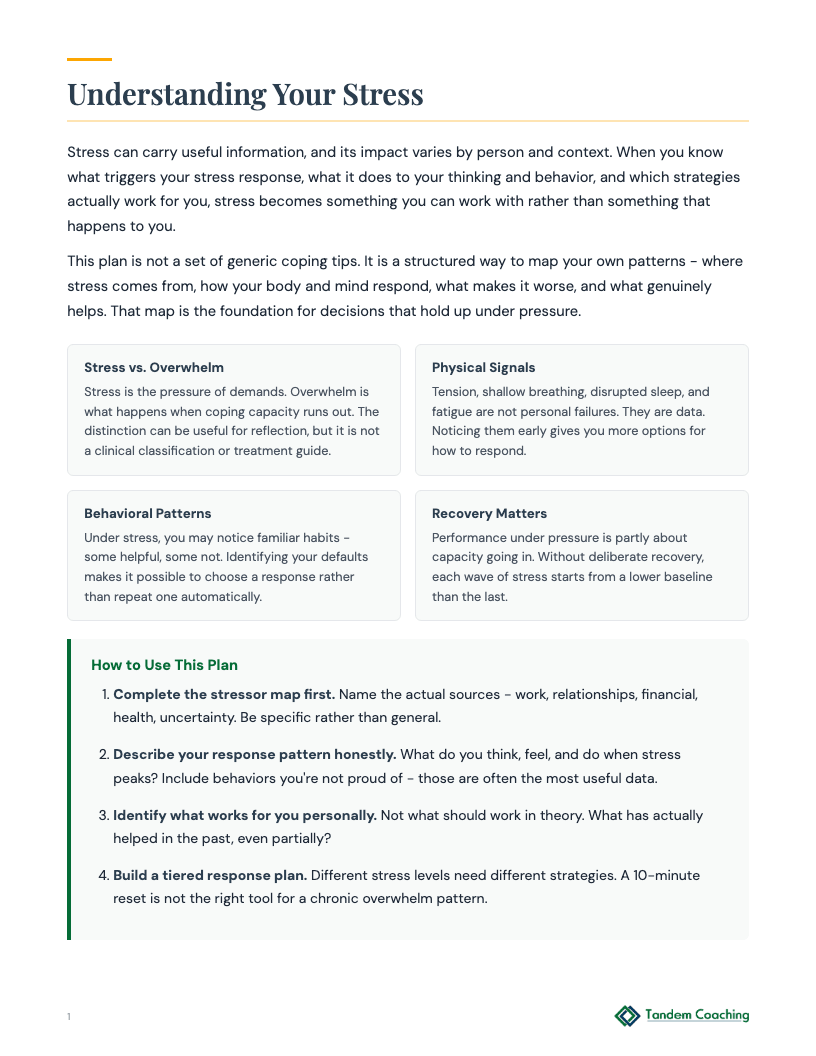
A step-by-step plan to identify stress triggers and build practical coping routines, grounded in evidence-based wellness techniques.
Get This Tool
Free, print-ready PDF.
When to Use This Tool
A client overwhelmed and needing a systematic way to understand and manage their stress
Mapping stressors alongside existing coping patterns before building a response plan
Creating a tiered stress response they can actually use when it gets hard
How to Introduce This Tool Plus
When stress peaks for you, what does that actually look like — and do you have a go-to way of responding, or does it tend to catch you off guard?
Coaching Tool Disclaimer
This tool is designed for coaching contexts, not clinical use. If you or your client is in crisis, contact the 988 Suicide and Crisis Lifeline (call or text 988) or Crisis Text Line (text HOME to 741741).
Browse All Pages
Tool Classification
Domain
Wellness
Type
Planner
Phase
Discovery
Action
Details
30 min
Mid session
As-needed
Topics
Resilience
Self-Care
Emotions
For the Coaching Practitioner
Plus
Coaching Scenarios
Plus
1 Senior leader in a sustained high-demand period with no recovery built in ▶
Context
A VP or director has been in a high-intensity work period - integration, restructuring, product launch - for 6-12 months. The intensity was originally time-bounded but has extended. They are functional but noticeably less sharp, less patient with their team, and describe their default state as 'just getting through the day.'
How to Introduce
The resistance here is typically the belief that recovery is a luxury the current situation doesn't allow. Position the tool as a performance optimization exercise, not a self-care one: 'Leaders who don't manage their recovery become the bottleneck. Let's look at what your current stress pattern is doing to your output.' The stressor mapping section should start with professional stressors but include personal ones - the plan only works if it's honest about the full picture.
What to Watch For
The default stress behavior section is the most diagnostic. If the client's unhelpful coping patterns include things that are also professional behaviors - working longer, communicating more aggressively, withdrawing from their team, micromanaging - those behaviors are creating downstream costs that the client may not be tracking. Also watch whether the tiered recovery strategy (immediate, same-day, weekly) gets filled in with actions the client would actually do, or aspirational ones they've never managed to execute.
Debrief
Start with the physical and emotional signal list: ask the client when those signals first appeared in the current period and whether they got there gradually or suddenly. The answer tells you whether this is an acute response to a specific period or a longer pattern of stress accumulation. Then focus on the immediate tier of the recovery strategy - what can be done within a working day without rearranging anything structural. That tier is what gets used; the weekly tier often doesn't.
Flags
If the physical signals described include sleep disruption, appetite changes, or somatic complaints that have persisted for months - or if the client mentions that colleagues or family have commented on visible changes in them - the pattern may have moved beyond performance coaching territory. Severity: high. Name what you're hearing specifically and explore whether a medical check-in is warranted alongside the coaching work. Do not treat persistent physical symptoms as purely a performance or mindset issue.
2 Professional whose stress is primarily generated by one major relationship or structural situation ▶
Context
A client's stress map is not diffuse but concentrated - one specific relationship (a manager, a client, a co-founder), one structural situation (a toxic team dynamic, an impossible deadline structure, a reporting relationship that doesn't work), or one life circumstance is generating the majority of the load. They describe managing the stress rather than addressing the source.
How to Introduce
This scenario requires a direct observation early in the tool use: 'Before we build a management plan, let's map where the stress is coming from - because the right response to one major source is different from the right response to many small ones.' The stressor list will reveal the concentration quickly. Position the tool as a way to see the pattern clearly before deciding whether the right response is management, adaptation, or change.
What to Watch For
If the same stressor appears repeatedly under different labels - 'my manager's expectations,' 'the way feedback is given,' 'the unpredictability of my role' are all the same thing - the client may be underreporting the intensity of one specific source. Watch whether the unhelpful coping patterns are specifically triggered by the concentrated stressor rather than by stress in general. If they are, the management plan addresses symptoms while the source continues.
Debrief
Start with the stressor concentration question: 'If this one thing were different, how much of your current stress would remain?' That question separates management-worthy diffuse stress from change-requiring concentrated stress. If the answer is 'most of it would go away,' the coaching conversation should turn toward what it would take to change or exit the source, not just manage around it. The recovery strategy is still worth completing, but frame it as capacity-building for a decision period, not a long-term solution.
Flags
If the concentrated stressor involves behavior from another person that would be categorized as hostile - sustained pressure, targeted criticism, or exclusion - and the client has adapted their behavior to manage that person's reactions rather than addressing the behavior directly, the stress management frame may be normalizing something that shouldn't be normalized. Severity: moderate. Name the distinction between managing stress and accommodating mistreatment.
3 Professional transitioning back to high-demand work after a health-related leave ▶
Context
A client is returning to work after a period of leave related to burnout, a health event, or mental health support. They are cleared to return and want to do so sustainably, but don't have a clear model for what a sustainable stress level looks like or what signals should prompt them to adjust.
How to Introduce
The primary value of the tool in this scenario is the signal identification section - building a personal early warning system. 'The goal here isn't to avoid stress - that's not possible. The goal is to know what your specific signals look like before they become serious, so you can respond earlier.' The stressor mapping and coping pattern sections will be useful but secondary to building the signal vocabulary and tiered response.
What to Watch For
Watch whether the stressor list includes the return itself as a stressor - the uncertainty, the changed relationships, the adjustment to being back - or whether it's entirely focused on the content of the work. The transition is generating its own load that the client may be minimizing. Also watch whether the unhelpful coping patterns include behaviors that contributed to the original leave. If those appear in the list, they need explicit attention, not just inclusion as data.
Debrief
Start with the signal list: ask the client to rank which signals appeared first, in what sequence, before the previous leave. That sequencing is the early warning system. The first signal in the sequence is the most important one to track going forward because it's the most recoverable moment. Then build the immediate recovery tier around what is specifically feasible during a work day, given whatever constraints exist from the health event or recovery period.
Flags
If the client is returning from burnout and their described immediate recovery strategies are largely cognitive - 'remind myself of my priorities,' 'think about what matters' - rather than physiological, relational, or behavioral, the plan may not address the kind of recovery the body and nervous system need after sustained burnout. Severity: moderate. Ask specifically about physical rest, not just mental reframing. This is not therapy boundary territory; it's practical physiology.
Tool Flow
Plus
Requires
- None - standalone tool
→
Produces
- named primary stressor list with physical and emotional signals
- default stress behavior profile including unhelpful patterns
- tiered recovery strategy plan (immediate, same-day, weekly)
Pairs Well With
ADHD
Feeling Context and Support Notes
Use this framework to structure a conversation about emotions and mindset while keeping interpretation with the client.
Why it pairsOnce the client has named their stressors and recovery tiers, this gives them a real-time framework for matching their current emotional state to a specific action when stress hits.
WellnessSupport and Response Options Map
Use this worksheet to explore resilience and emotions and turn the client’s observations into one optional next step.
Why it pairsThe stressor list and unhelpful behavior profile from the plan give you exactly the named emotional states this worksheet needs to build a personalized, state-matched coping menu.
WellnessPressure Response Reflection Toolkit
A client wants to use Pressure Response Reflection Toolkit as an optional reflection
Why it pairsUse this after the plan to sharpen the client's stress signature with a week of live trigger tracking and a grounding shortlist they can test against their recovery strategies.
Related Articles


Building Resilience Amid Change: The Power of Coaching
Read article →
Why AI Adoption Feels Like Losing Even When You Are Winning
Read article →
Do You Have to Tell Clients You Use AI? Standard 2.5 in Practice
Read article →
CEO Coaching: What Happens When the Person at the Top Gets a Coach
Read article →