A fast, ADHD-friendly worksheet to slow intense negative thoughts that feel true, and reframe them with evidence-based CBT steps.
Free, print-ready PDF.
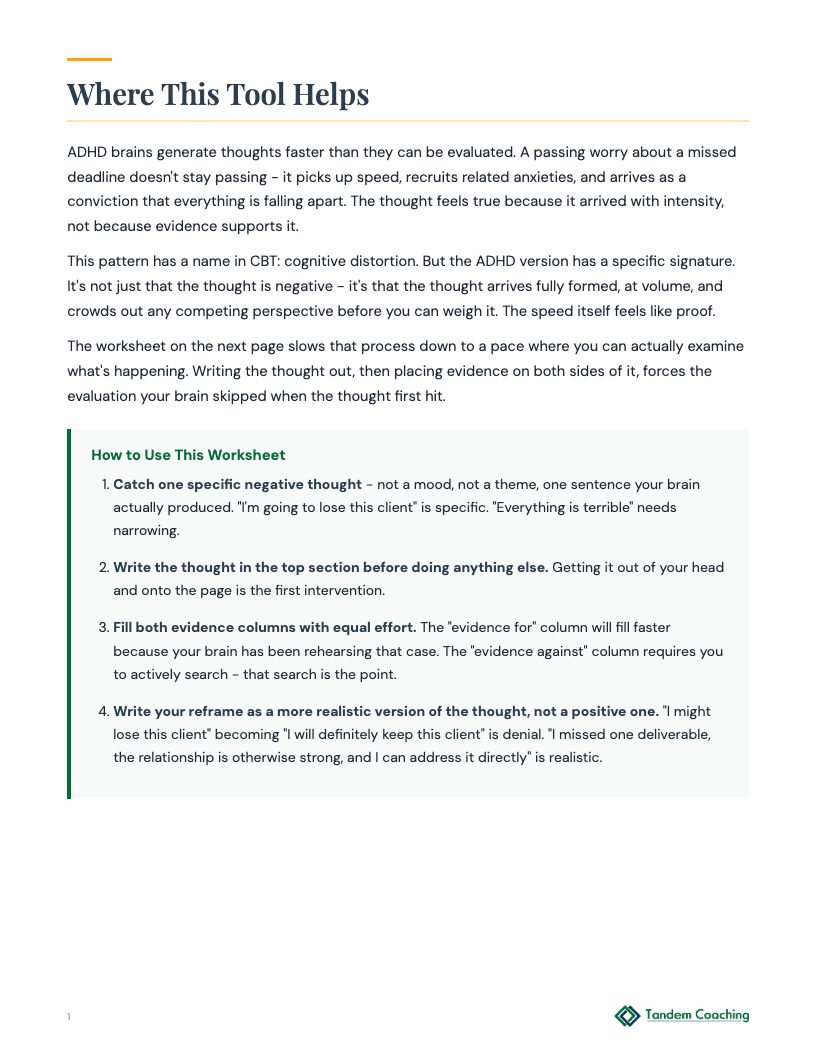
When a thought arrives at speed and volume, the speed feels like proof. This worksheet slows it down - captures the thought, weighs the evidence on both sides, and asks for a more realistic version rather than a positive one.
A client with ADHD who is a creative director received critical feedback from a client in a large review meeting. By the time she left the meeting, she had concluded that her agency is about to lose the account, that her team has lost confidence in her, and that she is not the right person to lead the account. She arrived at the next coaching session having held these conclusions for four days. She is not aware she moved from one piece of feedback to a series of sweeping verdicts. The worksheet is the tool that makes the sequence visible.
Name the ADHD mechanism before assigning the worksheet: 'Your brain moved very fast from the feedback to the conclusion. That speed is an ADHD signature - thoughts arrive fully formed and with enough intensity that they feel like accurate assessments. The worksheet doesn't ask you to think positively. It asks you to slow the sequence down and check the evidence you actually have versus the evidence your brain invented.' Assign it with one specific constraint: the negative thought she writes in the top section must be a single sentence that captures exactly what her brain concluded, not a general feeling.
Watch for the client filling the 'evidence for' column with the feedback and the 'evidence against' column with hopeful-sounding counter-arguments that she doesn't actually believe. The evidence against column should contain facts, not reassurances. Ask: 'Look at what you wrote in the right column. Are those things you believe, or things you wrote because you thought you should?' Real evidence against a thought is observable and specific - the account has been active for three years, the client approved the last four campaigns, there was no follow-up termination email. Also watch for the reframe drifting toward positive spin: the reframe is realistic, not optimistic.
Read the negative thought aloud and then read the reframe aloud: 'Which one is closer to what the available evidence actually supports?' That comparison - the original thought versus the evidence-based reframe - is the coaching moment. Then ask the post-tool prompt: 'Which piece of evidence against the thought would you be able to recall in the moment next time, without the worksheet?' Building one fact-based counter into accessible memory gives the client something to use before the next worksheet can be completed.
Array
A client with ADHD who is an operations manager knows from previous coaching that his negative thought spirals are cognitive distortions - he has the language, he understands the mechanism, and he agrees with the concept. The problem is implementation: by the time he remembers to do the worksheet, the thought has shifted and he is no longer emotionally connected to it. The coaching focus is not on understanding the tool but on closing the gap between when the thought arrives and when the worksheet gets completed.
Frame the timing challenge as an executive function problem, not a motivation problem: 'You already understand the tool. The issue is prospective memory - remembering to use it at the moment when it's most useful. The thought arrives at 2pm in a meeting; the worksheet is supposed to happen in the evening; by 6pm the emotional urgency has passed. We need to collapse that gap.' The solution is a physical worksheet kept somewhere accessible during the workday, so the first field can be filled in while the thought is still live, even if the rest is completed later. A phone note with the single sentence is enough to anchor the thought before it transforms.
Watch for the client doing a mental version of the worksheet and reporting that he 'already worked through it' without writing anything down. The writing is not incidental to the process - it forces a level of specificity that internal processing skips. The evidence columns require words, which require precision, which is where the distortion becomes visible. If he is doing it mentally, the 'evidence against' side is likely being generated and dismissed too quickly to examine. Also watch for him using the worksheet on low-stakes irritations rather than the high-intensity thoughts that are actually affecting his work.
Focus the session on the timing log: 'When did the thought arrive? When did you write it down? How much time between?' The gap is the data. Then ask: 'What was different about the times you caught it quickly versus the times it escaped?' The context differences usually reveal either a physical access barrier (no paper available) or a social one (he was in a meeting and couldn't write). Building a phone-based capture habit for those specific contexts solves more than any additional instruction about the worksheet itself.
Array
A client with ADHD who is a director of strategy has been telling himself for two years that he is 'bad at numbers' after a series of errors in financial presentations. The belief has become a fixed identity statement that he volunteers in meetings: 'I'm not a numbers person.' He avoids any task that involves quantitative analysis, delegates all financial work regardless of whether delegation is appropriate, and declines to develop in an area his role requires. The belief has never been tested - it is accepted as fact because it arrived after specific failures. The worksheet creates the first evidence-based examination of whether the belief is actually true.
Name that this worksheet targets a belief rather than a reaction: 'Most people use this for in-the-moment thought spirals. We're going to use it for a belief you've been carrying for two years without examining. The process is the same - write the belief as a specific statement, fill both evidence columns with real data - but the timeline is longer. Your evidence for will probably be two or three financial errors. Your evidence against is going to require you to look at the full body of work, not just the failures.' Assign it between sessions and ask him to bring the specific incidents that formed the belief.
Watch for the client conflating 'I made errors in financial presentations' with 'I am bad at numbers' - the leap from behavioral evidence to identity conclusion is the distortion to examine. In the evidence against column, watch for him leaving blanks rather than actively searching. Ask: 'In the past two years, have you worked with any quantitative information accurately? Any data analysis, any metric reporting, any forecasting?' He may not count those because the 'bad at numbers' identity filters them out as exceptions. The filtering itself is the data. Also watch for the reframe landing as 'I am good at numbers' - the realistic reframe is more specific: what conditions produce errors and which don't.
After reviewing both columns: 'If a colleague came to you with this same evidence and asked whether they were bad at numbers, what would you conclude?' The distancing question often surfaces a more accurate reading than first-person review. Then ask: 'What is the cost of the current belief to your work?' A two-year avoidance pattern in a strategy role has measurable costs. Making those costs concrete - specific opportunities declined, specific delegation decisions that created problems - connects the worksheet work to a business case for changing the belief.
Array
A client is unsure whether what they're experiencing is ADHD, depression, or both
LifeClient has strong self-knowledge but struggles to act on what they know
ADHDA client's emotional reactions feel valid but may be based on interpretation rather than fact