
Check the Facts Worksheet
Separate facts from assumptions when ADHD emotions run high, using a CBT/DBT-based worksheet to reduce misinterpretation-driven stress.
Get This Tool
Free, print-ready PDF.
When to Use This Tool
A client's emotional reactions feel valid but may be based on interpretation rather than fact
A client wants a structured way to test whether their emotional response fits the actual situation
A client is working on differentiating between facts and the story they're telling about those facts
How to Introduce This Tool Plus
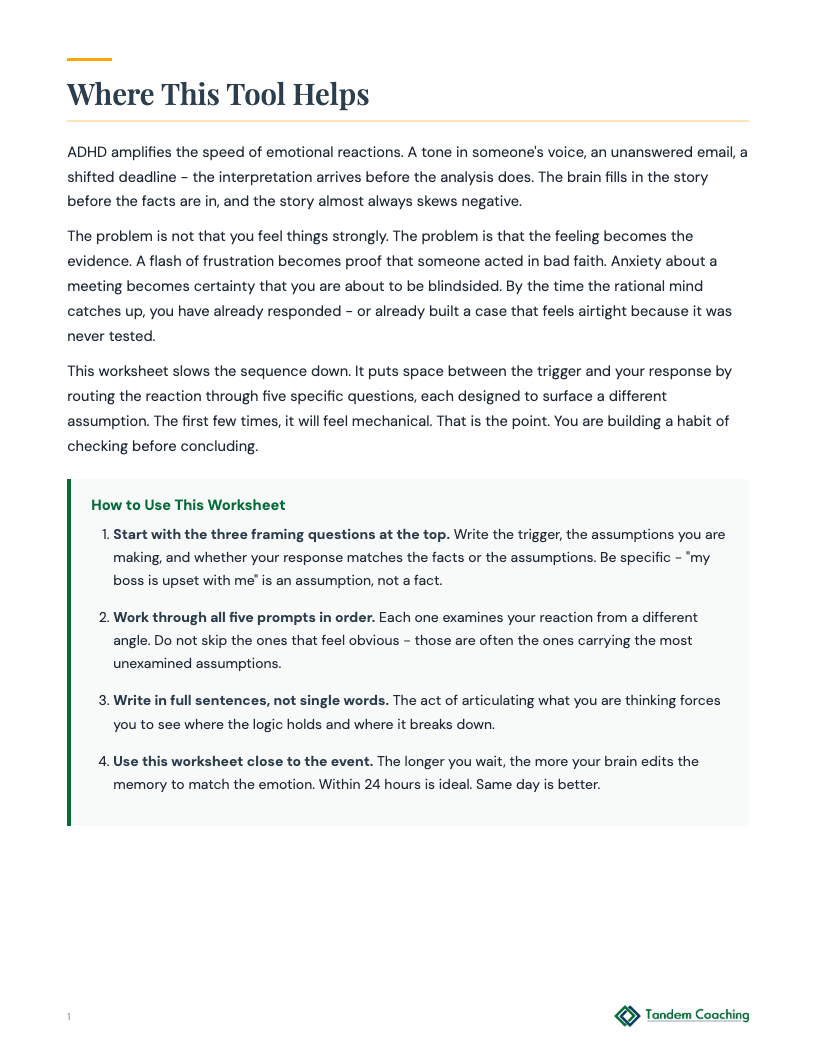
When a strong emotion feels completely justified, it's worth asking whether it's responding to what happened or to the interpretation of what happened. This DBT-based worksheet examines that distinction.
Coaching Tool Disclaimer
This tool is designed for coaching contexts, not clinical use. If you or your client is in crisis, contact the 988 Suicide and Crisis Lifeline (call or text 988) or Crisis Text Line (text HOME to 741741).
Browse All Pages
Tool Classification
Domain
ADHD
Type
Worksheet
Phase
Action
Reflection
Details
15 min
Between sessions
As-needed
Topics
Emotions
Mindset
Identity
For the Coaching Practitioner
Plus
Coaching Scenarios
Plus
1 Marketing director convinced team is undermining her after reorganization ▶
Context
A marketing director with ADHD recently survived a reorganization that eliminated her peer's role. She's interpreting delayed responses to emails and closed-door conversations as evidence her team is plotting her removal. Seeking coaching for 'political navigation' but the pattern extends beyond work.
How to Introduce
Frame this as a reality-testing tool, not emotional regulation. 'Before we strategize your team relationships, let's separate the data from the story you're building around it.' ADHD brains fill gaps with threat-based narratives faster than facts arrive. Name this: 'Your brain is doing what ADHD brains do - connecting dots that may not connect.'
What to Watch For
The framing questions reveal whether she distinguishes between events and interpretations. If 'team is undermining me' appears as the trigger rather than 'Sarah closed her door during my presentation,' she's working from conclusions, not facts. Prompt 4 will be hardest - ADHD rejection sensitivity makes alternative explanations feel like denial.
Debrief
Start with Prompt 1 evidence column. If it's thin or speculative, that's the conversation. 'You wrote three assumptions and one fact. What does that tell you?' Then move to Prompt 2 patterns. The question that opens this up: 'When else have you been certain someone was working against you?'
Flags
If she cannot generate any alternative explanations in Prompt 4, or if the 'evidence' in Prompt 1 consists entirely of emotional reasoning ('I could tell by her tone'), the rejection sensitivity may be severe enough to distort perception. Severity: moderate. Continue coaching but assess whether ADHD medication or therapy support is needed.
2 Senior engineer assumes project cancellation means performance failure ▶
Context
A senior engineer learned his six-month project was cancelled due to budget cuts. Despite clear communication about company-wide cost reductions, he's convinced the cancellation reflects poor performance and is catastrophizing about job security. His manager suggested coaching after he became withdrawn and defensive.
How to Introduce
Present as a diagnostic tool for decision-making under uncertainty. 'Before you update your resume or change how you show up at work, let's test whether your read of the situation matches the available data.' Don't frame as emotional work - engineers resist that. Frame as debugging faulty logic.
What to Watch For
Engineers often skip the framing questions or answer them technically rather than personally. If he writes 'project cancelled' as the trigger but can't name his assumptions, he's not engaging with the tool's purpose. Watch for binary thinking in Prompt 4 - either he's failing or succeeding, no middle ground.
Debrief
Start with the proportionality question from the framing section. Engineers respond to calibration language. 'You rated this as assumption-based. Walk me through that.' Then focus on Prompt 3 - the outside perspective. Ask: 'If your colleague's project got cancelled for budget reasons, what would you think about their performance?'
Flags
If he cannot separate the project outcome from his personal worth, or if Prompt 5 reveals he's considering dramatic actions (resignation, confronting leadership), the catastrophizing may indicate anxiety beyond normal career concerns. Severity: low to moderate. Continue coaching but monitor for signs of clinical anxiety that would benefit from therapeutic support.
3 Operations manager interpreting CEO's feedback as criticism of leadership capability ▶
Context
An operations manager received feedback from the CEO about process improvements needed in her department. She's interpreting this as evidence she's failing as a leader and is now second-guessing every decision. The feedback was delivered in a brief hallway conversation, which amplified her uncertainty about the CEO's intent.
How to Introduce
Frame as a calibration check between impact and intent. 'Before you change your entire leadership approach, let's examine what was actually said versus what you heard.' The hallway context matters - brief interactions leave room for interpretation that longer conversations would clarify. Use this as a case study in incomplete data.
What to Watch For
The initial assumptions question will reveal whether she's catastrophizing. Look for language like 'he thinks I'm incompetent' versus 'he wants process changes.' If she completes Prompt 1 quickly with minimal evidence, she's working from emotional conviction rather than data analysis. Prompt 3 will show whether she can access perspective outside her own anxiety.
Debrief
Start with what she wrote for the trigger versus her assumptions. The gap between 'CEO mentioned process improvements' and 'CEO questions my leadership' is the coaching conversation. Ask: 'If you wanted process improvements in someone's department, how would you bring it up?' This connects her experience as a manager to her reaction as a report.
Flags
If she cannot distinguish between feedback about processes and feedback about her capability, or if she's considering avoiding the CEO or making defensive changes to prove her worth, the reaction may indicate deeper imposter syndrome or anxiety about authority relationships. Severity: low. Continue coaching but explore the pattern of interpreting operational feedback as personal criticism.
4 Project manager certain client is dissatisfied based on delayed email responses ▶
Context
A project manager with ADHD noticed her primary client contact has been slower to respond to emails over the past week. She's interpreting this as client dissatisfaction and is considering preemptive damage control conversations. The client relationship has been strong, but her ADHD makes her hypersensitive to changes in communication patterns.
How to Introduce
Present as a pattern-recognition tool for client relationships. 'Before you have a conversation that might create a problem that doesn't exist, let's test what the data actually shows.' ADHD brains are excellent at detecting changes but poor at interpreting what changes mean. Name this strength and limitation upfront.
What to Watch For
She'll likely complete the framing questions quickly because the trigger feels obvious to her. The real work happens in Prompt 1 - if her 'evidence' consists of response time changes without other indicators, she's pattern-matching from anxiety. Prompt 4 will be crucial - ADHD rejection sensitivity makes neutral explanations feel like wishful thinking.
Debrief
Start with Prompt 2 about patterns. 'You wrote that you've been here before with other clients. What happened in those situations?' This moves from the current client to her relationship with uncertainty. Then ask: 'What would need to be true for this to be about the client's schedule rather than their satisfaction?'
Flags
If she cannot generate plausible alternative explanations for delayed responses, or if she's planning to address 'client dissatisfaction' that exists only in her interpretation, the ADHD rejection sensitivity may be creating relationship problems through preemptive defensive actions. Severity: moderate. Continue coaching but consider whether ADHD-specific therapy would help with rejection sensitivity patterns.
Tool Flow
Plus
Requires
- recent strong emotional reaction with named situation
→
Produces
- separated trigger-vs-assumption record
- multi-angle fact-check across five prompts
- assessed emotional proportionality rating
Pairs Well With
ADHD
ADHD vs Depression Comparison
A client wants to organize focus and mood observations before speaking with a licensed clinician
Why it pairsWhen fact-checking consistently surfaces distorted emotional reads across situations, use this to explore whether ADHD or depression is driving the pattern.
LifeConfidence Evidence and Learning Notes
Use this worksheet to explore identity and mindset and turn the client’s observations into one optional next step.
Why it pairsAfter fact-checking builds awareness of a distorted reaction, this scale shows whether the client can translate that insight into confident action.
WellnessEvent, Interpretation, and Options Log
Use this worksheet to explore mindset and emotions and turn the client’s observations into one optional next step.
Why it pairsWhen fact-checking reveals the distortion is self-critical rather than situational, this worksheet continues the evidence-examination work specifically targeting shame.
This tool is part of a coaching pathway
Step 5 of 6 in A client acts on digital impulses before they've had a chance to notice and choose
Use after Urge Surfing Practice Sheet. Then continue with Opposite Actions Worksheet if that next job fits.
Next: Opposite Actions Worksheet → Explore all pathways →Related Articles


Executive Function Strategies for ADHD Leaders: Working Memory, Impulse Control & Flexibility
Read article →
ADHD and People-Pleasing: Why I Say Yes When I Should Say No
Read article →
Do You Have to Tell Clients You Use AI? Standard 2.5 in Practice
Read article →
Coaching - It’s more than just asking questions
Read article →