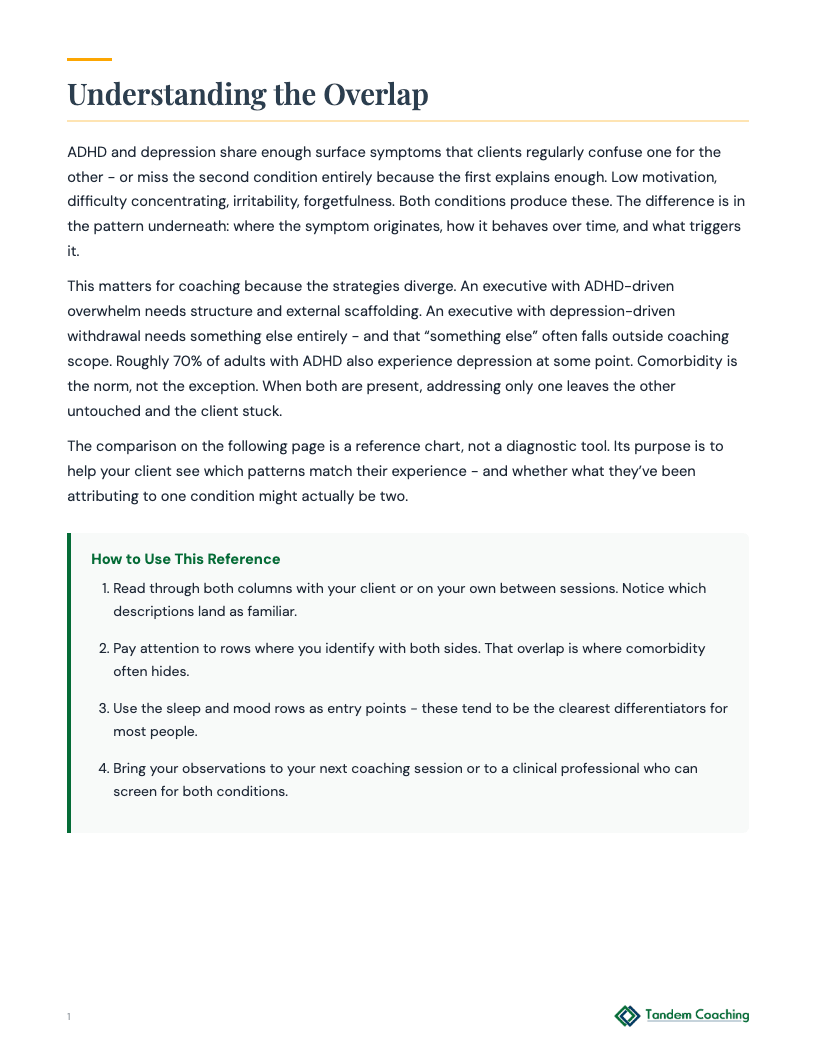
ADHD vs Depression Comparison
Organize focus and mood observations for a clinician without using a coaching worksheet to diagnose a condition.
Get This Tool
Free, print-ready PDF.
When to Use This Tool
A client wants to organize focus and mood observations before speaking with a licensed clinician
A client needs a non-diagnostic prompt for noticing when concentration, motivation, sleep, or mood changed
A client wants clearer questions for a clinician without asking a coach to identify a condition
How to Introduce This Tool Plus
This coaching guide cannot tell us whether ADHD or depression is present. Which patterns or changes would you like to describe to a licensed clinician?
Coaching Tool Disclaimer
This tool is designed for coaching contexts, not clinical use. If you or your client is in crisis, contact the 988 Suicide and Crisis Lifeline (call or text 988) or Crisis Text Line (text HOME to 741741).
Browse All Pages
Tool Classification
Domain
ADHD
Type
Framework
Phase
Discovery
Reflection
Details
15 min
Between sessions
Topics
Identity
Mindset
Emotions
For the Coaching Practitioner
Plus
Coaching Scenarios
Plus
1 Marketing director wants to organize sustained focus and mood changes before seeking clinical guidance ▶
Context
A marketing director has experienced missed deadlines, scattered focus, sleep changes, and reduced motivation for six months. She wants coaching help with work structure and a clearer way to describe the broader pattern to a licensed clinician.
How to Introduce
Set the boundary first: 'This chart cannot tell us what condition is present. We can use it to notice timing, context, and changes, then turn those observations into questions for a clinician.'
What to Watch For
Do not interpret column matches as evidence of ADHD, depression, or comorbidity. Watch for changes in daily functioning, persistent low mood, loss of interest, or safety concerns that should pause coaching and move to the appropriate clinical or crisis channel.
Debrief
Ask: 'Which descriptions are observations you can support with examples, and which are interpretations?' Finish with: 'What exact changes, dates, and questions will you take to a licensed clinician?'
Flags
This is non-diagnostic coaching preparation. Severity: moderate if functioning has materially changed. Response: keep coaching limited to agreed work strategies and encourage clinical evaluation. For immediate danger or crisis, use emergency or crisis services.
2 Operations manager in depression treatment wants to separate workplace coaching questions from clinical questions ▶
Context
An operations manager's mood improved during treatment, while project planning and follow-through remain difficult. His therapist suggested coaching for workplace skills, and he wants to prepare a clear update for his existing provider.
How to Introduce
Say: 'We are not revising your diagnosis or treatment. We can record which work patterns remain, when they began, and what support changes them so you can discuss that evidence with your provider.'
What to Watch For
Do not treat treatment response or persistent work difficulty as proof of a second condition. Avoid contradicting the existing care plan or interpreting the chart clinically.
Debrief
Separate two lists: workplace strategies appropriate for coaching and clinical questions for the provider. Confirm which list each next action belongs to.
Flags
Clinical identification and treatment remain with the licensed provider. Severity: low to moderate. Response: continue bounded workplace coaching only while encouraging the client to discuss unresolved symptoms with that provider.
3 Senior consultant wants to map why client work and administrative work feel different ▶
Context
A senior consultant performs strongly in client work but struggles with timesheets, expenses, and internal meetings. She wonders whether mood or attention may be relevant but has no clinical assessment.
How to Introduce
Frame the exercise as context mapping: 'Let's document which tasks are easier or harder, what conditions change that, and whether the pattern is new or longstanding. The chart cannot identify the cause.'
What to Watch For
Keep performance observations separate from diagnostic interpretation. If persistent low mood, loss of interest, major sleep or appetite changes, or safety concerns emerge, pause the comparison and encourage appropriate professional help.
Debrief
Identify practical workplace experiments that are safe regardless of diagnosis, then record any clinical questions separately for a licensed professional.
Flags
Severity: low when the issue is stable task context; higher when broad functioning or mood has changed. Response: coaching may address work systems, while diagnosis and treatment remain outside scope.
4 Finance executive recognizes family similarities and wants questions for a clinician ▶
Context
After his daughter's ADHD evaluation, a finance executive recognizes some longstanding patterns in himself. He wants to understand what to observe before deciding whether to seek his own assessment.
How to Introduce
Say: 'Family similarity can prompt useful questions, but it does not establish a diagnosis. Use the chart to record examples, timing, and impact, then decide what you want to ask a licensed clinician.'
What to Watch For
Do not equate professional success, family history, or recognition with presence or absence of a condition. Watch for grief or significant distress that needs a different support setting.
Debrief
Ask which observations are longstanding, which affect current functioning, and which questions he wants a clinician to address. Keep coaching focused on current work strategies.
Flags
Severity: low when this is curiosity and planning. Response: do not diagnose; support evidence gathering and referral. Use clinical or crisis support if distress or safety concerns become material.
Tool Flow
Plus
Requires
- None - standalone tool
→
Produces
- non-diagnostic focus and mood observations
- timeline and context notes
- specific questions for a licensed clinician
Pairs Well With
ADHD
Check the Facts Worksheet
A client's emotional reactions feel valid but may be based on interpretation rather than fact
Why it pairsUse this separately to examine one interpretation after clinical questions have been referred; it does not identify a condition.
WellnessEvent, Interpretation, and Options Log
Use this worksheet to explore mindset and emotions and turn the client’s observations into one optional next step.
Why it pairsUse this to address self-criticism without assigning a clinical explanation to the client's experience.
ADHDACT Acceptance Worksheet
A client is fusing with difficult thoughts or feelings in a way that drives avoidance
Why it pairsUse this as a coaching reflection on a difficult internal response, not as treatment or diagnostic follow-up.
Related Articles


Coaching Session Blueprints: What ADHD-Informed Executive Coaching Really Looks Like
Read article →
The Loneliest Seat: What Changes When You Reach the C-Suite
Read article →
Measuring Progress in ADHD Executive Coaching: Complete Guide
Read article →
Disclosure and Accommodation: A Practical Guide for ADHD Executives
Read article →