Breaks an ADHD shame spiral after a specific moment with guided reframes and self-compassion prompts grounded in CBT and compassion-focused therapy.
Free, print-ready PDF.
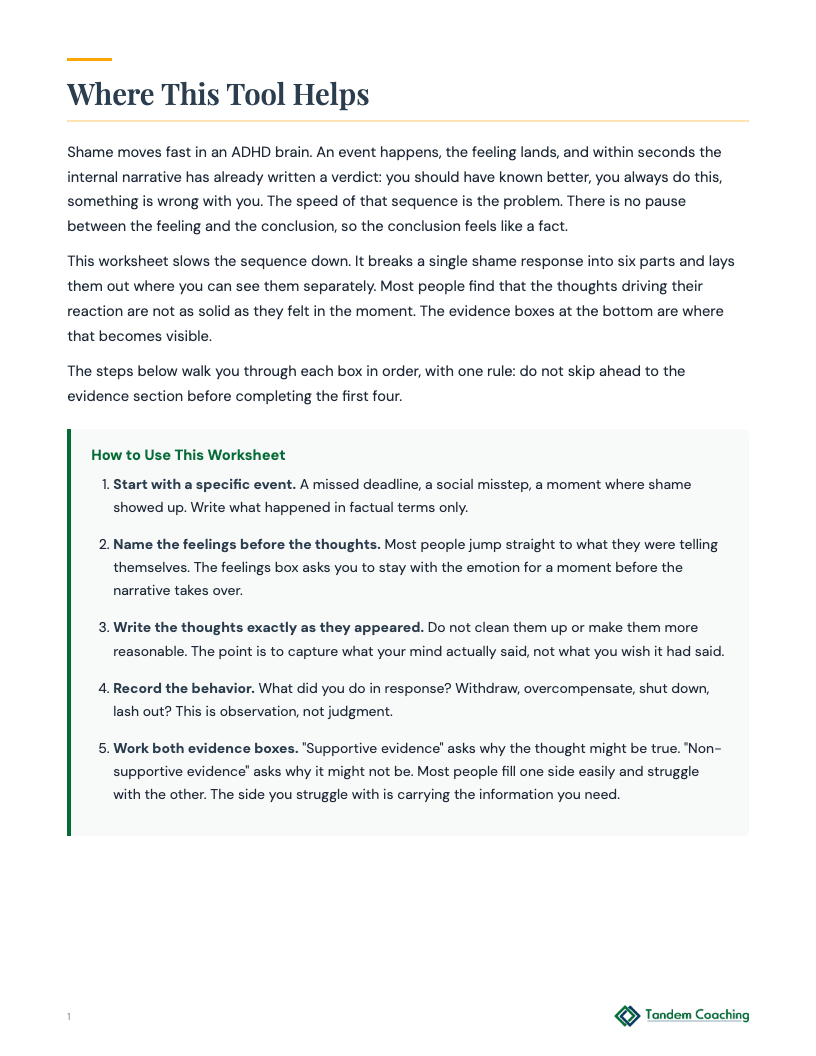
When shame hits, the mind moves very fast from event to verdict. This worksheet slows that sequence down - event, feelings, thoughts, behavior, evidence for, evidence against. The side you struggle to fill in is usually carrying the information you need.
A client with ADHD who is a chief marketing officer stood up in front of the executive committee, misstated a key metric, was corrected publicly by the CFO, and then lost his train of thought for approximately thirty seconds before recovering. He has been replaying the moment for a week, has not spoken about it with anyone, and arrived at coaching with a practiced narrative about 'needing better preparation.' The practiced narrative is the defensive layer. The actual shame response is running underneath it and affecting his willingness to present in any forum since the incident.
Do not engage the prepared narrative first. Ask about the moment directly: 'You said you need better preparation. Before we get to that - what happened in your body in those thirty seconds after the correction?' Shifting to the body experience moves past the analytical defense and into the territory the worksheet covers. Once he has named something from the physical memory, introduce the worksheet: 'I want you to do something with this before next session. Not the preparation question - that can wait. This six-box worksheet is going to walk you through that meeting, specifically. What happened, what you felt, what your brain said. The evidence boxes at the bottom are where we'll look together next week.'
Watch for the 'feelings' box being left sparse while the 'thoughts' box overflows. The event-to-thought pipeline is rapid in ADHD, and clients often cannot locate feelings because thoughts arrived too fast. If the feelings box has only 'embarrassed, frustrated,' ask in the debrief: 'You wrote two feelings. When you sat down after that meeting, what did your body feel like for the next hour?' Also watch for the supportive evidence column cataloguing every flaw in his preparation process, which is the cognitive move that keeps shame in place. The non-supportive evidence column is where the coaching attention goes.
Read the non-supportive evidence column aloud and ask: 'How many of these did you produce on your own, and how many did I have to ask about?' The ratio tells you how accessible self-compassion is for this client. Then ask the post-tool prompt: 'Which side filled faster - the evidence for or the evidence against?' For most clients with ADHD shame, the supportive evidence side fills in seconds. The labor differential between the two columns is the data. Close by asking what pattern he notices across the thoughts box specifically - not the event, but what his brain automatically said about him when the correction happened.
Array
A client with ADHD who is a senior program manager has a task she has been avoiding for three weeks: an email to her director acknowledging a project delay she caused. The delay is not catastrophic, her director has not escalated, and no deadline has been missed for the response. She cannot explain why she has not sent it. In exploring the avoidance, the coach identifies that shame about the initial delay has attached to the email response itself - sending the email feels like formally acknowledging an identity failure, not a project problem. The shame-to-compassion worksheet breaks the avoidance loop by examining the belief driving it.
Name the avoidance-shame connection before introducing the tool: 'The email is not hard to write. You know what to say. What's happening is that sending it feels like confirming something about yourself, not just updating your director on a project. The worksheet looks at that feeling directly - not the project, not the email, but the thought underneath the avoidance.' Assign it specifically for the email delay situation. The event for Box 1 is 'the project delay and my response to it.' The thoughts box will likely surface the belief that is blocking the initiation task.
Watch for the client completing the worksheet and returning with insight about the shame but still not having sent the email. Cognitive insight does not automatically produce behavioral change for ADHD clients - the insight needs a specific implementation bridge. Build one: 'You now know the belief that was blocking you. The email still needs to go. What needs to be different this week for it to happen?' Also watch for the behavior box containing 'I haven't done anything' when avoidance is itself a behavior - failing to send the email, redirecting attention, working on other tasks. Naming the avoidance as a behavior rather than an absence gives the client agency over it.
After reviewing both evidence columns: 'What does the email situation look like to you now compared to three weeks ago when you first started avoiding it?' The comparison should reveal whether the shame belief has softened. Then look at the behavior box: 'You wrote that you avoided the email. That behavior came from the thought in the thoughts box. Now that you've examined the thought - is it still giving the same instruction?' Connecting the thought directly to the avoidance behavior makes the mechanism concrete and actionable. The email send is the behavioral test of whether the reframe is holding.
Array
A client with ADHD who is a vice president of client services has a consistent internal response to mistakes that her coach has been observing across multiple sessions: when something goes wrong, regardless of scale, her immediate private reaction is some version of 'I'm not cut out for this.' She has described this thought after a minor scheduling error, after a client complaint that was resolved quickly, and after failing to recognize a team member's contribution in a meeting. The thought is not connected to the severity of the event. The worksheet creates a record of this pattern across multiple completed instances so the recurring verdict can be examined as a pattern rather than a reaction to specific events.
Frame the worksheet as a pattern-detection tool rather than a single-event debrief: 'I want you to do this worksheet three times this week - not necessarily for big events, but for any moment where you noticed that specific thought: 'I'm not cut out for this.' Three separate events, three separate worksheets. The value is in comparing them.' Multiple completed worksheets make visible what a single session cannot: the thought is identical regardless of what happened, which means it is not a response to the events but a pre-existing belief that events trigger. That observation is the coaching insight.
Watch for the client completing all three worksheets with the same thought in the top box, the same sparse non-supportive evidence, and the same belief surviving the evidence review. If the non-supportive evidence column is never growing across multiple completions, ask what is making it hard to populate: 'What would it take for you to write something in that right column that you actually believe?' The resistance to building counter-evidence often surfaces the belief system the shame is protecting. Also watch for her reframes being structurally identical across all three - a sign that the reframe has become formulaic rather than evidence-driven.
Lay all three worksheets on the table: 'What do you notice about the thought in the top box across all three? How similar is the language?' The comparison usually produces a visible pattern: the same verdict is being applied to radically different events. Then ask: 'If the thought is the same regardless of what happened, what does that suggest about where it is coming from?' That question moves the coaching conversation from event-level analysis to the origin and function of the belief. The post-tool prompt - 'if this pattern appears again, what's one piece of evidence against it you could recall?' - becomes the closing anchor for the session.
Array
A client is unsure whether what they're experiencing is ADHD, depression, or both
LifeClient has strong self-knowledge but struggles to act on what they know
ADHDA client's emotional reactions feel valid but may be based on interpretation rather than fact