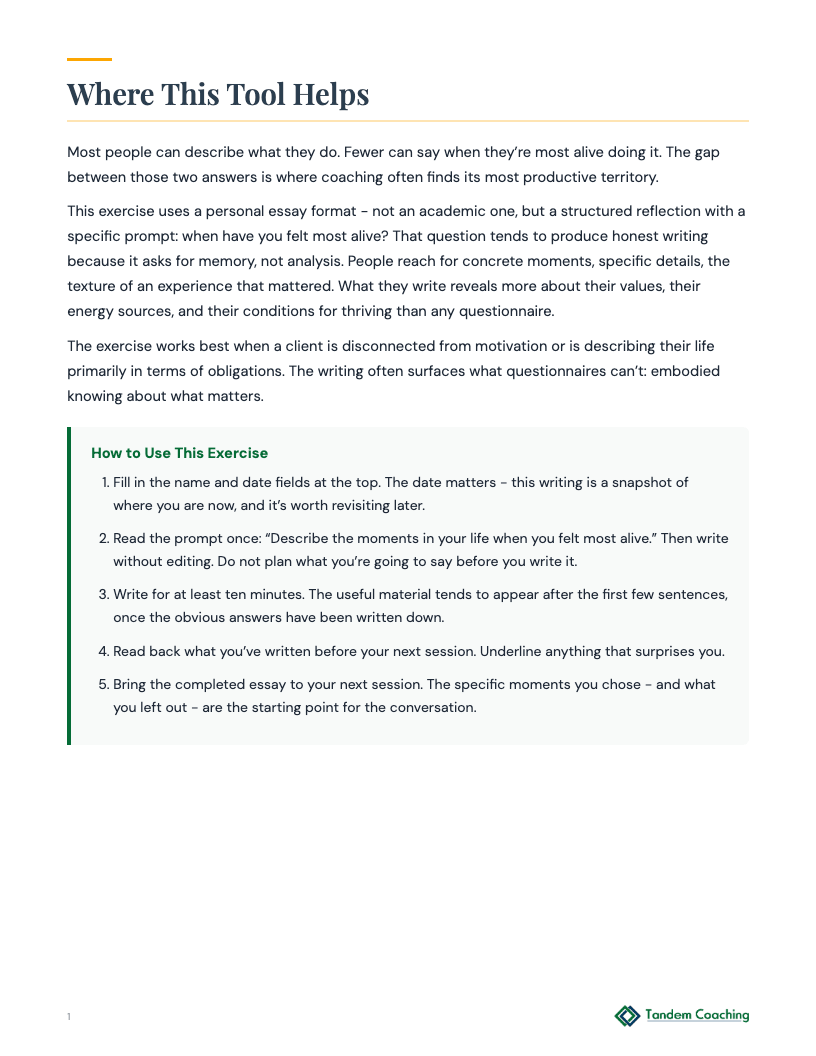
Reflective Essay: Moments of Aliveness
Reconnect with purpose by writing about real moments you felt most alive, using a structured reflection method grounded in coaching practice.
Get This Tool
Free, print-ready PDF.
When to Use This Tool
Client is disconnected from a sense of aliveness or purpose and struggles to locate it in their current experience
Client has not examined the conditions or qualities that make them feel most engaged and alive
Coach wants to help a client reconnect with intrinsic motivation by locating its experiential anchors
How to Introduce This Tool Plus
This reflective essay asks you to examine the moments in your life when you've felt most alive and what they have in common - would writing that before our session give us a richer starting point?
Browse All Pages
Tool Classification
Domain
Life Coaching
Type
Worksheet
Phase
Discovery
Reflection
Details
15 min
Between sessions
As-needed
Topics
Identity
Values
Mindset
For the Coaching Practitioner
Plus
Coaching Scenarios
Plus
1 Mid-career professional disconnected from what energizes them ▶
Context
A program director at a nonprofit has been in the same organization for nine years. She's effective and well-regarded, but describes herself as going through the motions. She can't identify what's missing because she's been in motion too long to remember what aliveness actually feels like. The work is present-state diagnosis before any goal-setting happens.
How to Introduce
Assign as pre-session writing, not an in-session exercise. 'I want you to write something this week - not about your career or your goals, but about the moments in your life when you felt most alive. Describe them specifically. What were you doing, who were you with, what was the quality of your attention? Write for at least ten minutes. Don't edit.' Clients like this one tend to produce rich material when the permission to step outside work is explicit.
What to Watch For
Pay attention to whether the moments she writes about are all from the past - college, early career, a specific project years ago - with nothing from the last two to three years. That temporal pattern is diagnostic. Also notice whether the aliveness moments share a structural element: autonomy, creative problem-solving, relational depth, external recognition. The pattern across moments is more telling than any single example.
Debrief
Start with: 'Read me the moment you wrote about most vividly.' Not the most important one - the most vivid. Then: 'When did you last have that quality in your day?' The distance between the vividness of the writing and the recency of the experience tells you something about the scale of the gap. Then work backward: 'What would need to exist in your current role for even a partial version of that to be present?'
Flags
If the client cannot identify any moment of aliveness - writes a few lines or produces a blank page with 'I don't know' - that's not a blank page problem. Sustained disconnection from what makes someone feel alive can indicate burnout that has progressed further than typical coaching addresses. Severity: moderate. Slow the forward-facing work and assess the client's overall support structure.
2 High performer who conflates achievement with meaning ▶
Context
A director of business development who has built a strong track record is starting coaching because he got the promotion he wanted and feels nothing. He's articulate about what he's accomplished and unclear about what he actually wants. The goal-setting frameworks he's used throughout his career don't seem to reach the question he's actually asking.
How to Introduce
Frame it as a calibration exercise, not a values assessment: 'There's a question I want you to sit with before our next session: when have you felt most alive? Not most successful, not most productive - most alive. Write about it specifically. What were the conditions? I want to understand what you're actually building toward.' This framing matters for achievement-oriented clients - it positions the exercise as strategic rather than introspective.
What to Watch For
Watch for aliveness moments that are all accomplishment-based - closing a deal, finishing a race, getting the offer. If none of the moments involve connection, learning for its own sake, or experiences outside of performance contexts, the client's intrinsic motivation structure may be thin. He may be optimized for external validation in a way that now has nowhere to land.
Debrief
Start with: 'What surprised you in the writing?' Then: 'Among the moments you wrote about, which one involved the least pressure to perform?' That question targets a different category than what he typically accesses. If moments without performance pressure don't appear in the essay or produce a blank reaction, name that observation directly: 'I notice all the moments involve a performance context. What would it take for aliveness to not require an audience?'
Flags
If the client becomes visibly uncomfortable or deflects when asked about aliveness outside of performance contexts - redirects to accomplishments, minimizes the question, or intellectualizes it - that discomfort is coaching territory. Severity: low. Work with it directly rather than moving on.
3 Coach working with a client who says coaching 'isn't working' ▶
Context
Three sessions in, a senior engineer says she doesn't feel like the coaching is doing anything. She came in with a defined goal (get promoted to principal) and the work has been productive on paper. But something about the engagement feels thin to both parties. The reflective essay gives access to a different kind of data than the goal-work has been producing.
How to Introduce
Be direct about the purpose: 'I want to try something different. Not goal-focused. I'm going to ask you to write about moments in your life when you felt most engaged and alive - before we meet again. I want to understand what you're actually reaching for underneath the promotion goal.' This reframe positions the exercise as a course correction, not an admission that prior work was wrong.
What to Watch For
If the moments she writes about have nothing to do with engineering or technical work - they're about teaching, mentoring a junior colleague, leading a cross-functional project - the promotion goal may be attached to the wrong thing. The aliveness data can reveal whether the stated goal is actually aligned with what drives her, or whether it's an inherited ambition.
Debrief
Read the essay as a probe into what's actually energizing. Start with the structural elements across moments. Then: 'How much of that is present in your current day?' Then: 'How much of it would be present if you got the promotion?' The essay can reveal that the client is pursuing a goal that would actually reduce access to what makes her feel most alive - which is important information before she invests more in the pursuit.
Flags
If the essay is genuinely very short or vague - and the client is otherwise articulate and engaged - the thinness may reflect a period of significant stress or overload that has depleted access to what normally energizes her. Severity: low. Don't push for depth that isn't there. Work with what she produces and return to the question in a later session.
Tool Flow
Plus
Requires
- None - standalone tool
→
Produces
- personal essay on peak aliveness moments
- concrete conditions for thriving
- intrinsic motivation anchors
- values-in-practice snapshot
Pairs Well With
Life
Values and Activity Context Map
Use this assessment to take stock of values and accountability before the client chooses what deserves attention.
Why it pairsThe essay's aliveness moments give you concrete behavioral evidence to test against each ranked value, revealing which values the client actually lives versus which they only claim.
LifeLife Purpose Discovery
A client wants to use Life Purpose Discovery as an optional reflection
Why it pairsOnce the client has concrete aliveness moments on paper, this turns those moments into an energy audit and a drafted purpose statement grounded in real evidence rather than abstraction.
LifeGROW Coaching Reflection
A client wants to use GROW Coaching Reflection as an optional reflection
Why it pairsOnce the client can name the specific conditions that make them feel alive, the visualization gives those conditions a future context and structure to plan toward.
Related Articles


Executive Career Reinvention: When Starting Over Makes Sense
Read article →
We are hired to give our clients solutions that work. Aren’t we?
Read article →
Life Coach Certification Online: What to Know Before You Enroll
Read article →
Engaged Neutrality: The Coach’s Stance That Holds Both Challenge and Support
Read article →