Clarifies and ranks your real values so decisions match them, using a structured hierarchy method coaches use to resolve value conflicts.
Free, print-ready PDF.
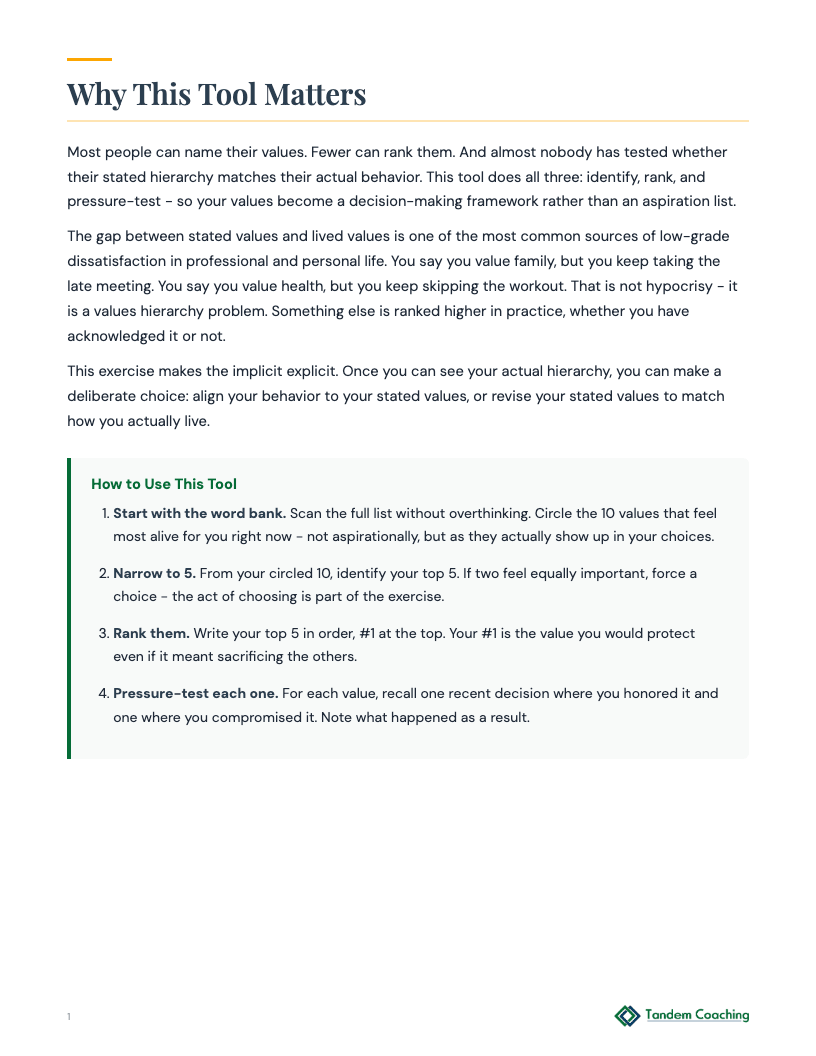
There's a distinction between the values we say matter most and the values our actual decisions reveal. Some clients find it clarifying to map both and see what the gap looks like. Would you be open to exploring that?
A senior product manager at a SaaS company has been with the organization for six years, consistently exceeds targets, and recently turned down a VP offer at a competitor. In sessions she describes herself as someone who values family and creativity, but her calendar shows 60-hour weeks and she's taken three weekend work trips in the past quarter. She's coaching because she feels vaguely dissatisfied but can't locate why.
Position this as an audit rather than an affirmation exercise. 'Before we work on what you want next, let's see what your choices have already revealed about what you actually value.' Expect some resistance to the gap-mapping section — clients who present as self-aware often believe they've already done this work. Name it directly: 'You know what you care about. What we're looking for is whether your time and attention are going there.'
If the client populates the top three tiers with relational values (family, creativity, health) but all her concrete examples of time and energy use point to achievement and security, the hierarchy is aspirational, not descriptive. The coaching signal is in the distance between the written hierarchy and the live evidence. If she fills the hierarchy in under five minutes without pausing, she's reciting a version she's told herself before.
Open with the concrete evidence, not the values. 'Walk me through what you did last Thursday.' Then ask her to locate that behavior in her hierarchy. 'Where does that fit?' The gap between her answer and her hierarchy is the coaching conversation. Then move to: 'What would have to change for the top of your hierarchy to show up in your week?' The question that tends to open things up: 'What's the value you live by that you haven't written down here?'
Array
A 42-year-old director of operations has two job offers: one in a larger company with more pay but less autonomy, one at a startup with lower pay but significant equity and influence. He can't decide. He keeps asking which is 'smarter' financially rather than engaging with what actually matters to him. His coaching goal is career clarity, but the presenting issue is that he can't access what he values enough to use it as a decision frame.
Frame this as giving the decision a foundation it currently lacks. 'Right now you're weighing these offers against each other. Let's first establish what you'd weight them against.' The resistance here is usually skepticism — he may see values work as soft and the financial comparison as hard. Acknowledge that directly: 'The numbers matter. But numbers don't tell you which regret you can live with.'
Watch whether the client places autonomy in the top tier after describing both offers. If it appears mid-hierarchy despite dominating his description of what draws him to the startup, the gap is worth exploring. Also watch for values that appear high in the hierarchy but have no supporting life evidence — a high placement of 'impact' from a client who hasn't been able to name a recent example of feeling impactful.
Start with the top tier. 'You've put autonomy at the top. Tell me about a time in the last two years when you had it.' If the examples are sparse or dated, that's a signal. Then: 'If you took the larger company role, which of these top-tier values would you be betting against?' Don't rush to the decision. The hierarchy is a lens, not an answer — the debrief should make the trade-offs visible, not make the choice for him.
Array
A first-time people manager at a mid-size professional services firm describes herself as deeply caring about her team. She placed 'people' and 'relationships' in her top values tier in a previous exercise. Her 360 feedback, just received, shows her team rates her low on directness and accountability. She avoids difficult conversations, lets underperformance slide, and her team is not developing. She's brought the 360 to coaching feeling confused — how can she value people and still be getting this feedback?
This is a precision instrument for that confusion. 'You said you value people. Let's look at what that means specifically — because the 360 suggests your team has a different experience of that value than you do.' Introduce the hierarchy as a way to examine not just what she values but how she's living each value. The resistance to watch for: she may want to use the hierarchy to confirm she's a good person rather than to examine whether her behaviors serve the people she values.
If she writes 'relationships' and 'care' at the top but her behavioral evidence cluster around avoidance and accommodation, she may be confusing care with comfort — her own comfort. The tell is in the action column. If every example of 'living this value' involves doing something nice rather than doing something hard, the values are functioning as identity protection rather than behavioral guides.
Start with the relationship between 'people' as a value and her team's 360 responses. 'Your team says they don't feel seen when it comes to their growth. Where does their development sit in your hierarchy?' Then: 'What would it look like to care for your team in a way they experience as care?' The distinction between what she means by care and what her team needs from care is the core of this debrief.
Array
I know my values in theory but I'm not sure I'm actually living them
LifeClient is achieving goals but feels disconnected from any larger sense of meaning
LifeClient articulates dissatisfaction with their current situation but cannot describe what they actually want