Productivity Commitment Worksheet

Turn a known sticking point into a specific, written commitment with clear actions and accountability, using a structured coaching worksheet.

Worksheet · 15 min · Print-ready PDF · Free download

Get This Tool

Free PDF - professionally formatted, ready to print or fill digitally

Preview Worksheet · 15 min
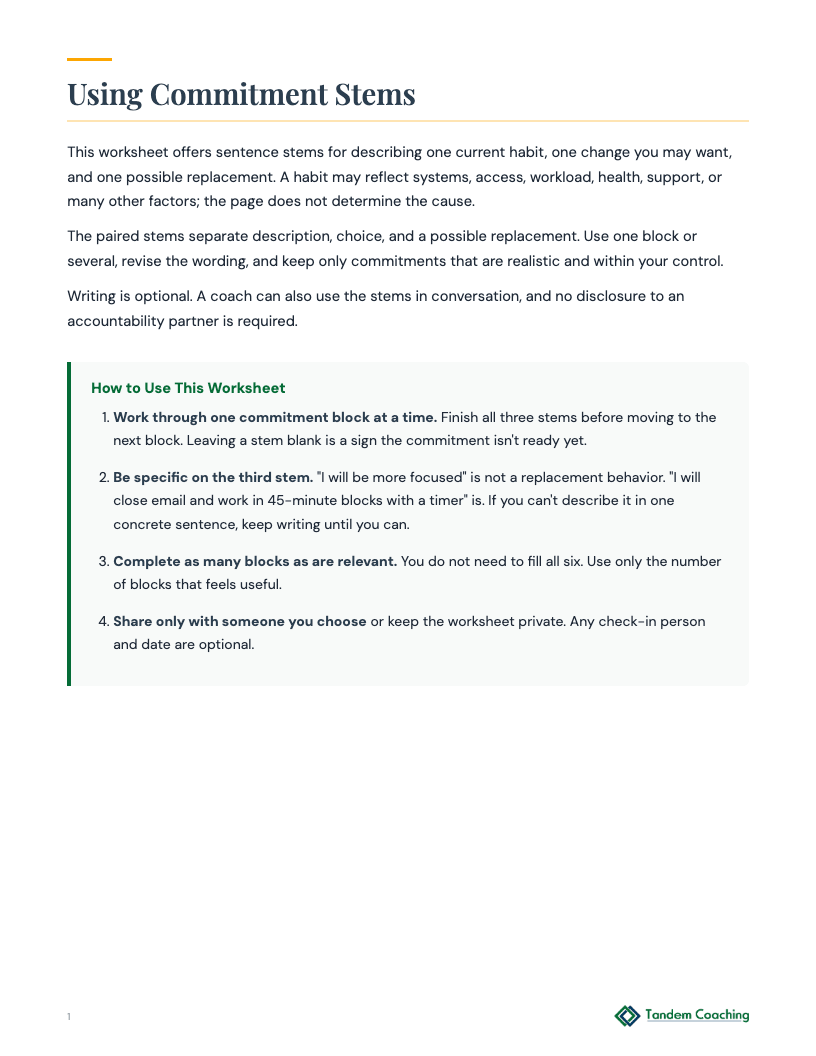
Productivity Commitment Worksheet - preview
When to Use This Tool
I know what's holding me back but I haven't made a clear commitment to change it
I want to articulate what I'm leaving behind and what I'm replacing it with
I keep repeating old patterns even though I know they don't serve me
How to Introduce This Tool Plus

Some clients find it powerful to make explicit commitments using an 'I used to / I will no longer / Because I will' structure - would making that kind of specific commitment feel like the right step right now?

Browse All Pages
Interactive Preview Worksheet · 15 min
Tool Classification
Domain
Life Coaching
Type
Worksheet
Phase
Goal Setting Action
Details
15 min Closing As-needed
Topics
Mindset Habits Accountability

For the Coaching Practitioner

Plus
Coaching Scenarios Plus
1 Senior manager breaking multitasking habit before a major product launch
Context

A senior manager knows constant context-switching is undermining their team's trust and their own output quality. They've said in sessions that they want to change but keep reverting. The next eight weeks have a product launch that will amplify any inefficiency.

How to Introduce

Frame this as a written contract, not a worksheet. 'You've identified this pattern three times now. What changes if you write down not just the intention but the exact replacement behavior?' Position the three-stem structure as the difference between a resolution and a commitment. Some clients resist the formality - name it: 'The specificity is the point. Vague commitments don't survive contact with a busy Monday.'

What to Watch For

If the third stem ('Because I will') stays abstract - 'I will be more present,' 'I will focus better' - the commitment won't hold. The third stem needs a specific observable behavior: a time, a tool, a physical boundary. If the client fills all six blocks quickly with polished language, they may be writing for you rather than for themselves. Ask them to read one aloud and describe what it looks like at 8am on Tuesday.

Debrief

Start with the accountability section - partner and check-in date. Clients who skip this section are signaling that they're not ready to be held. Ask: 'Who will know if you do this, and when will they hear about it?' Then move to the 'I will no longer' stems - are they specific enough to be violated? Vague commitments can't be broken, which is why clients write them. The question that tends to open this: 'Which of these would be hardest to report breaking to your accountability partner?'

Flags

If the client names the same pattern across four or more blocks, they may be describing a structural issue (role overload, inadequate delegation infrastructure) rather than a habit problem. Coaching a habit fix onto a structural problem won't hold. Severity: moderate. Explore whether the organization is a contributing factor before committing to individual behavior change as the primary lever.

2 VP transitioning from individual contributor to people manager role
Context

A VP promoted six months ago continues doing technical work that now belongs to their team. They recognize it intellectually but describe themselves as 'unable to stop.' The pattern is eroding their team's development and their own capacity for strategic work. They have a clear picture of what needs to change but haven't made a firm commitment.

How to Introduce

Position this at a closing session moment, after the pattern has been fully named in conversation. 'You've been clear about what you need to stop. What would change if you wrote that down in specific terms, with exactly what you're replacing it with?' Some clients in this scenario resist writing because it feels like admitting failure. Name that: 'This isn't about what you did wrong. It's about where you're going next.'

What to Watch For

Watch the 'I used to' stems closely. Clients who describe the old behavior with positive framing - 'I used to take ownership' instead of 'I used to do the technical work myself to make sure it was right' - are not fully seeing the pattern. The more positive the framing, the more resistant the habit. Also watch whether the replacement behaviors in stem three are delegation-specific or generic ('I will communicate more') - only specific behaviors transfer.

Debrief

Start with the 'Because I will' column. Read each replacement behavior and ask: 'Is this something your team would notice in your behavior this week?' If no, the behavior isn't specific enough. Then look across all six blocks for a theme - what is the client giving up that carries meaning for them? The pattern of technical behavior often reflects identity, not just habit. 'What does it say about you as a leader if you stop doing this work yourself?'

Flags

If the worksheet is completed quickly and all three stems sound polished, the client may be performing commitment rather than making it. Ask them to identify which block they're least confident about and why. If a client cannot name a single block where they feel uncertain, that's a signal to explore whether this exercise has engaged them at the level it needs to. Severity: low. Adjust by slowing down and staying with one block in session rather than completing all six.

3 High-performer whose perfectionism is collapsing their throughput
Context

A director who consistently produces excellent work describes 'never finishing anything' because everything needs one more revision. They've lost the ability to distinguish between work that warrants perfectionist standards and work that doesn't. Their backlog is growing and their team is waiting on decisions and deliverables they're sitting on.

How to Introduce

Frame this as a distinction exercise, not a productivity fix. 'Before we talk about what to do differently, let's name the specific patterns - not just 'perfectionism' but what you literally do. We'll use the three-stem structure to make those concrete.' Clients in this scenario often resist calling their pattern a problem because the quality of their output has been rewarded. Acknowledge the trade-off: 'The same pattern that produces excellent work is also the one that's creating the backlog.'

What to Watch For

The third stem is the diagnostic here. If the replacement behavior is still about quality - 'Because I will set a higher standard for what counts as finished' - the client is circling back to the same pattern with different words. The replacement needs to be time-bounded or procedural: 'Because I will give myself one pass and send it.' Watch also for blocks where the client struggles to name what they're replacing - that may indicate they don't yet see the specific behavior, only the outcome.

Debrief

Start with the accountability partner field. Clients whose perfectionism is tied to fear of judgment often choose accountability partners carefully - or avoid the field entirely. Ask: 'Who is the right person to hold this commitment, given what it's actually about?' Then return to each 'Because I will' stem and test it: 'If you did exactly this on Tuesday, would your backlog be one item shorter by end of week?' The question forces translation from principle to behavior.

Flags

Perfectionism at the level where throughput is consistently collapsing may indicate anxiety or fear driving the behavior rather than standards. If the client describes a physical response to sending work - tension, dread, difficulty sleeping - before evaluating the perfectionism as a habit problem, explore whether it functions as a coping mechanism. Severity: moderate. Continue coaching but assess whether the driver is structural (unrealistic external standards) or internal before designing the commitment.

4 Entrepreneur who keeps starting new projects before completing existing ones
Context

An entrepreneur two years into building a professional services practice has three unfinished initiatives that all felt urgent when started. Clients are waiting on deliverables from all three. The client describes the pattern as 'I lose interest once it's mostly done' - they can see the problem but have not connected it to a behavioral habit they could actually change.

How to Introduce

Use this at a closing session moment after mapping the unfinished projects. 'You can see the pattern in your project list. What would it look like to name it as a behavior - not the outcome, but what you actually do - and then write down what you're committing to instead?' Clients in creative or entrepreneurial roles sometimes resist commitment language because it feels like constraining their energy. Name it directly: 'This isn't about limiting what you start. It's about being honest with yourself about what finishing requires.'

What to Watch For

Watch whether the client can write 'I will no longer' statements about the new-project pattern specifically, or whether they generalize to something safer. 'I will no longer take on more than I can handle' is not actionable. 'I will no longer pitch a new service offering until the current implementation guide is complete' is. Also watch whether the accountability partner field is left blank - clients who avoid naming an accountability partner often have no one they want to be honest with about this pattern.

Debrief

Start by reading the 'I used to' stems together. Ask: 'Is this the full picture, or is there something underneath the pattern you're not naming here?' The incomplete-project pattern often carries a belief about what gets rewarded - starting gets attention, finishing doesn't. Then move to the 'Because I will' stems: 'Which of these replacements would require the most uncomfortable conversation with someone?' That's usually the one with the most leverage.

Flags

If the client describes the pattern of abandoning things close to completion across multiple domains - projects, relationships, commitments - not just professional work, the behavior may reflect something beyond a productivity habit. Severity: low to moderate. Note the pattern across domains, but don't over-interpret from a single worksheet. If it appears consistently across sessions, it warrants direct exploration rather than another behavioral commitment.

5 Manager using busyness as a shield against strategic conversations
Context

A manager who is reliably busy describes their days as consumed by operational tasks. When asked about strategic priorities, they deflect to execution details. Their manager has flagged that they need to operate more strategically. The client's busyness is real - but it is also serving a function: staying in execution mode means never having to do the harder thinking.

How to Introduce

Introduce this at a closing session moment after the busyness pattern has been named explicitly. 'You've identified that you're staying in operational mode. What if we made that specific - what are the exact things you're doing that are filling that space, and what you'd actually be doing instead?' Clients in this scenario often complete stem one (I used to) readily, because naming past behavior feels safe. The resistance comes at stem three - 'Because I will' - because the replacement behaviors require capacity they don't currently have.

What to Watch For

The third stem is the tell. 'Because I will dedicate time to strategy' is not a behavior. 'Because I will block Tuesday mornings for work that doesn't generate an immediate deliverable' is. Watch also for whether the replacement behaviors in column three are scheduled or contingent. Contingent plans ('I will do this when I have time') are a form of avoidance. The commitment needs a date and a structure.

Debrief

Start with the accountability section. Ask: 'Who in your current environment would notice if you made this shift - and who would push back on it?' The external environment is often part of what keeps the busyness pattern in place. Then work through the 'I will no longer' stems: which of these commitments would require renegotiating with someone else? The ones that require renegotiation are the high-value ones. Close by asking: 'What would you be able to see about your work situation in 60 days if these three commitments held?'

Flags

If the client cannot name even one replacement behavior in the strategic space - if the 'Because I will' stems all remain operational - they may not yet have a concept of what strategic work looks like for them in this role. Before behavioral commitment, the coaching may need to address the picture of the role. Severity: low. Continue coaching but check whether the strategic work has been defined clearly enough to make a commitment to it meaningful.

Tool Flow Plus
Requires
  • identified unproductive habits or patterns to change
Produces
  • named old unproductive habits with written commitment to stop
  • specific replacement behaviors committed in writing
  • accountability partner and check-in date recorded

Pairs Well With

Life

Reading Log

I read a lot but I never retain or apply what I learned

5 min Tracker
Life

Goal Achievement Planner

Client knows the goal but hasn't mapped what daily behaviors will actually carry them there

15 min Planner
Life

Session Rating Template

Coach wants structured session feedback but a free-form debrief produces inconsistent and hard-to-compare responses

5 min Assessment

Related Articles

How to Find an Executive Coach: 8 Steps That Work

How to Find an Executive Coach: 8 Steps That Work

Read article →
Information Radiator - Gut Check

Information Radiator - Gut Check

Read article →

How to Find & Choose the Right Coaching Supervisor

How to Find & Choose the Right Coaching Supervisor

Read article →
The Strength That Got You Promoted Is the One Holding You Back

The Strength That Got You Promoted Is the One Holding You Back

Read article →

10 Best Executive Coaches You Need to Know

Read article →
Transformational Coaching Skills: Powerful Coaching Questions to Ask Clients

Transformational Coaching Skills: Powerful Coaching Questions to Ask Clients

Read article →