Turn a clear life goal into daily actions and milestones with a coach-tested planner that keeps progress measurable and realistic.
Free, print-ready PDF.
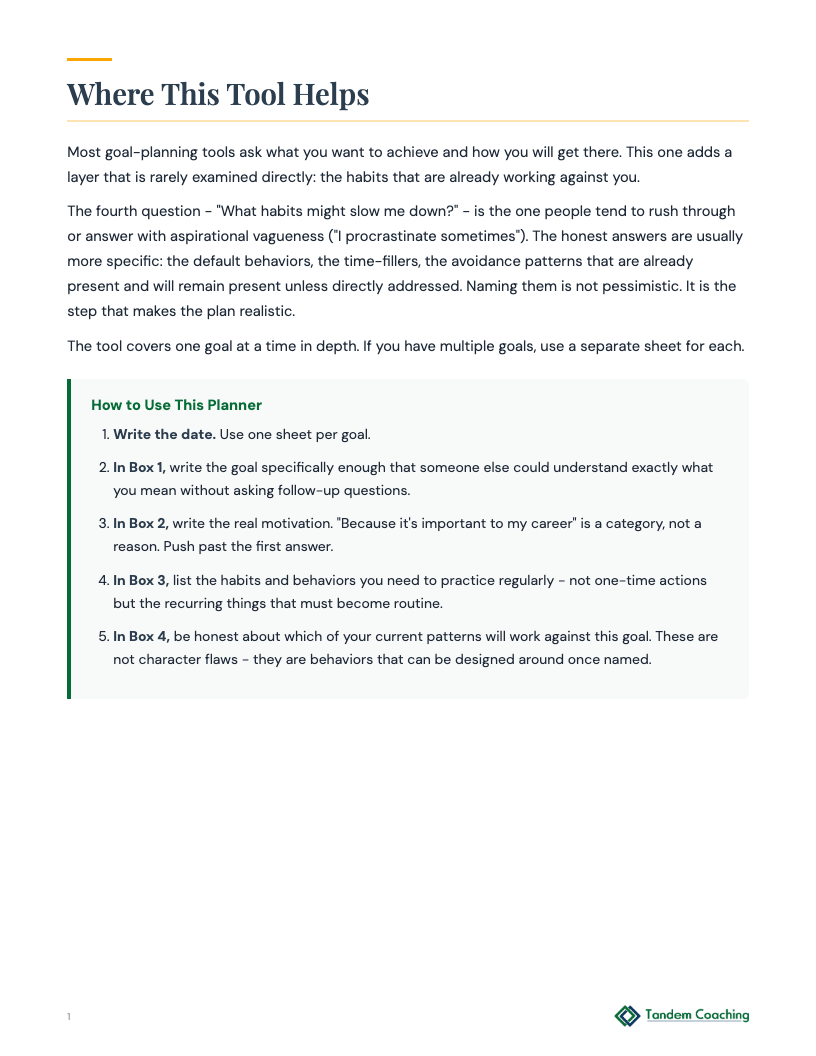
This planner works through a goal in four layers - what you want, why you want it, what habits you'll need to build, and which of your current patterns might get in the way - would that be a useful lens to apply to something you're working on?
A product manager has committed to becoming a principal engineer within 18 months. The goal is specific, the timeline is reasonable, and his motivation is genuine. In sessions he can describe the goal clearly but when asked what he's doing differently today than he was six months ago, the answer is vague. He has a goal without a behavioral architecture.
'This tool works through a goal in four layers - what you want, why you actually want it, the specific behaviors that have to become routine, and the patterns that are already working against it. The fourth box is the one most people underestimate. Before we start, I want you to assume the fourth box is the most important one.' That instruction sets up the blocking-habits section as primary, not supplementary.
Box 3 entries that are ambiguous or outcome-oriented rather than behavioral ('get better at systems design' rather than 'complete one architecture review per week'). Habits are recurring behaviors, not achievements. Watch also for Box 4 to list character traits rather than specific patterns: 'I procrastinate' rather than 'I spend the first 90 minutes of my day in Slack instead of focused technical work.'
Start with Box 4 - the blocking habits. 'Read me what you wrote. For each one: how often does this pattern actually show up in a week?' That frequency question converts abstractions into observations. Then: 'Which of these is already present right now, today - not as a risk but as an actual pattern?' That question establishes current-state honesty before any planning.
A client whose Box 4 contains only minor, easily-managed patterns ('I sometimes get distracted') while Box 3 calls for significant behavioral change may not have full access to his blocking patterns yet. Severity: low. Don't name the gap directly in the first use of this tool. Ask him to track for a week: 'Keep a note each time you notice a pattern from Box 4 showing up.' The data from that week will produce a more honest second round.
A director of people operations wants to transition into organizational design consulting. She has completed a goal-setting exercise before but Box 2 - why she wants it - consistently reads as a category answer: 'I want more autonomy,' 'I want to do work that matters.' These are defensible answers that say very little about what specifically matters to her.
'Box 2 is the one I want you to work hardest on. Most people land on a category - autonomy, meaning, challenge - and stop. I want you to get specific enough that if I read your Box 2 out loud, someone who knows you well would recognize it as yours. Not a life philosophy. The actual reason for this particular goal.' Naming the standard before she starts reduces the likelihood of a first draft that satisfies the form rather than the question.
Box 2 entries that describe external validation ('I want to be known as someone who builds great organizations') rather than intrinsic motivation. External-validation entries are not wrong, but they carry a different risk profile than internal ones - the goal that depends on recognition is more fragile under pressure. Watch also for Box 3 to be populated with one-time actions rather than recurring habits, which is the most common structural error.
Read Box 2 back to her. 'If this goal didn't happen - if the consulting transition never materialized - what specifically would you miss?' That question tests whether the motivation is toward something she actually wants or away from something she wants to leave. The answer usually clarifies the 'why' more than the written version did.
A client who cannot move Box 2 past a category description after two or three attempts in session may have a motivation structure for this goal that is more complex - or more ambivalent - than either of you has named. Severity: low to moderate. Try a different approach: 'When did you first think about this? What was happening?' The context of origin for a goal is often the clearest expression of the real motivation.
A general manager at a media company is excellent at setting organizational goals - specific, measurable, time-bound, resourced. When she applies the same framework to personal goals, something is missing. Her personal goals look like work objectives. They are technically well-formed and emotionally hollow. She can execute them but they don't carry her through difficulty.
'This planner asks four questions. The first two are the ones I want you to slow down on - what you want and why you actually want it. The last two are where your skills are already strong. I'm less interested in Boxes 3 and 4 today - I want to know what you write in Box 2 before I ask you anything else.' That sequencing tells her that the two 'soft' boxes are the ones that matter, not the execution-focused ones.
Goals in Box 1 that are written as deliverables ('complete executive education program') rather than outcomes ('operate with greater strategic autonomy'). Watch for Box 2 to use language that belongs to an annual review rather than a coaching conversation: 'This aligns with my development plan' is not motivation. It's positioning. The real why is usually less polished.
After she completes the four boxes: 'Read Box 1 and Box 2 together. Does the why you wrote actually explain why this goal and not a different one?' That pairing test often reveals that the motivation in Box 2 could support several different goals - which means it's a value, not a reason. Then: 'What's the version of Box 2 that you'd write if no one was going to read it?'
A client whose personal goals consistently look indistinguishable from professional ones - across multiple planning exercises, not just this one - may have a boundary between work identity and personal identity that is worth exploring directly. Severity: low. This isn't a problem to solve in the planner; it's a pattern to name: 'I notice your personal goals tend to read a lot like your work goals. What do you make of that?'
I know what's holding me back but I haven't made a clear commitment to change it
LifeI read a lot but I never retain or apply what I learned
LifeClient reviews the month but the reflection stays at the level of 'did I do the thing' rather than what it revealed