Personal Brand Statement

Clarify what makes you professionally distinctive with a structured, coach-tested framework for a concise, credible brand statement.

Worksheet · 30 min · Print-ready PDF · Free download

Get This Tool

Free PDF - professionally formatted, ready to print or fill digitally

Preview Worksheet · 30 min
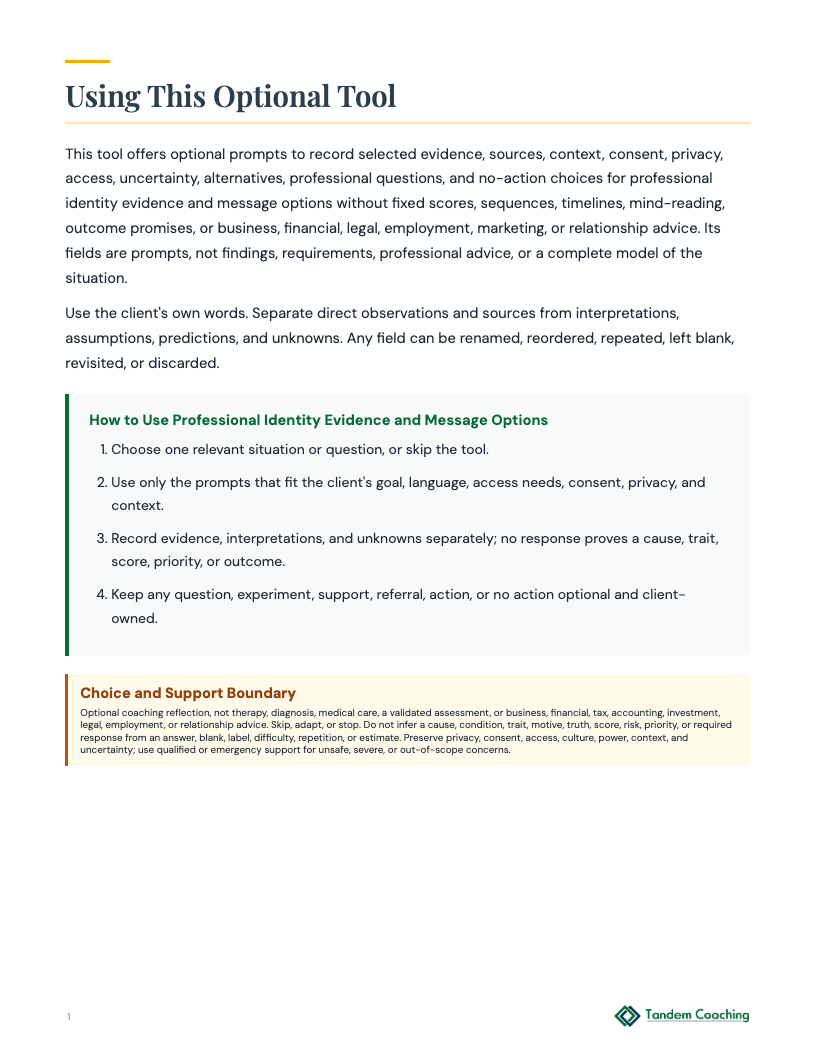
Personal Brand Statement - preview
When to Use This Tool
A client struggling to articulate what makes them professionally distinctive
Someone preparing for a career pivot who needs to reframe their narrative
A professional who keeps getting passed over and can't explain why
How to Introduce This Tool Plus

Before we jump in, take a moment to think about the last time someone asked what you do and your answer felt exactly right. What made it land? That's the thread we'll be pulling on today.

Browse All Pages
Interactive Preview Worksheet · 30 min
Tool Classification
Domain
Career
Type
Worksheet
Phase
Discovery Goal Setting
Details
30 min Between sessions As-needed
Topics
Identity Career Transition

For the Coaching Practitioner

Plus
Coaching Scenarios Plus
1 The mid-career professional who changes how she describes herself every time someone asks
Context

A 38-year-old director of product at a healthcare startup has a genuinely distinctive career: she started in clinical research, moved into user experience, and has spent the last five years building product from the ground up at two companies. She cannot tell the same story twice. In networking conversations she emphasizes different things depending on who's asking. On LinkedIn her headline says 'Product Director | Building at the intersection of health and technology' — a statement that describes the industry but nothing about her. She came to coaching because she's been passed over for two VP opportunities and received the same feedback both times: 'We weren't sure what you'd bring to this role specifically.' The brand statement worksheet structures her inventory and produces a 2-3 sentence statement that holds across contexts.

How to Introduce

Frame this as ending the multiple-version problem. 'You've been telling different stories to different audiences, which means no one is hearing the full picture — they're hearing the version you thought they wanted. The brand statement worksheet walks through six prompts: your professional values, what you do best, who you serve, the problems you solve, what makes your approach distinctive, and where you're headed. Those six answers, taken together, produce a draft statement in 2-3 sentences that works in a networking conversation, a cover letter, and a LinkedIn headline — without changing based on who's in the room.' The driving force prompt is the one to slow down on: 'I want to understand what motivates the work across all three chapters of your career — the clinical, the UX, and the product. There's a thread running through all of it that the people interviewing you haven't seen yet.'

What to Watch For

Watch for the six-prompt inventory to produce answers that are all output-framed — 'I build products,' 'I design experiences,' 'I manage roadmaps' — rather than impact-framed. The statement works when it describes what happens differently because she's in the room, not just what she does. Also watch for the driving force to be answered with the industry ('I care about healthcare') rather than with the underlying motivation that connects clinical research to UX to product. The industry is context; the driving force is what she's trying to accomplish within it. The draft statement usually fails when the driving force hasn't been identified — it reads like a job description rather than a professional identity.

Debrief

Start with the six prompts before touching the draft statement: 'Read me your answer to the distinctive approach prompt. Not the statement — just that one answer.' Then: 'If someone who worked with you three years ago heard that description, would they recognize you in it?' That question tests whether the inventory is aspirational or grounded in observed behavior. Then go to the draft statement: 'Read me the 2-3 sentences you wrote. Is the distinctive thing about you visible in that statement — or does it sound like it could describe someone else in your field?' Close with the session starter: 'Think about the last time someone asked what you do and your answer felt exactly right. What made it land?'

Flags

Array

2 The long-tenured specialist who is making his first job search in twelve years and can't explain his value to an external audience
Context

A 47-year-old senior data scientist at a large telecommunications company has been at the same organization for twelve years. His internal reputation is strong — he's been promoted twice, leads a team of six, and is consistently brought in on high-stakes analytical projects. He has never had to sell himself externally. He is now considering a move following a restructuring and has sent five applications with no response. When asked to describe his professional value in two sentences, he produces a list of technical skills and tools. He came to coaching to 'figure out what to do next.' The personal brand statement worksheet is introduced to convert internal reputation into externally legible value — translating the context-specific reputation that insiders understand into language that means something to someone who has never worked with him.

How to Introduce

Frame this as translation work, not reinvention. 'Your value isn't the problem — the language is. Inside your organization, people know what you've built and what happens when you're on a project versus when you aren't. Outside it, you're describing a tool stack, which looks identical to fifty other data scientist resumes. The brand statement worksheet takes the same underlying value and puts it in language that works for someone who has never seen your work.' The driving force prompt is key: 'Twelve years at one company means you stayed for a reason — or several. I want to understand what that reason was, because it's usually connected to what you'd want from the next place. That's part of the statement too.' The produces section is what to anchor the session on: six-prompt inventory, then a draft statement in 2-3 sentences that works without context.

What to Watch For

Watch for the inventory to produce answers that depend on insider context — 'I built the churn prediction model that reduced customer attrition by 18%' is impressive to someone who knows what that model replaced, but inert to someone who doesn't know the starting state. Push for the statement to work without the backstory: what is the pattern of problems he solves, across different contexts, using different tools? Also watch for the distinctive approach prompt to be answered with technical methodology ('I use ensemble methods') rather than with the behavioral or strategic pattern that makes him effective — how he frames problems, how he works with non-technical stakeholders, what he does that the tool documentation doesn't require.

Debrief

Start with the driving force prompt: 'Read me what you wrote. Why did you stay for twelve years?' Let him answer. Then: 'Is that same thing available in the kind of role you're looking for — or is this a pivot as well as a search?' That question tests whether the brand statement needs to include a directional element or can stay descriptive. Then go to the draft statement: 'If a hiring manager in [target industry] read this statement, without knowing your company or your twelve years of context — what question would they want to ask next?' A good brand statement produces the right next question. A generic one produces silence. Close with: 'Before we jump in, take a moment to think about the last time someone asked what you do and your answer felt exactly right. What made it land?'

Flags

Array

3 The career changer who has the skills for the new field but can't connect her old story to the new destination
Context

A 43-year-old former nonprofit executive director is moving into organizational consulting. She has fifteen years of running complex organizations, managing boards, building coalitions, and executing change in resource-constrained environments. She has identified the consulting firms she wants to approach. She cannot write a one-page version of her value that a consulting partner would recognize as relevant. She frames her nonprofit background as a liability rather than a differentiator — she believes she needs to apologize for it before claiming credibility in the new space. She came to coaching to work on the transition. The brand statement worksheet is introduced to reframe the nonprofit experience as evidence of the consulting competencies the target audience cares about.

How to Introduce

Frame this as building the bridge, not hiding the river. 'You've been treating your nonprofit background as a credential deficit. I want to reframe it: fifteen years of running an organization without margin for error, with a board, in a resource-constrained environment — that's a harder context than most consultants have ever worked in. The brand statement worksheet asks you to identify your distinctive approach. I want that answer to be specific about what running organizations in hard conditions actually develops, because that's the differentiator, not the liability you've been carrying.' The six-prompt inventory is the core work: 'I want the problems you solve prompt to be answered in language a consulting partner would recognize — not nonprofit language, not organizational management language, but the language of the problem they're selling to their clients.'

What to Watch For

Watch for the inventory to continue using nonprofit framing even after being asked to translate — 'I run strategic planning processes' rather than 'I help leadership teams make consequential decisions under uncertainty and resource constraint.' The translation isn't about pretending the nonprofit work didn't happen; it's about naming the competency the work demonstrated rather than the sector it happened in. Also watch for the draft statement to include an apology or a distancing phrase — 'While my background is in the nonprofit sector...' — which signals to the reader that she thinks the background is a problem. The statement works when the nonprofit origin is implicit context and the consulting value is explicit foreground.

Debrief

Start with the problems you solve prompt: 'Read me your answer. Is that the problem description a consulting firm's client would recognize as their problem — or is it the problem description of a nonprofit executive?' That question tests the translation directly. Then: 'Now read me the draft statement. Does it include any version of 'although' or 'despite' or 'while my background is'?' If it does, that phrase is where the apology lives — it needs to come out. Then go to the driving force: 'What is it about organizational change that you've spent fifteen years doing this work to accomplish?' Close with the session starter: 'Think about the last time someone asked what you do and your answer felt exactly right. What made it land?'

Flags

Array

Tool Flow Plus
Requires
  • None - standalone tool
Produces
  • six-prompt professional values and aspiration inventory
  • draft personal brand statement in 2-3 sentences
  • named driving force behind professional work

Pairs Well With

Career

Quadrants of Likes and Dislikes

A client unsure what kind of work they actually want to be doing more of

15 min Framework
Life

Ikigai Discovery

A client feels successful but unfulfilled and wants to understand why

45+ min Framework
Life

Ikigai

Client is successful by external measures but cannot articulate why the work feels hollow

30 min Framework

This tool is part of a coaching pathway

Step 1 of 6 in A client struggling to articulate what makes them professionally distinctive

Next: Role Models and Mentors Reflection → Explore all pathways →

Related Articles

Executive Career Reinvention: When Starting Over Makes Sense

Executive Career Reinvention: When Starting Over Makes Sense

Read article →
Executive Career Pivot Strategy: Framework for Adjacent Moves

Executive Career Pivot Strategy: Framework for Adjacent Moves

Read article →

Executive Transition Runway Calculator | How Long Can You Really Last?

Executive Transition Runway Calculator | How Long Can You Really Last?

Read article →
Chief AI Officer Career Path: Is CAIO Right for You?

Chief AI Officer Career Path: Is CAIO Right for You?

Read article →
4 Executive Career Paths in the AI Era | TRANSITION BRIDGE™ Framework

4 Executive Career Paths in the AI Era | TRANSITION BRIDGE™ Framework

Read article →
Executive Career Decision Framework | TRANSITION BRIDGE™ Criteria

Executive Career Decision Framework | TRANSITION BRIDGE™ Criteria

Read article →