

Behavior Pattern Reflection
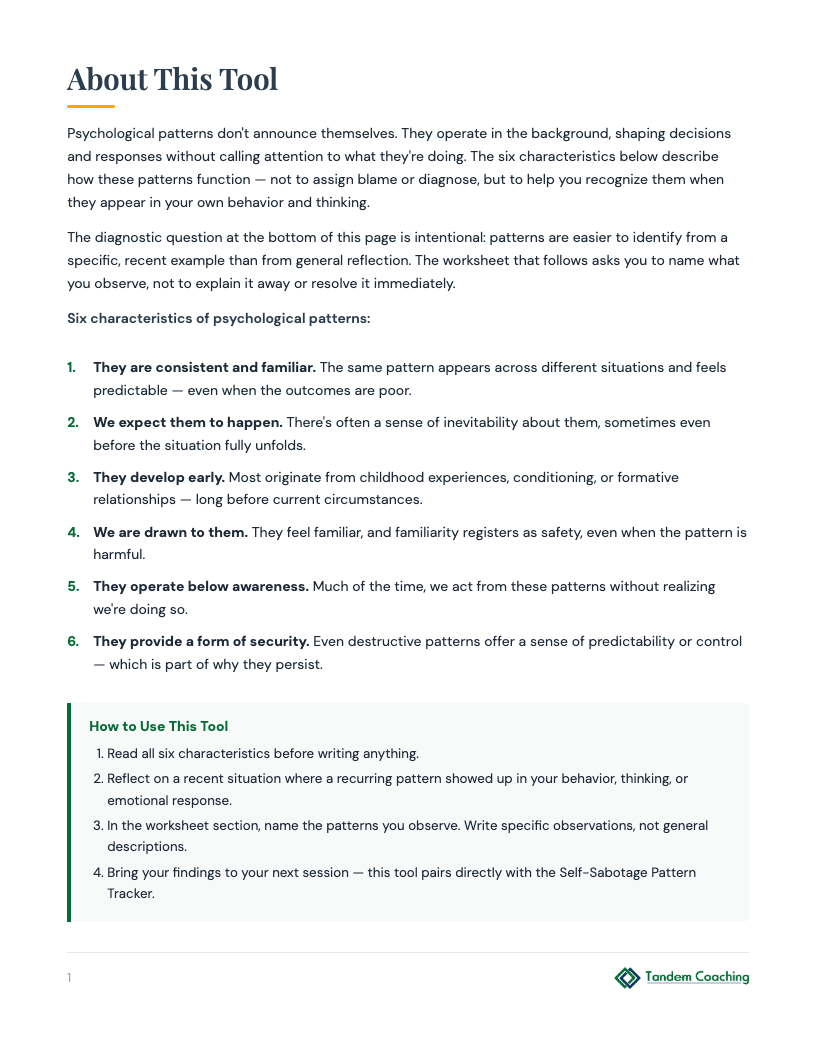
Notice a recurring behavior or thinking pattern through specific examples without diagnosing its cause.
Get This Tool
Free, print-ready PDF.
When to Use This Tool
A client who knows their patterns are holding them back but hasn't been able to name them precisely
Someone who oscillates between self-confidence and self-doubt and can't see the pattern
A professional who wants a structured way to examine how their thinking is shaping their results
How to Introduce This Tool Plus
Think of one recent situation where a recurring response showed up. What did you notice, and what would you like to try differently next time?
Coaching Tool Disclaimer
This tool is designed for coaching contexts, not clinical use. If you or your client is in crisis, contact the 988 Suicide and Crisis Lifeline (call or text 988) or Crisis Text Line (text HOME to 741741).
Browse All Pages
Tool Classification
Domain
Life Coaching
Type
Assessment
Phase
Discovery
Reflection
Details
15 min
Opener
Monthly
Topics
Mindset
Identity
For the Coaching Practitioner
Plus
Coaching Scenarios
Plus
1 Technically excellent professional who keeps stalling at the leadership threshold ▶
Context
A high performer who has been promoted to the edge of senior leadership and is not making the transition. They are getting feedback about presence, strategic thinking, or executive communication — all of which they understand intellectually but haven't been able to integrate. The individual contributor identity is still running the show.
How to Introduce
Frame this as a psychological audit, not a performance review. 'This is not about what you're doing — it's about the beliefs running the operating system underneath what you're doing.' The resistance pattern common here is rationalization: the client can explain why each psychological characteristic is the rational response to their environment. Don't argue the rationalization — name it: 'Notice that the explanation you just gave me is exactly what someone with a fixed mindset would say about why their fixed mindset makes sense. That's worth sitting with.'
What to Watch For
Watch the Attitude Toward Risk section. Leaders who stall at the threshold between individual contributor and senior leadership often rate themselves as moderate-risk-takers — capable of change in stable conditions. Ask about the last time they took a risk that failed visibly. If they can't name one in the past 18 months, risk tolerance may be more performative than real. Also watch for Attitude Toward Criticism — clients who complete this section quickly and confidently often haven't asked anyone else to rate them.
Debrief
Start with the characteristic they rated lowest — not highest. 'You rated yourself most limited here. Tell me what you were thinking when you wrote that.' Then ask: 'If someone who works closely with you completed this audit about you, would their rating match yours?' The gap that often opens is more useful than the ratings themselves. Move to one characteristic: 'Which one of these, if you shifted it even partially, would have the most downstream effect on the feedback you've been getting?'
Flags
If the client completes the audit with all moderate-to-high ratings across all six characteristics and presents this as an accurate self-assessment, but the external feedback they're receiving suggests significant gaps, the audit may be being used defensively. Severity: moderate. A gap between self-report and external observation that is this consistent usually indicates the self-report is protecting something. Explore gently what it would mean to rate lower in the areas where feedback suggests limitation.
2 Founder or owner who built a successful company and is now running against their own psychological patterns ▶
Context
An entrepreneur who succeeded by trusting their instincts, moving fast, and relying on their own judgment. The company has grown to a size where those patterns are now causing friction — the founder's certainty is slowing decisions that the team should own, and their response to criticism is shutting down the feedback loops they need. They know something needs to change but frame it as a team or process problem.
How to Introduce
Introduce as a self-audit rather than a diagnosis. 'This maps six psychological patterns — not to judge them but to see them. Most of the patterns that built your company are still in there running, even when the context has changed.' The common resistance: the founder who succeeded through these patterns doesn't experience them as limiting — they experience them as strengths. The reframe: 'The question isn't whether these served you. It's whether they're serving the company now that it's ten times bigger.'
What to Watch For
Watch the Attitude Toward Learning and Attitude Toward Others sections for internal consistency. Founders who describe themselves as curious and open to input often simultaneously describe their team's ideas as underdeveloped or not yet ready for implementation. If both things are true in the same conversation, the self-rating may not be tracking behavior. Note the gap without challenging it directly in the moment — it's material for the debrief.
Debrief
Start with Attitude Toward Certainty — for founders, this is usually the most loaded section. 'What did you write here?' Then: 'Name a decision in the last quarter where you changed your position based on someone else's input. What made that possible?' If they can't name one, that's the conversation. Move to the cross-reference: 'You rated yourself open to learning but you just told me you haven't changed a significant position in six months. Help me understand how those fit together.'
Flags
Founders who have built their identity substantially around being right tend to experience psychological challenges to certainty as threats rather than as development opportunities. If the client becomes defensive, minimizing, or dismissive during the debrief of any characteristic — particularly Certainty or Criticism — note the pattern. Severity: low. Continue working but recognize that the psychological patterns embedded in a successful founder identity may require more time and trust to examine than a single tool session provides.
3 Manager who wants to develop their team but cannot model the growth mindset they are trying to install ▶
Context
A people manager who has genuine intentions around team development and describes growth mindset principles fluently in conversation. Their team, however, does not experience them this way — mistakes are corrected rather than explored, feedback flows one direction, and ambiguity is quickly resolved rather than sat with. The manager is trying to develop others without having done the audit on themselves.
How to Introduce
Frame this as a prerequisite to the team development work. 'Before we talk about how you develop your team's mindset, this is a diagnostic of your own. The patterns you're trying to install will be undercut if you're running different ones.' Resistance often appears as 'I know I have room to grow, but my team's issues are real.' Don't dispute this — redirect: 'Absolutely. And your patterns are real too. This is about getting a clear picture of yours.'
What to Watch For
Watch Attitude Toward Failure and Attitude Toward Criticism in tandem. A manager who rates high on tolerance for failure but simultaneously gives feedback in ways their team experiences as critical and minimizing is likely applying different standards to themselves than to others. If the self-ratings on these two sections are high but team dynamics suggest otherwise, ask: 'How does your team know it's safe to bring you a mistake?' If they struggle to answer, the behavior isn't matching the belief.
Debrief
Start with the two sections most relevant to team dynamics — Attitude Toward Failure and Attitude Toward Others. 'Based on what you wrote here, what would your team say about how you respond when something goes wrong?' Then use that as a bridge: 'If your team completed this audit about you — not about themselves, about you — which sections would they rate differently than you did?' That question usually surfaces the development edge most directly.
Flags
If the manager's responses consistently reflect an idealized self-concept that appears disconnected from team feedback they've received, this tool may be functioning as a vehicle for self-presentation rather than self-examination. Severity: low. If this pattern persists across multiple sessions and modalities, consider whether 360 data or structured team feedback would provide the external reference point the self-report cannot.
Tool Flow
Plus
Requires
- None - standalone tool
→
Produces
- named psychological patterns with specific written examples
- earliest-origin reflection for highest-scoring pattern
Pairs Well With
Life
Confidence Evidence and Learning Notes
Use this worksheet to explore identity and mindset and turn the client’s observations into one optional next step.
Why it pairsUse this after the audit so the client builds their evidence inventory against the specific patterns they just named, not a vague sense of doubt.
LifeBelief Evidence Reflection
Use this assessment to take stock of mindset and identity before the client chooses what deserves attention.
Why it pairsThe audit names the pattern and its earliest origin; this worksheet unpacks the belief underneath it and documents what staying there is costing the client.
LifeSelf-Talk Evidence and Alternatives
Use this worksheet to explore mindset and identity and turn the client’s observations into one optional next step.
Why it pairsThe audit hands you a named, written pattern that feeds directly into this worksheet's starting point, skipping the hardest step of getting the client to see it.
Related Articles

AI Is Reshaping Leadership Development - But Not How You Think
Read article →
What Your Career Has Taught You — And What It Hasn’t
Read article →
Why Legal Leaders Lead Differently — And What That Costs Them
Read article →
Identity Architecture: How Career Shapes Who Leaders Become
Read article →