Identify and reframe the harsh inner voice that shows up under pressure using a structured, evidence-based worksheet used in coaching practice.
Free, print-ready PDF.
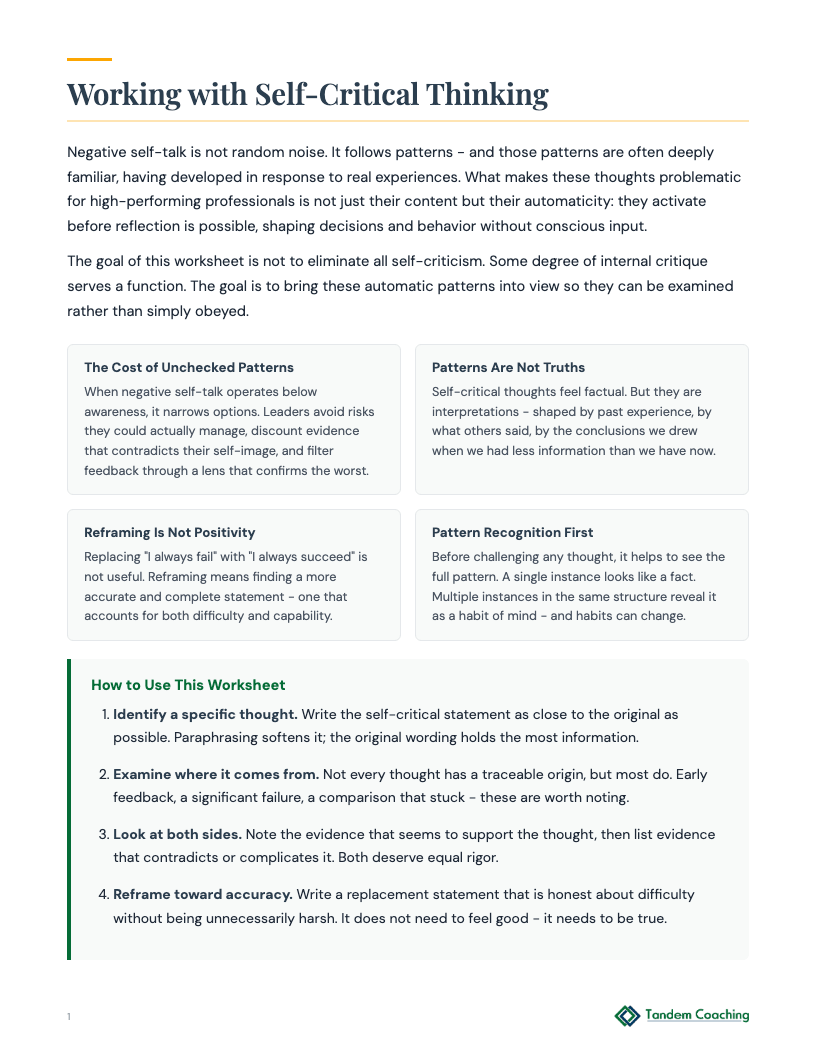
There's a voice that tends to show up when you're under pressure - what does it usually say, and where do you think it learned to say that?
A director or VP experiences an intense critical voice after any perceived public failure - a meeting that didn't go well, a decision that got questioned, an email that landed poorly. The self-criticism is immediate, harsh, and prolonged well past any useful reflection period. It is affecting their willingness to take risks in front of senior stakeholders.
The critical voice in high-performers is often adaptive in origin - it drove the precision and preparation that produced results - and has become maladaptive in degree. Name that distinction before introducing the tool: 'This voice probably served you at some point. Let's look at what it's actually saying and whether it's still giving you accurate information.' Starting with origin rather than replacement tends to reduce defensiveness. Clients who feel their inner critic is being pathologized will protect it.
The origin section will matter here more than in other scenarios. If the client traces the critical voice to a specific environment - a demanding parent, a humiliating supervisor, a high-pressure training period - the voice is operating as if that context is still current. Watch whether the evidence rebalance section generates genuinely proportionate counter-evidence or whether the client writes what sounds like counter-evidence but frames it as a fluke ('that worked out but it was lucky').
Start with the trigger question: when specifically does the voice arrive? The timing is often more precise than clients initially describe, and precision matters. Then move to the origin: ask the client to read what they wrote about where this voice came from, and ask whether the context that installed it is still the context they're operating in. The replacement belief should be accurate, not kind - accuracy is what makes it usable. End with: 'What would you tell a colleague who made the same mistake?'
If the critical voice is constant rather than episodic - present not just after failures but as background noise most of the time - or if the client describes it as something that wakes them up at night or makes concentration difficult, what's being described goes beyond a self-talk pattern. Severity: high. Name what you're hearing specifically and explore whether additional support is indicated before continuing with the worksheet-based work.
A professional returning after a gap for caregiving, health, or life circumstances has a specific inner critic pattern: they are 'behind,' their skills are 'outdated,' and anyone who considers them will see the gap first and everything else second. The voice is loudest when preparing applications, doing interviews, or networking.
The critical pattern here is comparison-based and prospective: 'they will think.' Frame the worksheet as an examination of a specific recurring thought rather than a general confidence exercise. 'What exactly does the voice say when you open LinkedIn?' That specificity is more useful than 'I feel like I'm behind.' The origin section will often surface something about professional identity being tied to continuous employment in ways the client hasn't examined.
The evidence rebalance section needs to include evidence from the gap period itself, not just before it. Clients in re-entry scenarios often discount everything that happened during the gap as non-professional, even when significant skills, judgment, and resilience were developed. If the counter-evidence column only contains pre-gap material, point that gap out explicitly. The replacement belief should address what the voice claims, not just state the opposite of it.
Start with the gap between what the voice says others will think and what the client knows about how hiring decisions actually get made. Ask: 'Have you ever made a hiring decision? Did you immediately disqualify people with gaps?' That question often produces a shift. Then focus the debrief on what the voice is protecting against - rejection, which is real and possible, versus categorical disqualification, which is an assumption. The replacement belief should hold that distinction.
If the career gap involved a health crisis, caregiving under duress, or grief, and the client describes the gap period with shame rather than neutrality, the self-critical voice may be carrying something about the circumstances of the gap that has not been processed. Severity: moderate. Don't avoid that emotional content in service of completing the worksheet.
A client in their late 20s or early 30s has a distinct critical internal voice that they can often attribute to a specific formative supervisor - demanding, dismissive, or prone to public criticism. The voice still narrates their performance years after that relationship ended, often using the same phrases or tone.
When a client can identify whose voice the inner critic sounds like, the origin section is already partially complete. Start there: 'Tell me about where that voice comes from - you mentioned it sounds like someone specific.' The worksheet then becomes a way to examine whether the standards that voice installed are accurate assessments of current reality or artifacts of a specific relationship context. The goal is not to dismiss the critical voice but to update it.
The rebalance section is where clients with an identified-voice critic often struggle most. Counter-evidence from after the relationship ended is more important than counter-evidence from within it - because the voice is trying to tell them that the supervisor's assessment was permanently true. Watch whether the counter-evidence is being generated from the old relationship context ('even my former supervisor said I was good at X') versus their own accumulated evidence.
Start with whether the critical voice's standards are still the right standards for the context the client is currently in. Demanding supervisors sometimes install genuinely useful precision; sometimes they install standards appropriate to their own context that don't transfer. That's worth examining specifically. Then move to the replacement belief: it should sound like the client's own voice, not a corrected version of the supervisor's. Read it aloud and ask: 'Whose voice is that?'
If the supervisor relationship involved sustained public humiliation, threats, or behavior that the client describes with heightened affect even now, the impact may have gone beyond a self-talk pattern. Severity: moderate. Proceed with the tool but stay with the emotion if it surfaces when describing the origin. Don't redirect back to the worksheet mechanics when something important is happening.
My client says they know what they value but their choices don't reflect it
LifeClient writes goals that sound good but stall as soon as specificity is required
LifeClient is achieving goals but feels disconnected from any larger sense of meaning