Identify and challenge long-held self-beliefs that feel like facts using a structured coaching worksheet grounded in evidence-based reflection.
Free, print-ready PDF.
What's a story you've been telling yourself about what you can or can't do — and how long have you been telling it?
A senior professional who is well-regarded by peers and managers consistently fails to advocate for themselves at compensation reviews, fails to claim credit for work they led, or speaks with excessive hedging in executive settings. Their output and others' perception of them far exceed their own self-perception.
The resistance will be framed as realism: 'I'm just being accurate' or 'I don't want to oversell.' Name the gap before introducing the tool: 'Your manager says X about your work. You say Y about your work. Those two can't both be accurate.' The belief origin section will be important here - the underselling pattern usually has a source (often a formative professional experience or a family message about arrogance) that feels like wisdom rather than a limitation.
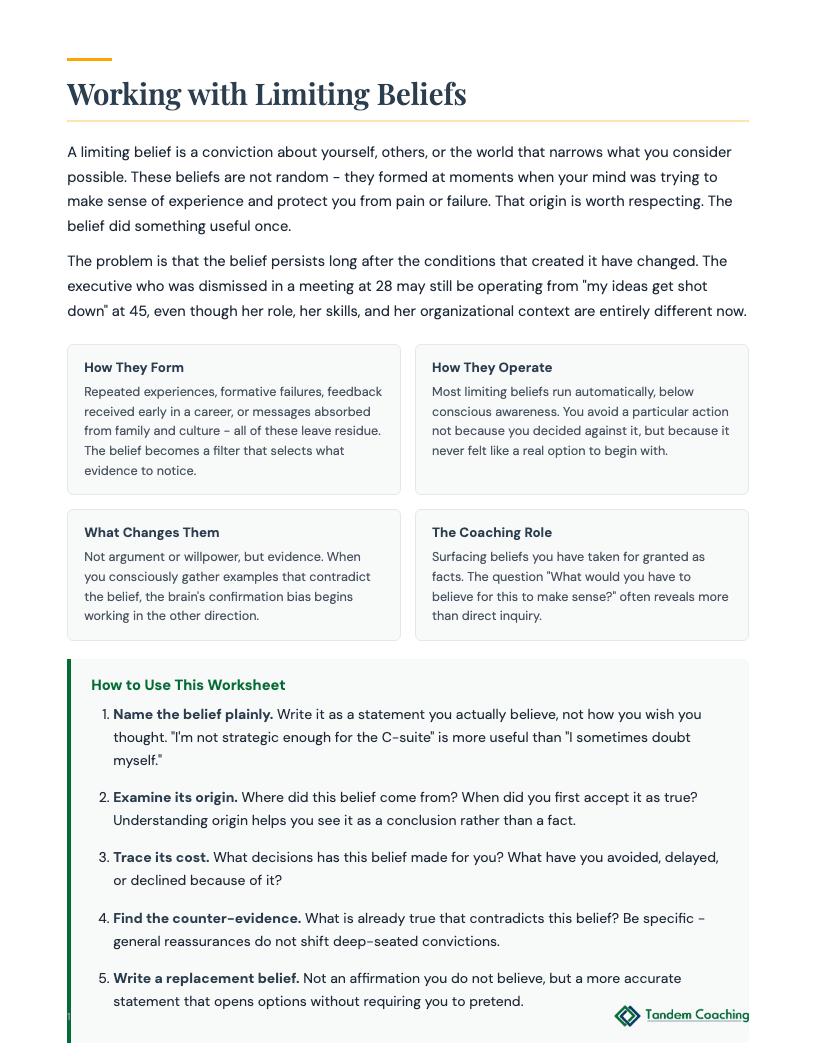
The counter-evidence section is where the work either lands or doesn't. If the client generates counter-evidence that is quickly qualified ('yes, but that was different'), the belief is defending itself. Count how many qualifiers appear in the counter-evidence column. More than two or three suggests the belief has a strong hold. The replacement belief should be specific and testable - not 'I am capable' but 'My work on X is worth the compensation I'm asking for.'
Start with the origin section. Ask when they first learned that downplaying was safer or more acceptable than claiming. The emotional quality of that answer tells you how long the belief has been operating and how much authority it carries. Then read the replacement belief aloud and ask: 'Does this feel true, feel like wishful thinking, or feel threatening?' Each answer points to a different coaching direction. The one concrete action should involve a specific visibility or advocacy behavior, not more reflection.
If the belief origin traces back to consistent invalidation, public humiliation, or being penalized for confidence - especially in early career or childhood - the pattern may have a more emotional foundation than the worksheet surfaces. Severity: low. Continue coaching but be alert to whether the client's relationship with visibility and exposure has a shame quality to it that goes beyond professional strategy.
A manager who is ready for a director or VP role keeps pointing to a specific gap - a competency area, a type of experience, a credential - as the reason they're not ready. The gap is real but not disqualifying. They have been preparing for the next role rather than pursuing it.
The preparation-as-avoidance pattern deserves to be named before the tool is introduced. 'What would need to be true for you to be ready? And how will you know when you have enough of that?' If the answer is vague or keeps expanding, the readiness standard is a moving target - which means the belief is doing the work, not the gap. Position the worksheet as a way to examine the belief about the gap rather than the gap itself.
Watch the cost section carefully. Clients who have been waiting for readiness for more than 12 to 18 months often have visible costs - missed cycles, passed-over opportunities, colleagues who were less qualified and got promoted - that they've normalized. Naming those costs explicitly, not just abstractly, is what gives the worksheet traction. If the replacement belief gets written as 'I am ready' without evidence grounding, it will not stick.
Start with the three beliefs and ask which one has been in place the longest. The oldest belief usually has the most evidence against it (because the person has had the most time to accumulate it) but also the most authority. Then move to the cross-belief theme - often the underlying belief is something about deserving or belonging, not competence. The concrete action should involve a direct pursuit of the role, not more preparation for it.
If the client's environment genuinely does disadvantage people like them - there is real structural evidence that the level they're aiming for has never included someone from their demographic or background at this company - the 'limiting belief' framing may be too individualistic for the situation. Severity: moderate. Acknowledge the systemic reality alongside the internal belief work. The coaching is incomplete if it treats a structural barrier as a mindset problem.
A consultant, coach, designer, or other knowledge worker consistently prices below market and struggles to raise rates. They attribute this to market conditions but the belief driving it is 'I'm not experienced enough to charge that' or 'People will find out I don't know as much as they think.'
This pattern often involves multiple entangled beliefs, so position the tool explicitly: 'Let's pick three specific beliefs and work each one separately. Don't combine them.' Clients in this pattern often want to solve the problem in aggregate ('I need to believe in myself more') rather than doing the specific belief-by-belief work. The origin section is particularly important for knowledge workers - the beliefs are often installed by professional environments that defined expertise very narrowly.
The counter-evidence section can be sabotaged by imposter syndrome logic: every piece of counter-evidence gets explained away ('I got that client because they didn't know the market' / 'that project went well because the client was easy'). If counter-evidence is consistently attributed to external factors while failures are attributed to internal ones, that asymmetry is the belief pattern in action. Name it explicitly.
Start with the cost section: what has this belief specifically prevented them from pursuing or charging over the past 12 months? Make it concrete in dollars or lost opportunities. Then move to the replacement belief and test it: 'If you charged this rate and a client said yes, what would you think?' The answer to that question shows whether the new belief has actually been installed or is just being written down.
If the pattern of self-qualification includes persistent worry about being exposed or found out - beyond pricing into interactions with clients, delivery quality anxiety, or compulsive over-preparation - the pattern may have an anxiety component that pure belief-work won't fully address. Severity: low to moderate. Continue with the tool but note what you're observing and explore it in a subsequent session.
A high-achiever who suspects imposter syndrome is operating under the surface but hasn't examined it directly
LifeMy client says they know what they value but their choices don't reflect it
LifeClient writes goals that sound good but stall as soon as specificity is required