Pinpoint fixed‑mindset patterns that fuel imposter feelings, and get a clear growth‑oriented path forward using a validated mindset assessment.
Free, print-ready PDF.
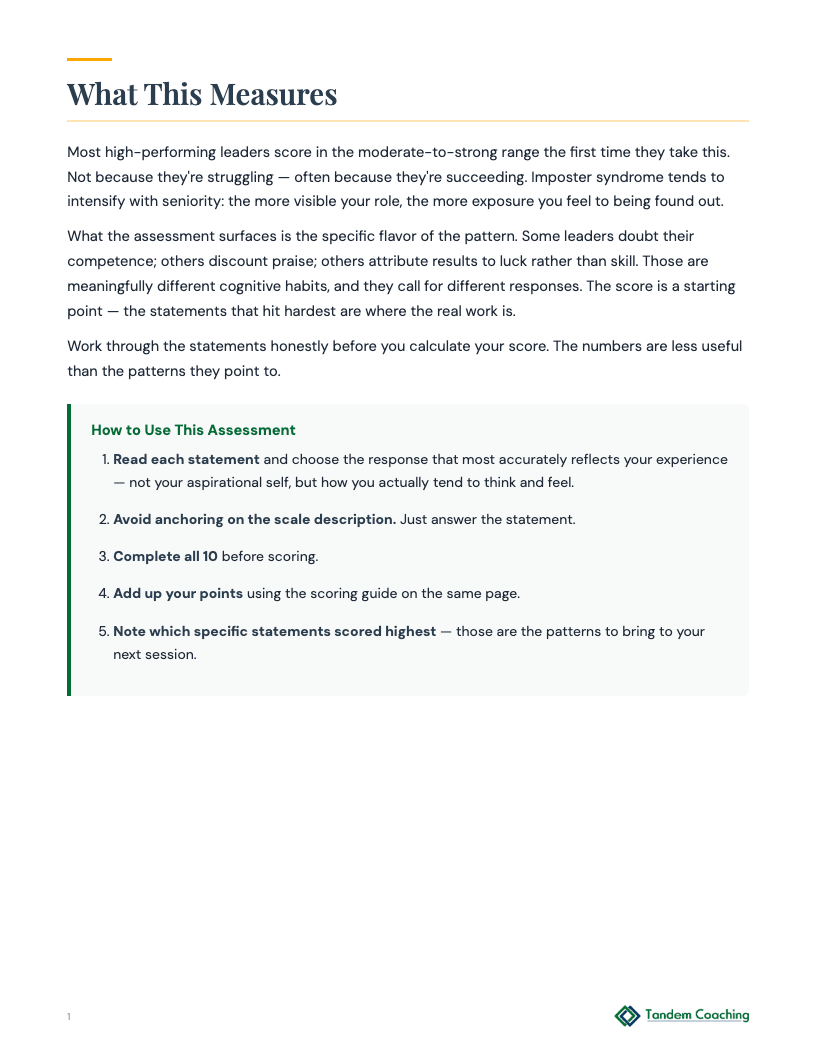
As you look at your scores, notice where you landed and whether it matches your own sense of yourself. What feels accurate — and what surprises you?
A director promoted from individual contributor to leading a 12-person team six months ago. They sought coaching for 'leadership development' but consistently frame their promotion as the company needing someone quickly rather than recognizing their qualifications.
Frame this as a calibration tool, not self-criticism. 'You keep saying you got promoted because they needed someone. Let's see what's actually driving that story.' Expect pushback - they'll want to discuss leadership skills instead. The resistance is the point: they're more comfortable focusing on future competence than current worth.
Speed through statements 3, 5, and 9 - the ones about deserving success and internalizing achievements. If they pause longest on statement 7 about never being enough, they're using perfectionism to avoid the deeper question of whether they belong in the role at all.
Start with their highest-scoring statement and ask: 'Read that one back to me. Now tell me what your team would say if they heard you say that.' The gap between their self-perception and their team's experience of their leadership often breaks the pattern open.
If they score high on statements 6 and 8 (fear of exposure and anxiety) but low on everything else, they may be experiencing role transition stress rather than imposter syndrome. Moderate severity. Continue coaching but explore whether the anxiety is about competence or about identity shift from individual contributor to leader.
A principal consultant at a strategy firm who leads client engagements but systematically redirects all positive feedback to their team members. They came to coaching for 'executive presence' after their managing director noted they seem uncomfortable taking credit for wins.
Position this as a business development diagnostic. 'Clients need to know they're working with someone who owns their expertise. Let's see what happens when you try to claim credit for your work.' Frame deflecting praise as a business risk, not a character flaw - it makes clients question whether they hired the right person.
They'll likely score moderate on most statements but spike high on statement 3 about accepting compliments. Watch for them to rationalize this as 'good leadership' or 'team building.' If they complete the reflection section with only team-focused costs, they're still avoiding the personal impact.
Ask them to read their reflection about costs out loud, then follow with: 'What does your managing director see that you don't?' This moves from their internal narrative to external business impact. The question that usually opens this up is: 'What would change if clients saw you the way your team does?'
If they score minimal overall but refuse to engage with the reflection section, they may be using intellectual compliance to avoid emotional content. Low severity. Note the pattern and return to it in future sessions rather than pushing now.
A VP of Product who advanced from manager to VP in three years during a company's hypergrowth phase. They consistently attribute their success to 'being in the right place at the right time' and worry they won't be able to replicate results in a more stable environment.
Frame this as a pattern recognition exercise. 'You keep saying you got lucky with timing. Let's see if that story is serving you or limiting you.' The resistance will be intellectual - they'll have data about market conditions and company growth. Acknowledge the external factors while focusing on what they contributed within those conditions.
Statement 5 about attributing success to luck will likely score highest. If they score low on statements about competence but high on statements about deserving success, they're not questioning their skills - they're questioning whether their skills matter. This is a different pattern than classic imposter syndrome.
Start with statement 5 and ask: 'What would someone who worked alongside you during that growth phase say about your contribution?' Then: 'What skills did you develop during hypergrowth that transfer to any environment?' The goal is separating their capabilities from the specific context where they developed them.
If they score high on statement 10 about avoiding new challenges, combined with their attribution pattern, they may be developing learned helplessness about their own agency. Moderate severity. Explore whether they're avoiding opportunities that would test their skills outside the hypergrowth context.
A department head whose 360 review revealed consistent feedback about 'playing small' and 'not owning their expertise.' They're genuinely surprised by this feedback and sought coaching to understand why others see them differently than they see themselves.
Present this as a blind spot detector, not a self-assessment. 'Your 360 says you play small, but you don't feel like you have imposter syndrome. Let's see where the gap is.' Expect them to intellectualize or dismiss statements that don't match their self-image. The tool's value is in surfacing unconscious patterns.
They may score minimal overall while exhibiting the behaviors the tool measures. Watch their body language and tone when reading statements - do they pause, shift, or change inflection even while marking low scores? The disconnect between their responses and their reactions is the data.
Start with: 'Walk me through how you answered statement 3 about accepting compliments.' Then ask: 'What would your direct reports say about how you respond when they praise your decisions?' Focus on specific behavioral examples rather than their self-assessment scores.
If they score minimal but their 360 feedback is consistent about playing small, they may have a significant blind spot about their own behavior patterns. Moderate severity. The coaching conversation is less about imposter syndrome and more about self-awareness and feedback integration.
Client sets goals but never writes down what success would actually look like
LifeClient writes goals that sound good but stall as soon as specificity is required
LifeClient is achieving goals but feels disconnected from any larger sense of meaning