Reframe self-limiting beliefs that keep stopping you from acting, using a structured coaching method grounded in cognitive reframing.

What's a belief about yourself that keeps you from doing something you actually want to do — and where do you think that belief came from?
A VP of people and culture has been in coaching for three months. Across multiple sessions, the same belief surfaces in different forms: 'I'm too direct for this culture.' She uses it to explain why a peer relationship is difficult, why she doesn't advocate for a budget request, and why she holds back in executive team discussions. The belief has become a master explanation that she applies to situations that may not share the same cause. She has never examined whether the belief is accurate, whether it applies equally to all contexts, or whether there are alternatives she might actually believe.
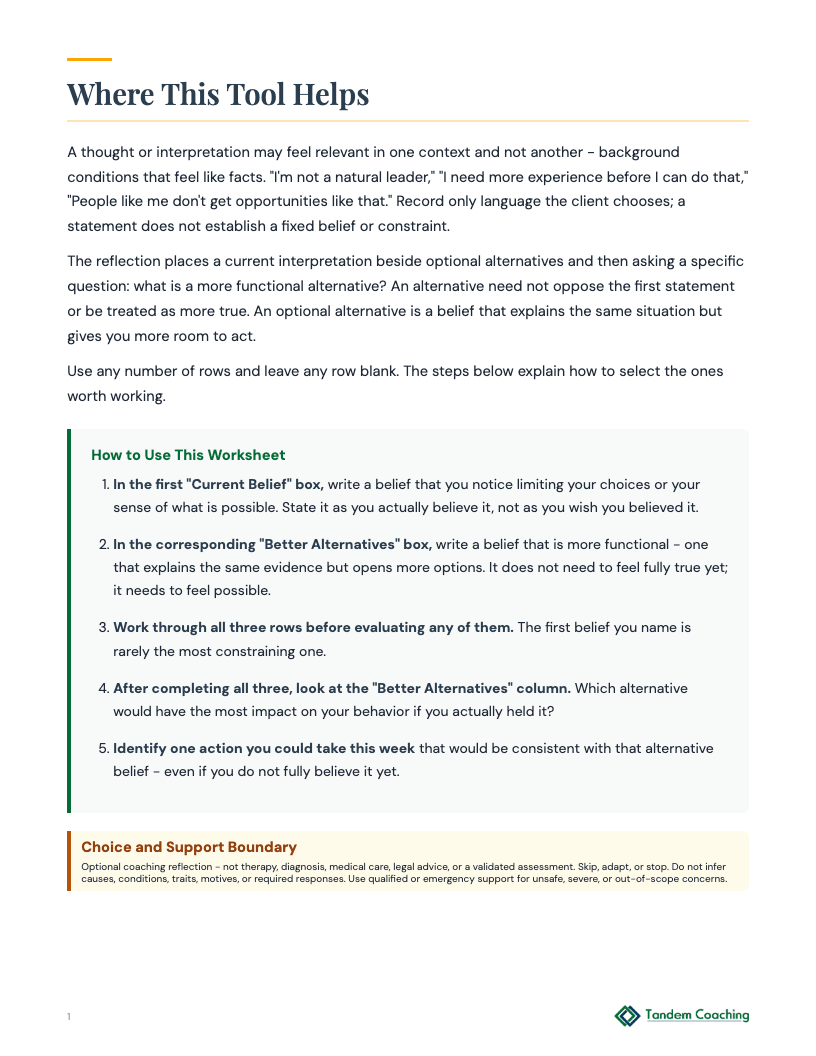
Position the grid as an accuracy test, not a positive reframe. 'You've described the belief that you're too direct for this culture in at least three different situations over the past several sessions. This tool asks you to write that belief in the first row, and then in the second column, write one or two alternatives that might also be true. The alternative doesn't have to be more comfortable than the original belief - it just has to be something you could actually believe based on the evidence you have. The post-tool questions ask which alternative would require the most from you and what you'd have to stop doing. Those are the diagnostic questions.' Framing alternatives as accuracy alternatives rather than positive substitutes reduces the reframe-resistance pattern.
Watch whether she writes one alternative or two, and whether the alternatives are genuinely different from the original belief or softened versions of it. 'I'm too direct for this culture' and 'I'm somewhat direct for this culture' are not meaningfully different alternatives - they share the same causal claim. A genuinely different alternative would challenge the premise: 'My directness works well in some relationships and not in others and I haven't mapped which' or 'The culture has more tolerance for directness than I've been testing.' Also watch the post-tool question about what she'd have to stop doing to hold the alternative belief. If the answer is 'I'd have to stop treating the belief as settled,' she has already seen the dynamic clearly.
Start with the alternative she wrote. 'Read me the alternative you believe most. Not the most aspirational one - the most believable one given your actual experience in this organization.' Then: 'You've identified what you'd have to stop doing to hold that alternative. Walk me through the last week - where specifically did the original belief function as a reason not to do something?' The behavioral trace - where the belief acted as a decision input in the past week - is more useful than discussing the belief abstractly. Then: 'If the alternative were true - the one you named as most believable - what would you have done differently in that situation?'
If the alternatives she writes are all variations of the original belief - if she cannot generate a genuinely different frame - the belief may be functioning as a fixed conclusion rather than an interpretation she holds. Severity: low to moderate. Name it directly: 'You've written three alternatives that all arrive at the same place as the original. I want to push one step further: is there anyone in this organization who would describe your directness as an asset? What would they say?' External perspectives often generate alternatives that self-directed reframing doesn't produce. If she cannot name anyone who views it as an asset, explore what that data means.
A senior manager of strategy at a technology company has consistently high performance reviews and strong technical credibility. He has been passed over for promotion twice. In coaching, a recurring belief has emerged: 'I'm not politically astute enough for the next level.' He uses this belief to explain why he doesn't build executive relationships proactively, why he declines invitations to participate in cross-functional working groups, and why he doesn't advocate for his team's visibility. The belief has become self-fulfilling: the behaviors it produces are creating evidence that the belief is accurate.
Name the self-fulfilling structure before introducing the tool. 'There's a dynamic worth naming before we work through this. The belief you've described - that you're not politically astute enough - produces specific behaviors: not building relationships proactively, not joining the working groups. Those behaviors then produce evidence that the belief is true. The grid asks you to write the belief and then identify alternatives. The alternatives need to be ones you could actually act from - not beliefs you'll hold in your head, but beliefs that would produce different behavior. The post-tool question is the one that matters most for you: what would you have to stop doing to hold the alternative? Because what you'd have to stop doing is probably what's been producing the evidence for the original belief.' The self-reinforcing structure needs naming before the reframe work can land.
Watch whether he writes alternatives in the 'skills' frame ('I could develop political intelligence') or the 'evidence' frame ('The evidence that I'm not politically astute is incomplete'). Skills-frame alternatives still accept the original premise and push resolution into the future. Evidence-frame alternatives challenge whether the belief is accurate now. The evidence-frame alternative is more useful as an action driver. In the post-tool question about what he'd have to stop doing, watch whether he names a specific behavior - declining the working group invitations - or a general disposition. Specific behaviors are the action target; general dispositions are not.
Start with the most behaviorally credible alternative - the one he could act from today. 'You've written [his alternative]. If that were true - if you accepted that alternative rather than the original - what would you do differently in the next two weeks?' The two-week time constraint tests whether the alternative belief is action-capable. Then: 'The cross-functional working group invitation you mentioned - you declined it because of the original belief. If the alternative were your operating assumption, what would your response to that invitation have been?' Using a specific recent decision as the test case is more productive than discussing the alternative belief in the abstract.
If the alternatives he generates are both future-oriented ('I could become more politically astute') and neither challenges the accuracy of the original belief in the present, the reframe has produced aspirational beliefs rather than alternatives that could change current behavior. Severity: low. Work through one alternative with him in session that challenges the current evidence directly: 'You've built strong relationships with your direct reports and at least two cross-functional peers. What would someone who is genuinely politically unaware do differently than you have done?' The evidence challenge sometimes produces an alternative he can believe more quickly than constructing one from scratch.
A director of communications at a healthcare system has been considering an internal move to a VP role for eighteen months. Every time the conversation comes to action in coaching - identifying a specific opportunity, reaching out to the hiring manager, signaling interest internally - a consistent belief appears: 'I need more experience before I'm ready.' Her coach has cataloged seven situations over eighteen months where this belief arrived as a reason not to act. The belief applies equally to situations involving direct readiness evidence and to situations where the readiness case is strong. She treats it as a conclusion rather than examining it as a belief.
Use the eighteen-month pattern as the entry point. 'This belief - that you need more experience before you're ready - has appeared in seven different conversations we've had over the past eighteen months. It has been the reason not to act in each of those situations. This grid asks you to write that belief and then write better alternatives. The word 'better' in the column header means more accurate, not more positive. An alternative is better if it more completely accounts for the evidence you have. The post-tool question asks what you'd have to stop doing to hold the alternative. I suspect the answer will be specific.' The eighteen-month data is the evidence the reframe is built on.
Watch whether the alternatives she writes are timeline-shifting versions of the original belief ('I'll be ready in six months') rather than genuine alternatives to the readiness premise ('My current experience is sufficient for this role and I've been treating readiness as a threshold I can't name'). Timeline shifts don't change the belief - they defer it. Also watch what she writes for 'better alternative' when the readiness belief has produced paralysis: clients in this pattern often produce alternatives that feel good to write but don't challenge the premise ('I am always growing'). The post-tool question about what she'd have to stop doing is the most productive section - it often produces the most specific answer and the clearest action target.
Start with the post-tool question. 'You've answered what you'd have to stop doing to hold the alternative. Read it to me.' If the answer names a specific behavior - stopping the research phase before signaling interest - that becomes the action target. Then: 'The VP role that opened three months ago - you chose not to signal interest. If you were holding [her alternative belief] at that moment, what would you have done?' The specific decision reversal test makes the alternative concrete. Then: 'What would more experience actually look like? Name it specifically - what would you have at the end of six more months that you don't have now?' If she can't name it specifically, the readiness threshold isn't real.
If the alternatives she writes across all three rows are all timeline-based ('I will be ready when I have X') rather than evidence-based challenges to the readiness premise, the belief is functioning as a permanent protective structure rather than a hypothesis she's willing to test. Severity: low to moderate. Name it directly: 'You've written alternatives that all require more time. None of them challenge whether the readiness threshold you're pointing to actually exists or whether you've met it. Is there a version of this where you are already ready, and what would it take for you to consider that version seriously?'
A high-achiever who suspects imposter syndrome is operating under the surface but hasn't examined it directly
LifeMy client keeps going back and forth on a decision and can't move forward
LifeMy client says they know what they value but their choices don't reflect it