Belief Evidence Reflection
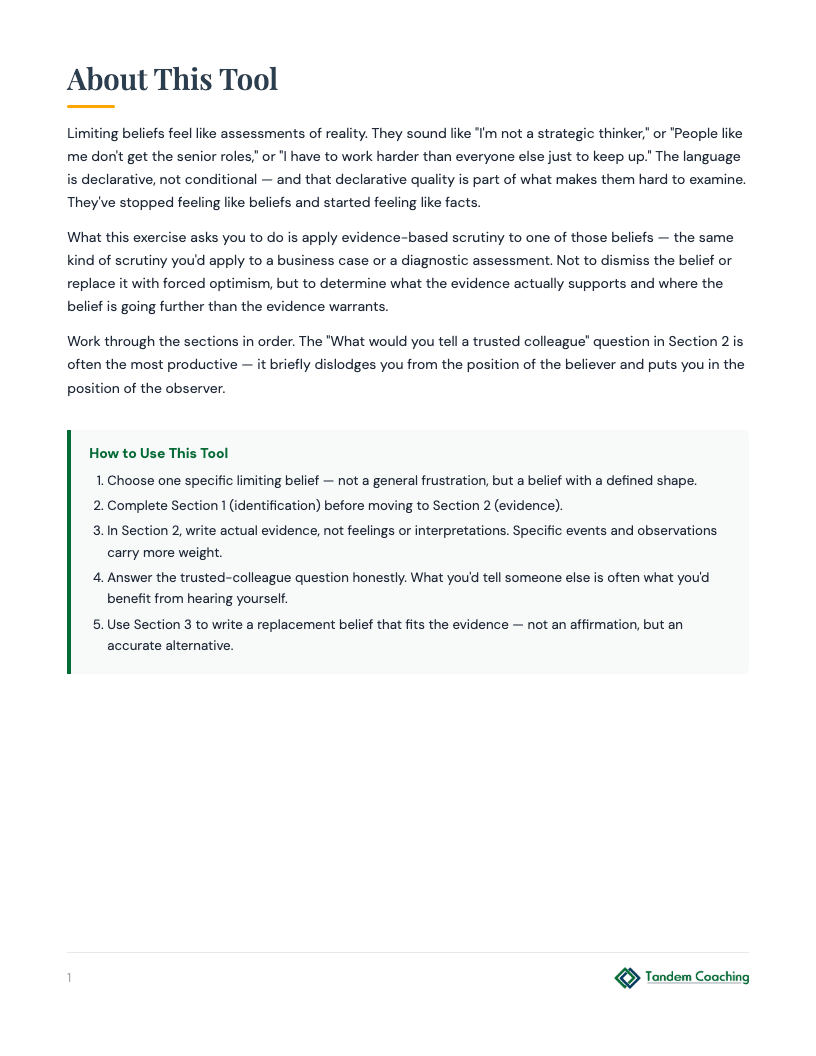
Compare a belief with supporting and contradicting evidence, then write a more accurate alternative.
Get This Tool
Free, print-ready PDF.
When to Use This Tool
A client who keeps bumping into the same ceiling and suspects the block is internal rather than external
Someone who's identified a limiting belief but hasn't examined where it came from or tested whether it's true
A professional whose behavior in high-stakes moments is being driven by an assumption they've never questioned
How to Introduce This Tool Plus
Name the belief you want to work on. Not the surface version — the one underneath that, the story you're actually running on. What is it telling you about yourself or what's possible?
Coaching Tool Disclaimer
This tool is designed for coaching contexts, not clinical use. If you or your client is in crisis, contact the 988 Suicide and Crisis Lifeline (call or text 988) or Crisis Text Line (text HOME to 741741).
Browse All Pages
Tool Classification
Domain
Life Coaching
Type
Worksheet
Phase
Discovery
Action
Details
30 min
Between sessions
As-needed
Topics
Mindset
Identity
For the Coaching Practitioner
Plus
Coaching Scenarios
Plus
1 Senior leader whose coaching goals keep cycling back to the same root concern ▶
Context
A VP of Sales has been in coaching for four months. She has cycled through three different stated goals: communication with her CEO, building a high-performance team culture, and personal resilience. Each goal produces good conversation and some behavioral shifts, but within six weeks she returns to describing a sense of being 'fundamentally not enough' for the role. She is performing well by external measures. The surface goals are real, but they are not the work.
How to Introduce
This tool requires a specific framing to land well: 'We've been working on the presenting layers — how you communicate, how you lead, how you recover. I want to go deeper and look at the beliefs underneath those behaviors. This is a different kind of work — it takes longer and feels less concrete at first. Are you willing to sit with that for a few sessions?' The resistance to watch for in this scenario: clients who are high-performers often experience belief excavation as indulgent — 'I should just change the behavior.' Name it: 'The behaviors are symptoms. If we keep treating symptoms, the same pattern reappears, which is what's been happening.'
What to Watch For
This tool has three pages. The depth of engagement typically increases across the pages. Watch whether the client's Limiting Belief in the first box is genuinely excavated or whether it's a socially safe version of the real one. 'I sometimes doubt my capabilities' is a safe version; 'I believe that people who perform at this level were born with something I don't have' is an excavated one. Also watch the Evidence For column — clients with strong internal critics can generate extensive evidence for the belief quickly, which is diagnostic in itself.
Debrief
Start with the Evidence Against column. Ask the client to read each item aloud. Then ask: 'When you wrote these, did they feel equally real to you as the evidence for the belief?' The asymmetry in felt-truth between the two evidence columns is usually significant — and naming it opens the question of what maintains that asymmetry. From there, the Alternative Belief: 'Write a belief about yourself that accounts for the same evidence. Not the opposite — something more accurate.' The word 'accurate' is more useful than 'positive' for clients who are evidence-oriented.
Flags
If the excavated limiting belief contains themes of unworthiness, fundamental deficiency, or believing they have deceived others into thinking they are competent — particularly if these themes are stable and pervasive across multiple life domains — the depth of the belief may require sustained therapeutic work to address. Severity: moderate. Continue coaching and use the tool to build awareness, but assess whether the client's belief system is within the normal range of coaching work or whether they would benefit from parallel therapeutic support.
2 Leader transitioning industries whose transferable value is invisible to himself ▶
Context
A director of strategy at a healthcare company is in the process of transitioning into technology. He has strong analytical capability, stakeholder management experience, and a record of delivering complex change initiatives. Every conversation about the transition involves extensive hedging: 'I don't have the technical background they'll expect,' 'I'll be starting over,' 'they're going to see through me.' His coach suspects he has a belief about what makes someone qualified for roles in technology that is filtering out his own qualifications.
How to Introduce
Frame this as a belief audit rather than career support. 'You keep coming back to what you lack. Before we work on positioning for the transition, I want to excavate the belief underneath that list. Because your actual qualifications tell a different story than the one you're leading with.' The three-page structure is particularly useful here — the first page surfaces the belief, the second examines the evidence, the third constructs an alternative. Walk him through each page in a single session rather than between sessions.
What to Watch For
Pay attention to the specificity of the belief he excavates. 'I'm not qualified for technology' is too broad to work with. 'I believe that technology organizations only value people who can build technical systems, and my work is in strategy, not systems' is a belief with a specific and examinable structure. Push for that level of specificity before moving to the evidence page. Also watch whether the Evidence For column is populated primarily with information about what others have (technical credentials, CS degrees) versus what he lacks — the comparative framing is its own pattern.
Debrief
After the Evidence Against column is populated, ask: 'If a candidate presented this evidence to a search committee, would you say they're qualified for a senior strategy role in technology?' The third-person reframe makes the evidence more visible to clients who are systematically discounting it. Then move to the Alternative Belief: 'What's a belief about your qualifications that accounts for everything in the Evidence Against column?' This sequence often produces a significantly different self-description than the one the client started with.
Flags
If the client's limiting belief about the transition is inseparable from beliefs about age, belonging, or not being 'one of them' in a culturally homogeneous field — and these themes feel charged beyond career strategy — explore whether identity is operating below the surface. Severity: low. The tool is appropriate, but the transition work may carry more weight than the professional-change framing suggests.
3 Manager whose relationship to authority figures follows the same pattern across jobs ▶
Context
A manager has been with her current organization for three years and has had three different managers in that time. With each one, the relationship has followed the same arc: initial enthusiasm, a period of strong collaboration, then a precipitating event that she experiences as a betrayal of trust, followed by significant disengagement. She attributes each instance to the specific manager's flaws. Her coach has noted the pattern but the client hasn't connected the three instances.
How to Introduce
This requires careful framing — the pattern involves other people, and the client may experience belief excavation as an accusation. 'I want to look at what you've come to believe about authority figures in professional settings — not whether those beliefs are fair, but what they predict and whether they're serving you. We're going to use these three instances as data.' Position the authority-relationship belief as a working hypothesis to be examined, not a conclusion.
What to Watch For
Watch whether the Limiting Belief the client identifies is specific to behavior ('I believe my managers will eventually prioritize their own career over our relationship') or global about authority ('I believe people in authority positions are ultimately not trustworthy'). The specificity of the belief determines what's workable. A behavior-specific belief can be examined against evidence; a global belief about authority requires more sustained work. Also watch the Alternative Belief — clients with stable authority-relationship patterns often generate alternatives that are closer to 'managed expectations' than genuine belief revision.
Debrief
After completing the three pages, bring the three instances back in. 'If we look at the Alternative Belief you've written — what would have been different in instance two if this was the belief you were operating from?' This makes the belief's behavioral consequences visible in a specific historical situation rather than an abstraction. It also gives the client something concrete to examine rather than a general intention to 'trust more' or 'expect less.'
Flags
If the precipitating events in all three instances involve a specific type of interaction — public criticism, being overruled, discovering the manager had made a decision affecting her without consultation — the pattern may have roots in earlier authority relationships that coaching alone may not resolve. Severity: moderate. Continue coaching and use the tool to build awareness, but assess whether the pattern is within the range of behavioral coaching work or whether a referral to a therapist would be beneficial to address the underlying authority relationship pattern more deeply.
Tool Flow
Plus
Requires
- named limiting belief suspected to drive behavior
→
Produces
- excavated limiting belief with origin and duration
- evidence-examined belief record with contradicting data
- evidence-based replacement belief with one aligned action
Pairs Well With
Life
Values and Activity Context Map
Use this assessment to take stock of values and accountability before the client chooses what deserves attention.
Why it pairsOnce you've surfaced the replacement belief, this checks it against the client's actual value hierarchy before they act on it.
LifeSMART Goal Planner
A client wants to use SMART Goal Planner as an optional reflection
Why it pairsThe worksheet closes with one aligned action - use this to build that action into a specific, deadline-bound commitment right away.
LifeLife Purpose Discovery
A client wants to use Life Purpose Discovery as an optional reflection
Why it pairsAfter excavation clears what the client thought they couldn't do, purpose discovery answers what they actually want their life to stand for.
Related Articles

Coaching Supervision for Internal vs. External Coaches
Read article →
Do You Have to Tell Clients You Use AI? Standard 2.5 in Practice
Read article →
Definition of Done – More Than a Checklist
Read article →
What Your Career Has Taught You — And What It Hasn’t
Read article →