Turn descriptive journaling into insight with targeted prompts and a simple rating scale that makes patterns and progress clear over time.
Free, print-ready PDF.
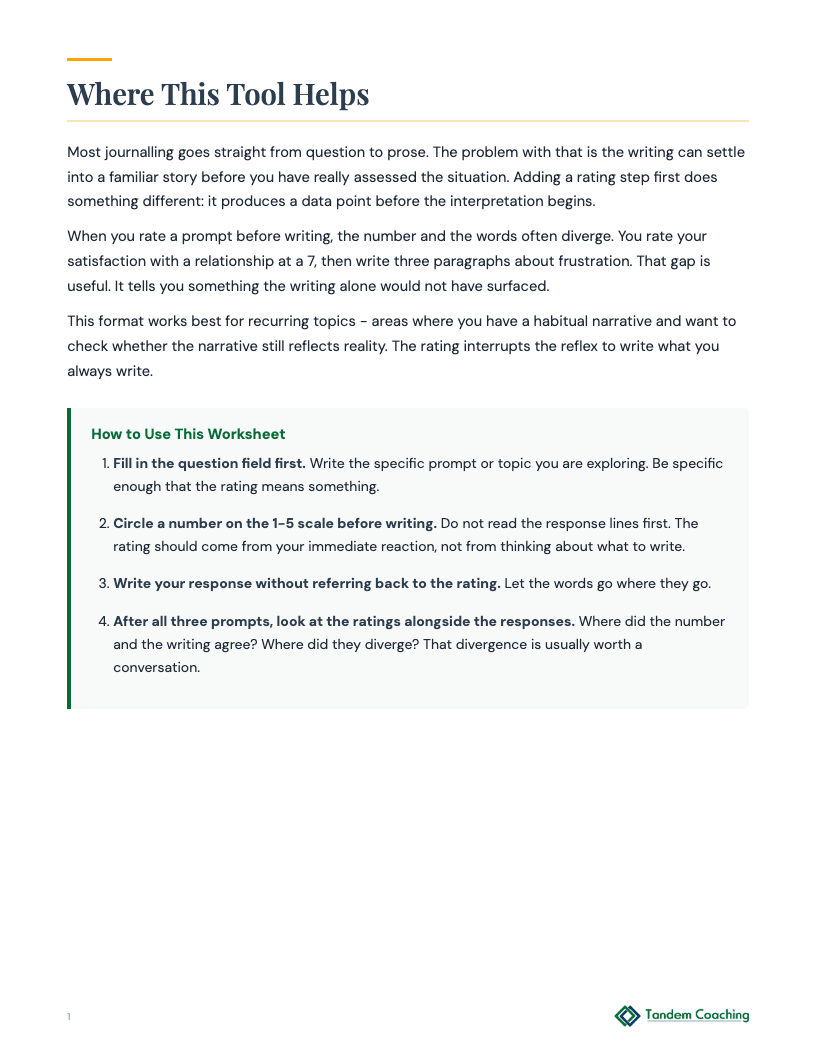
This gives you three prompts, each with a 1-5 rating and space for a written response - would using it between sessions and bringing the results give us a richer starting point than a verbal check-in?
A chief of staff to a Fortune 500 CEO is sharp, articulate, and excellent at summarizing situations for others. In coaching sessions his responses are detailed and accurate but they never quite land anywhere - he describes what happened, what was said, who was in the room, but stops short of telling you what he thinks or what it means. His coach has noticed that when pressed for interpretation he defers to 'it depends' or restates the facts. He uses precision as a substitute for perspective.
Frame the rating step as the tool's mechanism, not an add-on. 'Most journaling exercises ask you to write about something. This one asks you to rate it first - 1 to 5 - before you write. That rating is a data point you commit to before your analytical brain takes over. Your job is not to justify the rating. It is to notice what the rating and the writing are doing differently.' The resistance to name: clients who are strong analytical thinkers sometimes rate everything at a 3 to avoid commitment. If that happens, name it directly.
Watch the gap between the rating and what gets written. If he rates a situation 4 but the written reflection is neutral and measured, the rating captured something the writing is suppressing. If he consistently rates in the 2-4 range with nothing at the extremes, he may be performing balance. The most useful entries are the ones where the rating and the writing contradict each other - 'I rated this a 5 for stress, but here's why it was fine.' That contradiction is the conversation. Watch also for entries where the written section sounds like a memo rather than reflection - he will default to that mode.
Start by reading a rating he gave and then reading the corresponding written entry. 'You rated this a 4. I'm reading what you wrote. What's missing from the writing that the number knew?' That framing - 'what the number knew' - tends to work with analytical clients because it names the rating as intelligence, not feeling. Then find any entry where the written reflection contradicts the rating. 'Tell me more about what was actually happening here.' The goal is to locate the moment where he starts editorializing rather than reporting.
If every entry across two weeks reads like a situation report with no personal stake or perspective - if you could not tell from the writing alone that this person is the subject - the tool is being used as a documentation exercise rather than a reflective one. Severity: low. This is a coaching conversation about why insight feels less safe than accuracy. It is also possible the prompts in this tool are not the right access point for this client; consider whether a values or identity-focused tool gets closer to where his self-knowledge actually lives.
An operations director is three sessions into coaching with a clear presenting issue: she feels undervalued and invisible in the senior leadership team. She has provided her coach with extensive documentation - meeting notes, email threads, org chart analysis - and can describe the organizational dynamics precisely. But when her coach asks 'what do you want from this situation?' she pivots back to describing the problem. She has not answered the question directly in any session.
Frame the rating as a commitment mechanism. 'Before you write anything, you rate the prompt from 1 to 5. That number is your answer before your brain edits it. What you write after is your chance to make sense of the number - not to argue with it.' For her specifically: 'The prompt is going to ask what you want. Rate how clear you are about that first - 1 being completely unclear, 5 being completely clear. I'm less interested in the writing than in what the gap between your rating and your entry tells us.' The resistance: she may rate herself high on clarity and then write something vague. That contradiction is the data.
Watch whether the written response to any want-focused prompt is specific enough to be actionable. 'I want to be valued' is not a want - it is a result. 'I want to be included in the Q3 planning conversation' is a want. If every entry stays at the outcome level without ever reaching a specific request or behavior, she is describing desire without identifying an ask. The rating is useful here: if she rates clarity at 2 and then writes something that sounds confident, the low rating may be more honest. Watch for any entry where she names something concrete - that is the session to work from.
Start by reading the prompt's rating and then the written entry for any session where they diverge significantly. 'You said you were a 2 on clarity here, but this is what you wrote. What would a 5 look like?' Then look at all the entries together: 'If I read everything you've written here across the week, what does this person want?' Let her answer that question about herself in third person - it sometimes creates enough distance for something specific to emerge. Follow with: 'Is there anything in this record that surprised you - something you wrote that you hadn't said to me yet?'
If three or more sessions of rating-and-reflection produce no specific, actionable want - only descriptions of the problem and its unfairness - she may be using the documentation (including this tool) as a way to build a case rather than to find a path. That pattern can mean the presenting issue is not the real issue, or that she is not yet ready to take action she already knows she needs to take. Severity: low. Name the pattern without judgment: 'I notice everything we've gathered describes what's wrong. I want to understand what you want to do about it.' Then assess whether she is stuck in analysis or in something else.
A VP of People has been named executive sponsor of a large-scale performance management overhaul. She is two months in, and her team is waiting for direction. She has been gathering information - reading frameworks, meeting with stakeholders, collecting perspectives - and has not yet made any commitments. She describes this as due diligence. Her manager describes it as stalling. Her coach suspects she does not yet know where she stands.
Frame this as a way to distinguish information-gathering from position-formation. 'Right now you're collecting perspectives. This tool is going to ask you to commit to a number before you write - that number is your current position, even if it feels incomplete. The writing is where you explore the number, not where you decide whether it was right.' For the initiative specifically: 'Pick one design question you've been sitting with. Rate your confidence in your position from 1 to 5. Then write where that number comes from.' Do this in session first before assigning as between-session work.
Watch whether the ratings on the same prompt shift across the week. Increasing clarity (1 to 3 to 4) suggests she is actually forming a position through reflection. Stable low ratings on the same question week after week suggest she is waiting for permission or more information - neither of which the reflection is providing. Watch what she does with a high-confidence rating: if she rates her position at 4 and then spends the written section qualifying it, she may have the position but is not ready to own it. The qualifier pattern is the coaching conversation.
Start with the highest-confidence rating she gave all week. 'You rated yourself a [4] here. Read me what you wrote.' Then: 'That sounds like a position. Is that your position?' If she hedges, stay with it: 'What would you need to drop the hedge?' Then go to the lowest-confidence rating. 'This one's a 2. What's keeping this unclear - is it information, or is it something else?' The distinction between needing more data and not wanting to take a stand is the question she has been avoiding. The tool gives her enough of a structure to approach it.
If all ratings across two weeks cluster at 1-2 regardless of the prompts, and the written sections are all framed as questions rather than positions, the clarity she needs may not come from more reflection. Severity: low. She may need a structured decision-making tool rather than a journaling tool - or a direct conversation with her manager about what 'executive sponsorship' actually requires her to decide and own. Consider whether the coaching work is about helping her find a position, or helping her understand what is making positions feel unsafe.
Client has strong self-knowledge but struggles to act on what they know
ADHDA client is unsure whether what they're experiencing is ADHD, depression, or both
LifeClient notices the internal commentary but has never examined what it assumes or whether it's accurate