Spot the hidden assumptions in your inner commentary and test whether they’re true, using a structured audit grounded in evidence and patterns.
Free, print-ready PDF.
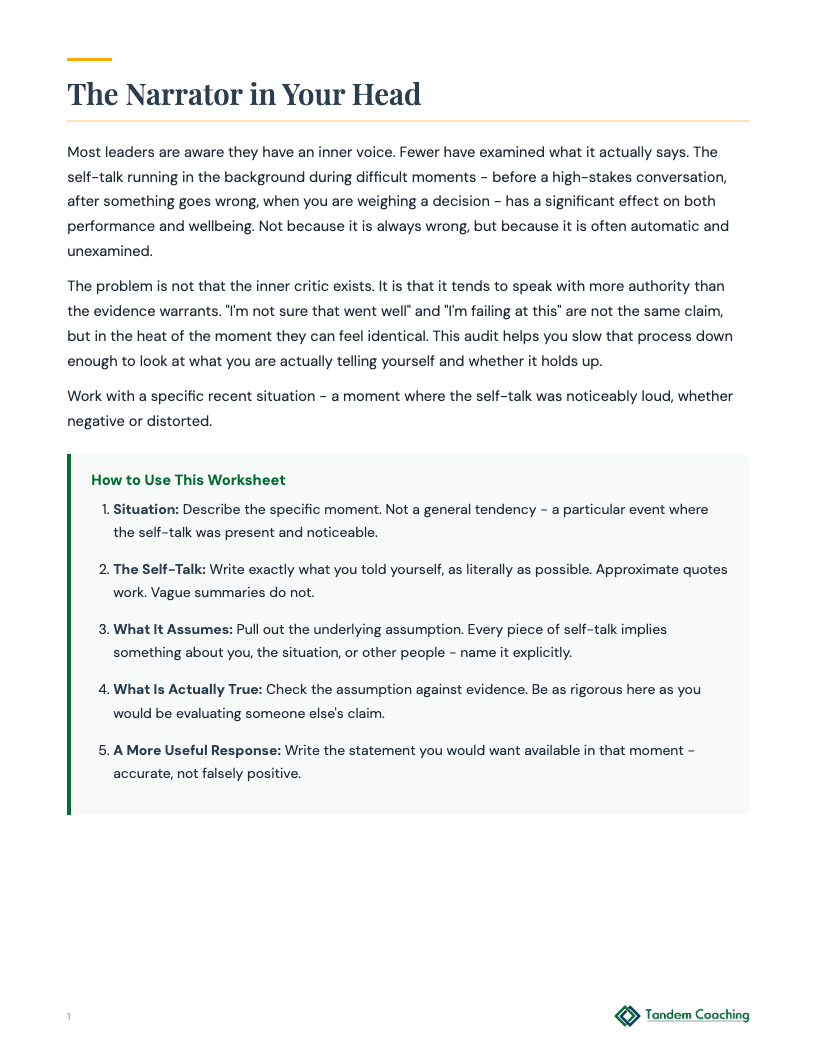
This tracks the self-talk from a specific situation through what it assumes, what's actually true, and what a more useful internal response would be - would working through a recent example be a useful way to use our time?
A manager describes preparing well for presentations but experiencing a sharp internal shift once they're in the room. Content confidence collapses into a running commentary: others know more, the audience is bored, they're being assessed negatively. They can't identify the assumption driving it, only the outcome - they underperform relative to their preparation.
The worksheet works backward from the moment the self-talk activates. 'We're not starting with what you should think instead - we're starting with what you actually think, in that specific room. Column two is verbatim. Not the tidy version - the one that runs while you're talking.' Some clients resist Column 2 because writing it down makes it feel more real. Name it: 'What you write there isn't a belief you're endorsing. It's data about what's running in the background.'
Watch Column 2 closely. If the entries are vague ('I get nervous', 'I worry about how it's going'), the client has described a state, not the self-talk. Push for the actual sentence: 'What does the voice say, specifically? What's the exact thought?' Also watch Column 3 - the underlying assumption. Clients often write a second layer of self-talk here rather than the belief beneath it. 'What would have to be true about you or the situation for that thought to make sense?' is the question that surfaces the assumption.
Start with the Column 3 entries - the assumptions. Ask: 'How long has that assumption been operating? Is this specific to presentations or does it show up in other high-stakes situations?' If the assumption is domain-specific, the intervention can be targeted. If it crosses contexts, that's a different scope. Then move to Columns 4 and 5 together. 'Of what you wrote in Column 5, which version could you actually access in the moment - not in advance, but right then?' That question makes the worksheet actionable rather than an exercise in retrospective analysis.
If the Column 3 entries describe fundamental beliefs about capability ('I'm not actually qualified', 'I'm going to be exposed') rather than situation-specific interpretations, the self-talk pattern may be more entrenched than a single exercise can address. Severity: low. The worksheet is still useful for mapping, but note whether the assumption appears to predate this role or situation - that context shapes what interventions are realistically available.
A newly promoted VP describes a persistent comparison loop: every difficult situation triggers a mental inventory of what peers at this level would know that they don't. The self-talk is comparative and anticipatory, not tied to specific failures. They describe it as a low-level hum that affects decision confidence and willingness to take positions in senior forums.
Anchor this to a concrete recent situation rather than the general pattern. 'Pick the last time this showed up clearly - a specific meeting, a specific decision. We're going to run that one through the worksheet rather than the pattern in the abstract.' The five columns work better with specific events. Some clients in this situation resist writing Column 2 because the self-talk sounds petty or irrational when written. Name it: 'The point of writing it down isn't to judge it. It's to see what's actually driving the behavior.'
Watch Column 3 - the assumption - for scope. If the assumption is 'I'm not ready for this level,' that's different from 'I should already know what I don't yet know.' The scope of the assumption determines what kind of response in Column 5 is plausible. Also watch Column 5 for the characteristic substitution problem: clients replace the self-talk with its opposite ('I am ready') rather than with a more accurate statement ('I've handled situations like this before and learned the rest'). The reframe needs to be credible, not just positive.
Start with Column 4 - the accurate evidence. Ask the client to read it aloud and then ask: 'Is that evidence available to you in the moment, or does it only appear afterward?' Evidence that can only be accessed retrospectively won't interrupt the pattern. Then move to Column 5 and ask: 'What would need to be true for you to actually say that to yourself, in that room, during the next situation like this?' Close by asking which of the five columns was hardest to complete and what that difficulty tells them about where the leverage is.
If the Column 2 entries extend beyond professional capability concerns into identity questions ('I don't belong here', 'I'm not the kind of person who does this'), the intensity of the imposter dynamic may warrant more direct attention than a self-talk reframing exercise provides. Severity: low. Continue coaching and note whether the pattern appears across multiple contexts or is specific to this role transition.
A senior individual contributor describes a pattern their manager has also noticed: specific critical feedback produces a withdrawal response that persists well beyond what the feedback situation calls for. The client can acknowledge the feedback as valid but cannot stop the internal narrative that converts it into a statement about their overall trajectory. The withdrawal is visible to their team.
Position this as a translation exercise. 'Something happens between receiving the feedback and the story you end up with. This worksheet maps that translation - what actually happened, what you said to yourself about it, what assumption that rests on, and what the evidence actually supports.' Clients who are high performers often resist the exercise because they've already integrated the behavioral lesson from the feedback. Name the distinction: 'This isn't about whether the feedback was right. It's about what you added to it after.'
Watch Column 3 carefully. The assumption the client names should explain why the specific feedback produced the magnitude of response it did. If the assumption is 'I need to be correct' or 'mistakes mean something permanent about me,' that's what the worksheet is working with - not the original feedback. Also watch Column 4. Clients in this pattern often write evidence that confirms the self-talk rather than accurate evidence. If Column 4 looks like Column 2 with softer language, the client hasn't yet accessed counterevidence. 'What would someone who had watched your last three years of work say to that entry in Column 4?'
Start with the gap between Column 2 and Column 4. Ask: 'What's the distance between what you said to yourself and what the evidence actually supports?' Then ask about Column 3: 'When did that assumption first start running - is it specific to this role or does it have a longer history?' The answer usually changes the scope of what the worksheet can accomplish in isolation. Close with Column 5: 'What would you actually need to believe about this situation for Column 5 to feel true rather than aspirational?'
If the feedback-response cycle includes significant behavioral disruption (days of withdrawal, visible impact on team communication, difficulty re-engaging with the work), the emotional intensity may be beyond what a cognitive mapping exercise can address alone. Severity: low to moderate. The worksheet is useful for awareness and framing, but note whether the intensity of the feedback response suggests a pattern that needs more direct attention.
Client has strong self-knowledge but struggles to act on what they know
ADHDA client is unsure whether what they're experiencing is ADHD, depression, or both
LifeClient is aware of self-critical thinking but has not identified which specific patterns are most active