Break past repetitive, surface answers with structured prompts that explore the same issue from multiple evidence-based perspectives.
Free, print-ready PDF.
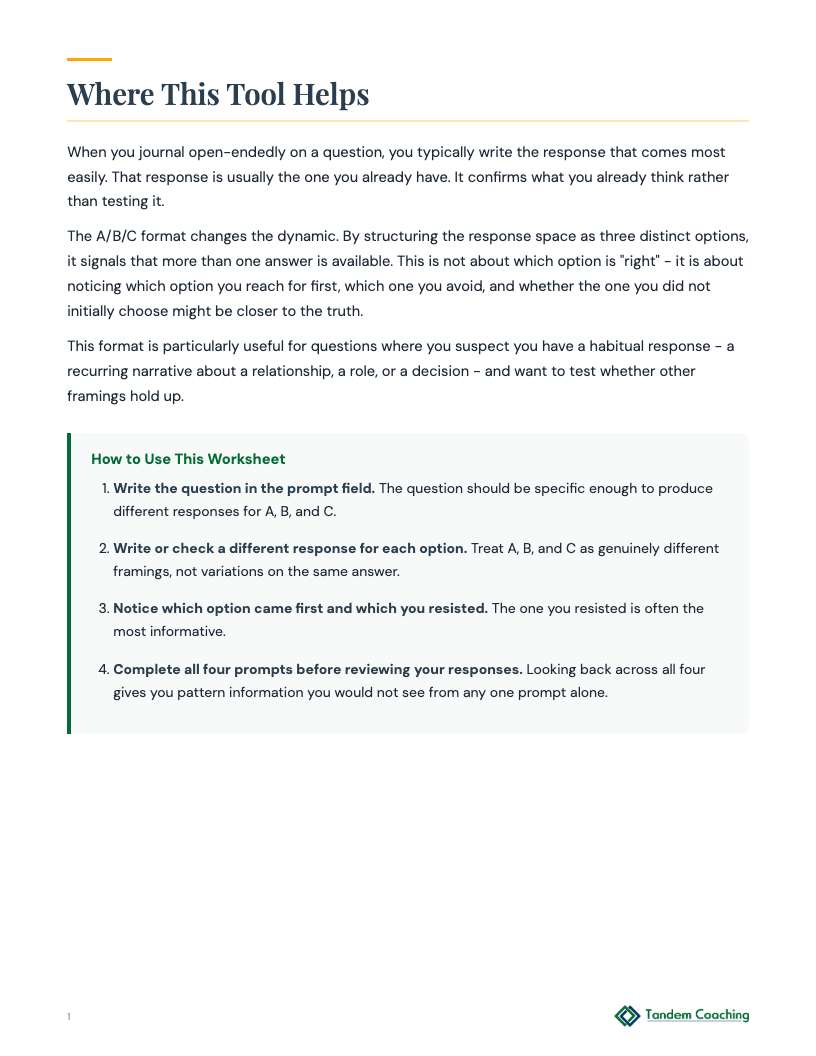
There's a worksheet that asks the same question three different ways — logical, emotional, and observer. Would you be open to trying it on a question that's been on your mind?
A senior manager at a financial services firm has been exploring a specific career question for three sessions. Each time the topic comes up, she gives the same answer - articulate, considered, and unchanged. She's not avoiding the question; she's locked into her first response and cannot seem to move past it.
Don't frame this as a journaling exercise for someone who already journals. 'This worksheet asks the same question three ways before you move on. We're going to use it on the question you've been answering the same way for three sessions. Write your first answer in A. Then I want a second answer from a completely different angle in B. Then a third in C that neither of the first two touched.' The A/B/C labels make it feel structured rather than exploratory, which reduces resistance.
B and C responses that are elaborations or qualifications of A rather than genuinely different angles. That pattern is subtle - the client thinks she's giving a different answer when she's actually defending the first one from a slightly different position. Watch for length differences: when one response is significantly longer than the others, it's usually the one she believes.
After she's completed the four questions: 'Which response across the whole worksheet surprised you most - something you wrote in B or C that you didn't expect?' Then: 'Was there a response in C that you resisted writing?' The resistance signal is often where the most useful material is. Then look at Question 1 specifically: 'Your A answer on this one - does it look the same after seeing B and C?'
A client who produces genuinely identical A/B/C responses - not subtle variations, but the same core content expressed in different words - may have a belief system around the question that is not accessible through reframing. Severity: low. Don't push. Use a different question on the next prompt block, one that doesn't carry the same weight, to demonstrate the format before returning to the loaded one.
A COO is deciding whether to take on a board position at an organization he respects. He's been framing the decision in terms of time constraints and strategic fit. In sessions, he keeps returning to it without resolution. The problem isn't information - he has plenty. The problem is that he's been analyzing it from one angle.
'You've been working this decision from the strategic angle for a few sessions. This worksheet applies a different structure - same question, three different lenses. I want you to use: what makes sense logically, what you actually feel about it when you drop the analysis, and what you would tell a close friend if they were in your situation and you had to give advice. Write Question 1 as the decision itself.'
Responses where the 'logical' angle is substantially longer than the emotional or outside-observer angle - this usually indicates the client has been running primarily on the analytical channel and the other two are underdeveloped. Watch for the emotional angle to be disguised as logic ('it doesn't make strategic sense for my bandwidth right now'). Ask him to separate the feeling from the rationale.
Start with the outside-observer angle - what he'd tell a close friend. 'Is the advice you'd give a friend different from what you're actually doing?' That question surfaces the gap between the perspective he can access for others and the one he's applying to himself. Then: 'Look at your emotional angle. Is there a clear answer in there that you've been arguing with?'
A client who finds the emotional perspective column impossible to write - not brief, but genuinely blank after a full attempt - may be systematically suppressing the affective channel in decision-making. Severity: low to moderate. Don't diagnose this in session. Note it, and return to it with a softer question: 'What would this decision feel like if it were already made in each direction?'
A director of strategy generates good insight during coaching conversations. She leaves sessions with clear observations about her patterns and preferences. By the next session, those insights have faded - she remembers the conversation happened but not what she concluded. Writing between sessions hasn't stuck because it feels like homework.
Frame this as a structure, not a journaling practice. 'This isn't free-writing. It's four questions, each answered three ways. You pick the four questions - they should be things you're currently working on. The structure holds the reflection so you don't have to generate it from scratch.' The difference between this and open journaling is that the A/B/C structure is already there. She's filling in, not generating.
Clients who pick safe or abstract questions - 'What does leadership mean to me?' - rather than specific active situations. The format works best when the question is live: a current decision, a current relationship, a current friction. If her questions are all categorical, the answers will stay categorical. Push toward the specific: 'Turn that into a question about something happening this week.'
Ask her to bring the completed worksheet to session. Don't summarize it for her - ask her to read the response she found most useful. Then: 'Is there anything in here that you wouldn't have arrived at in a conversation without the writing?' That question tests whether the written format is adding something or just documenting what she already knows in session.
A client who consistently completes the worksheet thoroughly between sessions but says she found it unhelpful may be in a category where writing surfaces content but doesn't process it. Severity: low. The worksheet may be serving as good pre-work material for the session conversation, even if she doesn't experience it as valuable on its own. Reframe accordingly: 'Think of it less as the work and more as the prep.'
Client has strong self-knowledge but struggles to act on what they know
ADHDA client is unsure whether what they're experiencing is ADHD, depression, or both
LifeClient notices the internal commentary but has never examined what it assumes or whether it's accurate