Plan your week while clearing last week’s lingering tension, using a coach-tested structure that keeps priorities calm and realistic.
Free, print-ready PDF.
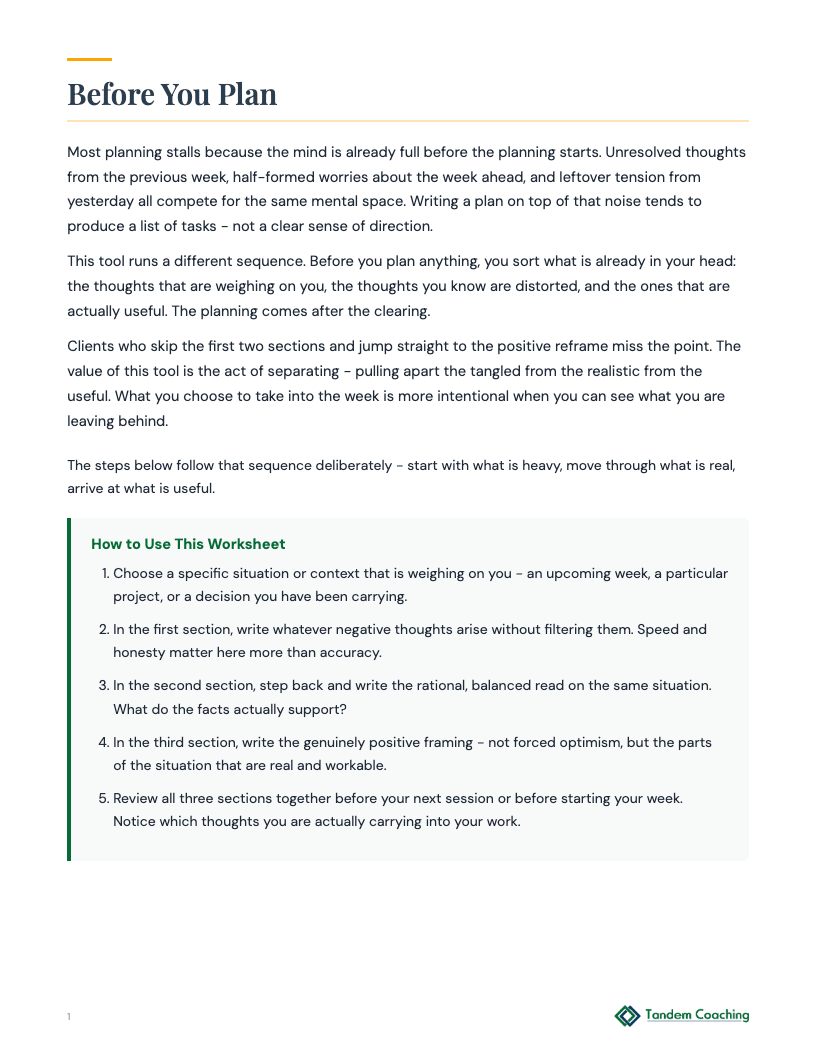
There's a structure here that sorts what's weighing on you before you plan anything - it moves from what's heavy, to what's accurate, to what's actually useful - would that be a helpful way to open this week?
A director at a mid-size company is disciplined about weekly planning - they block time, set intentions, and build task lists. But they arrive at Monday with unresolved tension from the previous week that bleeds into everything: meetings feel heavier, small things irritate, and their team picks up on the residual edge. The planning is solid. The clearing isn't happening.
Frame this as a pre-planning tool, not a planning tool. 'Before you write the week's list, this worksheet clears the field first - what's weighing on you, what's actually accurate about what's weighing on you, and what's real and usable. The planning comes after.' Some clients resist because it sounds like journaling. Call it cognitive sorting: 'You're separating signal from noise before you plan, not instead of planning.'
Clients who complete the Rational Thoughts section by dismissing everything in the Negative section ('that's just anxiety, it's not real'). The rational read isn't supposed to erase the negative thoughts - it's supposed to sit alongside them. If the Rational section is all corrections of the Negative section rather than an independent read of the same situation, the client is editing, not sorting. Watch also for Positive sections that are aspirational ('things will work out') rather than specific to the current situation.
Ask the client to read their Negative section first, then their Rational section. Ask: 'Which thought in Negative is still present even after you wrote the Rational version?' That thought is the one that has hold. It's also usually the one worth spending time on in session. Then: 'What from the Positive section do you want to carry into the week - and what might get in the way of actually carrying it?' That sequence moves from diagnosis to intention.
A client whose Negative section contains several specific, named thoughts about a colleague, a relationship, or a recurring conflict - and whose Rational section consistently minimizes or explains away those thoughts - may be using rationalization as a way to avoid a direct conversation they've been deferring. Severity: low. Surface the pattern, not the content: 'I notice your Rational section tends to explain these away. What would happen if you didn't?'
A senior consultant describes the start of every week as already behind. She has too much in her head, too many open loops, and a physical feeling of tightness that begins Sunday evening. She has tried task management systems, time-blocking, and prioritization frameworks. None of them have addressed the underlying cognitive load because none of them start with clearing.
Introduce this during a session where the overwhelm is present. 'Before we plan anything today, let's spend 10 minutes sorting what's already in your head. Three sections - what's weighing on you, what's actually accurate, what's useful and real. We're not solving anything yet, just sorting.' The sequence matters: negative before rational before positive. Don't let her skip to the positive.
Negative sections that are comprehensive and specific ('I'm going to miss the Thursday deadline, my client is already frustrated, my manager thinks I'm dropping balls') - these clients have done the work. Watch for Rational sections that add new items instead of addressing what's in Negative: 'I should also think about X' signals cognitive expansion, not sorting. Also watch for the Positive section to be empty or one-line - for high-output clients under pressure, positive framing often genuinely feels inaccessible.
Start with the Rational section. 'Which of the items in your Negative section did your Rational section actually change your read on?' That question surfaces whether the exercise shifted anything or just created more content. Then: 'Read me what you wrote in Positive.' The quality of the Positive entries reflects how resourced the client actually feels heading into the week. Thin positive entries are worth exploring directly.
A client who completes this worksheet weekly for four weeks and the Negative section doesn't change in content or intensity - the same named anxieties appear week after week - may have a structural work problem rather than a cognitive management problem. Severity: moderate. 'Your negative section has included [X] four weeks in a row. What would it take to address that directly?'
A COO can generate weekly task lists efficiently and executes them reliably. But when asked 'what are you working toward this week?' the answer is vague or absent. Tasks get done, but a coherent sense of direction doesn't emerge from them. The client says they feel productive but purposeless, and they can't explain why the work doesn't feel meaningful even when it's being done well.
Frame this as a direction-setting tool, not a mood management tool. 'This worksheet clears the mental noise first, then leaves you with the parts of the situation that are real and workable - the ones worth directing energy toward. The goal at the end isn't a list of tasks. It's a clear sense of what matters this week.' That reframe is important for task-oriented clients who might otherwise treat the three sections as another list to populate.
Positive sections that are entirely external ('the team is solid,' 'the project is on track') with no internal element - nothing about what the client finds meaningful, energizing, or worth their attention. Watch also for the connection between the Positive section and what actually goes on the weekly task list: if the things named as positive have no relationship to the tasks being planned, the planning and the direction-finding are running on separate tracks.
After reviewing all three sections, ask: 'Looking at what you wrote in Positive - what in this week's tasks actually serves those things?' If the answer is 'not much,' that's the session. The follow-up: 'What would need to change this week for the tasks and the direction to be in the same conversation?' That question often surfaces what the client already knows but hasn't said.
A client who consistently produces clear Negative and Rational sections but whose Positive section is sparse or missing across multiple uses of this tool may have a low baseline of genuine satisfaction with their current work. Severity: moderate. Explore whether the purposelessness is situational (current role, current period) or patterned.
My client keeps going back and forth on a decision and can't move forward
LifeClient describes feeling 'bad' or 'off' but cannot name the emotion with any specificity
LifeClient has strong self-knowledge but struggles to act on what they know