
Inner Critic Defusion Worksheet
Quiet harsh self-talk that blocks follow-through and risk-taking in ADHD using evidence-based defusion prompts from ACT and CBT.
Get This Tool
Free, print-ready PDF.
When to Use This Tool
A client's inner critic is loud enough to interfere with performance and risk-taking
A client needs techniques for defusing from self-critical thoughts rather than engaging with them
A client wants to experiment with ACT-based defusion strategies for the critical inner voice
How to Introduce This Tool Plus
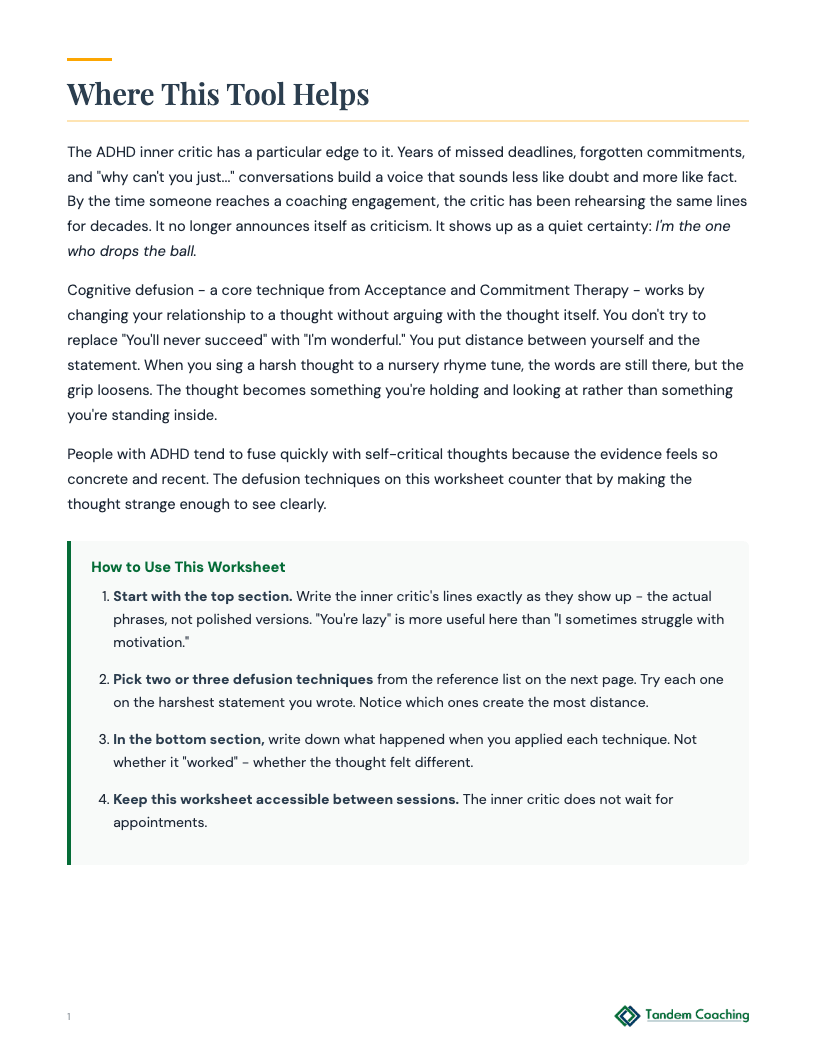
The inner critic's power comes partly from how seriously we take it. These ACT defusion techniques don't try to disprove the critic - they change your relationship to what it's saying.
Coaching Tool Disclaimer
This tool is designed for coaching contexts, not clinical use. If you or your client is in crisis, contact the 988 Suicide and Crisis Lifeline (call or text 988) or Crisis Text Line (text HOME to 741741).
Browse All Pages
Tool Classification
Domain
ADHD
Type
Worksheet
Phase
Action
Reflection
Details
15 min
Between sessions
As-needed
Topics
Mindset
Identity
Emotions
For the Coaching Practitioner
Plus
Coaching Scenarios
Plus
1 Software engineer with ADHD paralyzed by perfectionism after recent production bug ▶
Context
Senior developer whose code caused a system outage three weeks ago. Since then, they've been unable to push any code to production, spending hours reviewing and re-reviewing changes. They think the problem is technical confidence, but the real issue is a critic voice that now equates any mistake with catastrophic failure.
How to Introduce
Frame this as debugging the voice, not the code. 'You know how to trace a bug through system logs. Let's trace this voice that's keeping you from shipping.' Most engineers resist the 'silly' techniques because they want logical solutions to what feels like a logical problem. Name this upfront: 'The critic uses your engineering brain against you. We need to short-circuit that with something it can't argue with.'
What to Watch For
Engineers often write sanitized versions of the critic statements - 'I need to be more careful' instead of 'You're going to break everything again.' Push for the actual voice, not the professional translation. If they resist the singing technique but engage with 'Thanks for sharing,' they're protecting their professional identity while still doing the work.
Debrief
Start with whichever technique created the most visible reaction - usually laughter or eye-rolling. 'What happened to the thought when you sang it?' Then connect back to their work: 'When this voice shows up at 2pm on a Friday before a deployment, which technique could you actually use?' The goal is a specific intervention they'll remember under pressure.
Flags
If the client can't access any version of the critic voice - keeps intellectualizing instead of reporting actual statements - the shame may be too deep for defusion techniques alone. Severity: moderate. The production incident may have triggered a trauma response that needs therapeutic support before coaching can address the performance impact.
2 Marketing director avoiding delegation because inner critic predicts team failure ▶
Context
Mid-level marketing leader promoted six months ago, now managing a team of five. They're working 70-hour weeks because they can't delegate anything meaningful. They frame it as 'being thorough' but the real issue is a critic voice that says if they're not personally handling everything, the team will fail and it will be their fault.
How to Introduce
Position this as team development, not personal work. 'Your team can't grow if you're doing their thinking for them. But something's making delegation feel dangerous. Let's figure out what that voice is saying.' Expect resistance to writing down the harsh statements - they'll want to focus on delegation techniques instead. The critic voice is what's blocking those techniques from working.
What to Watch For
New managers often write critic statements that sound like leadership advice: 'I should be more involved' instead of 'If you let them handle this, they'll screw it up and everyone will know you're a fraud.' The real statements are usually about exposure and judgment. If they fill the defusion section quickly, they're performing the exercise rather than experimenting.
Debrief
Start with the connection between the critic statements and their delegation patterns. 'Read me the harshest thing you wrote. Now tell me the last time you gave someone else a high-stakes project.' The pattern will be obvious. Then explore which defusion technique felt most accessible: 'When you're about to take something back from your team, what could interrupt that impulse?'
Flags
If all the critic statements are about team competence and none are about personal adequacy, the client may be projecting their own imposter syndrome onto their team. Severity: low. Continue coaching but watch for whether they can separate their anxiety from their team's actual performance. If they can't, the delegation problem may require addressing the underlying imposter pattern first.
3 Consultant whose inner critic intensifies during client presentations despite technical expertise ▶
Context
Independent consultant with deep domain expertise who freezes during client presentations. They know their material cold, but the moment they're presenting, an inner critic starts a running commentary about how they're boring the room or missing the mark. They think they need presentation skills training, but the technical delivery isn't the problem.
How to Introduce
Frame this as performance interference, not skill development. 'You know your content. Something else is happening in that room that's not about expertise.' Many consultants resist acknowledging the critic voice because their professional identity depends on appearing confident. Start with: 'What's the voice saying while you're presenting that you'd never say out loud?'
What to Watch For
Consultants often write critic statements that focus on client judgment rather than personal inadequacy: 'They think you're wasting their time' instead of 'You don't belong in this room.' Both are valid, but the personal inadequacy statements usually carry more charge. If they engage more with the 'Thanks for sharing' technique than the silly voice techniques, they're protecting professional dignity.
Debrief
Start with the timing: 'When in the presentation does this voice get loudest?' Usually it's during Q&A or when they see certain facial expressions. Then connect the defusion technique to that moment: 'Next time you see that look on someone's face and the voice starts up, what could you do that takes three seconds or less?' The intervention has to be invisible to the client.
Flags
If the critic statements are all about client reactions and none about personal competence, the client may have social anxiety that's masquerading as presentation nerves. Severity: moderate. The defusion techniques will help in the moment, but if the underlying pattern is anxiety-based rather than confidence-based, they may need additional support to address the root cause.
4 Project manager with ADHD whose critic voice escalates when they lose track of details ▶
Context
Experienced project manager whose ADHD medication stopped working as effectively six months ago. They're missing small details in project plans and the inner critic has become vicious about these lapses. The critic voice is now louder than the actual feedback they're getting from stakeholders, creating a cycle where fear of mistakes makes them less focused.
How to Introduce
Connect this directly to the ADHD-critic feedback loop. 'ADHD brains miss details sometimes. That's neurological. But there's a voice that turns missed details into character assassination. Let's separate the brain difference from the voice that's making it worse.' Expect them to want to fix the detail-tracking first. The critic voice is what's making the tracking system unusable.
What to Watch For
ADHD clients often write critic statements that sound like facts: 'You can't be trusted with important details' feels true because of recent evidence. Look for statements that generalize from specific incidents to global character judgments. If they spend more time on the critic statements than the defusion techniques, the voice has more power than they're acknowledging.
Debrief
Start with the escalation pattern: 'Walk me through what happens from the moment you realize you missed something to the moment the critic voice kicks in.' Then test the defusion: 'Try the silly voice technique on the harshest statement. What happens to the certainty that it's true?' The goal is breaking the automatic fusion between missed detail and personal failure.
Flags
If the critic statements include themes of being 'broken' or 'defective' rather than just 'careless' or 'unreliable,' the client may be carrying shame about their ADHD diagnosis that goes beyond work performance. Severity: moderate. The defusion techniques will help with immediate relief, but deeper ADHD acceptance work may be needed to prevent the critic from regenerating.
Tool Flow
Plus
Requires
- identified recurring inner critic phrases
→
Produces
- written inner critic statements exposed on paper
- applied defusion technique record
- altered relationship to self-critical thought
Pairs Well With
ADHD
ADHD vs Depression Comparison
A client wants to organize focus and mood observations before speaking with a licensed clinician
Why it pairsAfter defusion surfaces recurring critic phrases, this framework helps you spot whether the volume is symptom-driven rather than purely mindset-based.
LifeConfidence Evidence and Learning Notes
Use this worksheet to explore identity and mindset and turn the client’s observations into one optional next step.
Why it pairsOnce the client has separated from critic thoughts, this scale measures which confidence dimensions those thoughts have most suppressed.
ADHDCheck the Facts Worksheet
A client's emotional reactions feel valid but may be based on interpretation rather than fact
Why it pairsAfter defusion creates distance from the inner critic, use this to test whether the critic's claims hold up factually.
Related Articles


Adaptive ADHD Leadership: 7 Strategies That Work
Read article →
Executive Function Strategies for ADHD Leaders: Working Memory, Impulse Control & Flexibility
Read article →
Leading With ADHD: Executive Leadership Strategies That Work
Read article →
ADHD Meeting Mastery: 6 Executive Strategies
Read article →