Pocket guide to spot and reframe fixed-mindset self-talk in the moment, grounded in proven growth mindset coaching practices.
Free, print-ready PDF.
Look at the reframe table. Pick the fixed mindset phrase that sounds most like your own inner voice right now. What situation is it showing up in?
A director of operations completed a growth mindset domain assessment two sessions ago and identified three domains where his orientation is more fixed: criticism, skills development, and obstacles. He intellectually endorses the growth mindset framework and can describe his fixed patterns accurately in retrospect. In session conversations, however, he reports using fixed-mindset language in the moment without noticing - his team observes it before he does. The gap is between conceptual understanding and real-time self-monitoring.
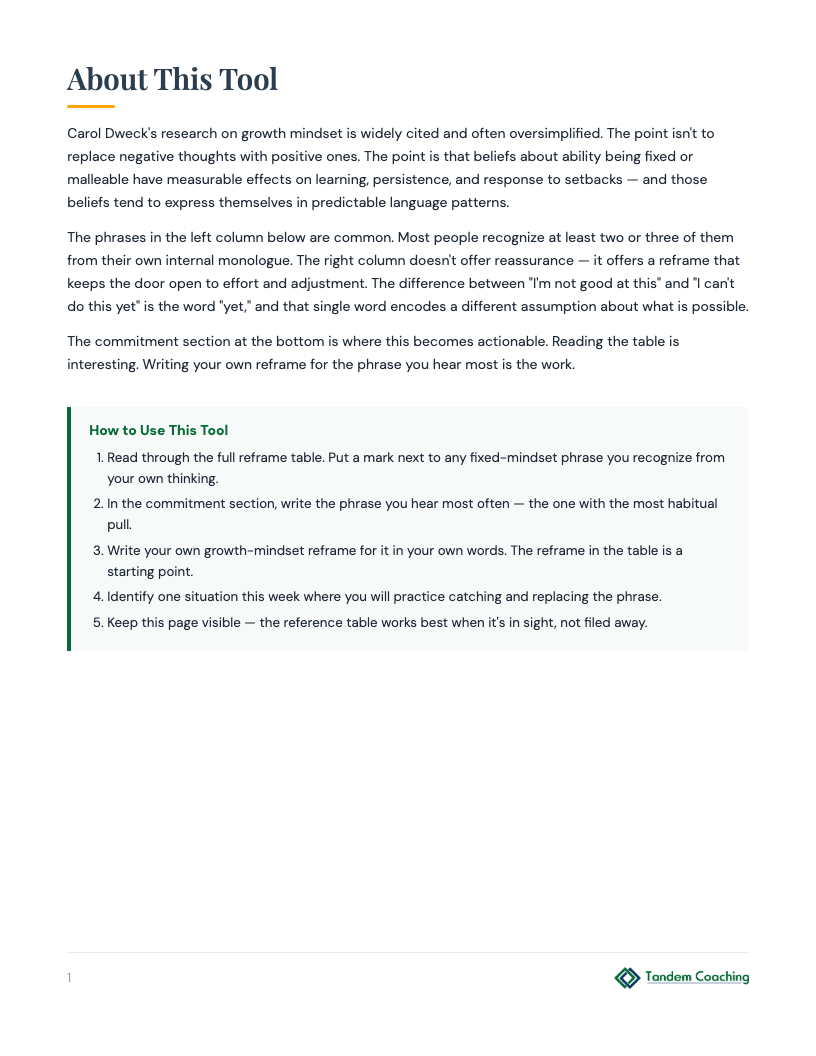
Position the reference table as an interruption tool, not an educational one. 'You already understand the framework. What this sheet does is different - it takes the eight phrases that come up most often and puts them in front of you as a recognition system. The commitment section at the bottom is the important part: you identify the single phrase you use most, write your own reframe for it, and name one situation this week where you'll practice catching it. The value isn't in reading the table - it's in writing your reframe in your own language so it's available when the original phrase fires.' The personalization requirement is what makes the tool active rather than passive.
Watch which phrase he marks in the table. The most revealing choice is often not the phrase that sounds most like him in conversation, but the one he marks most quickly - the immediate recognition. Then watch his written reframe: if it matches the right-column text from the table almost verbatim, he is not yet writing in his own language. His reframe should be specific enough that it would make sense in the context of his actual work ('I haven't learned to navigate this stakeholder relationship yet' rather than 'I can't do this yet'). Generic reframes signal that the personal translation hasn't happened.
Start with the phrase he marked. 'Read me the situation you named for practicing the reframe this week. Walk me through how the fixed-mindset phrase typically shows up in that situation - what triggers it.' This establishes the concrete context before testing whether the reframe is specific enough to work there. Then: 'If you're in that situation and the original phrase fires - say it's a stakeholder meeting where criticism lands wrong - what do you actually say to yourself? Use the reframe you wrote, not the table version.' The in-context test surfaces whether the reframe is genuinely his or borrowed.
If the situation he names for practice is low-stakes or hypothetical - if the fixed-mindset phrase he identifies is 'feedback is criticism' but the practice situation is 'journaling in the evening' rather than 'the 1:1 with my manager on Thursday' - the tool has been completed without being grounded. Severity: low. Name it directly: 'The phrase you marked shows up most in performance conversations and reviews, based on what you've described. Is there a higher-stakes situation this week where you'd be more likely to encounter it than journaling?'
A senior manager at a professional services firm received 360 feedback indicating that her team experiences her communication style during difficult periods as discouraging - specifically that she uses language suggesting that problems are intractable and that performance gaps are fixed. Examples in the feedback: 'That's just not how we do things here,' 'This team has never been able to do X,' 'This is why I don't delegate this.' She was surprised by the feedback. She does not experience herself as having a fixed mindset. Her coach wants her to build awareness of the specific language patterns before working on the team-facing behavior.
Use the 360 data as the reason for the tool without repeating the feedback verbatim. 'The feedback described specific phrases your team experienced as discouraging. This sheet maps the most common fixed-mindset language patterns and their growth-oriented alternatives. I want you to read through the left column and mark any phrases that might be in the family of what was flagged. I'm not asking you to confirm that you said those exact things - I'm asking what resonates as familiar territory for you. Then we'll work on a specific reframe in your own language.' The recognition task is less confrontational than asking her to confirm what the feedback reported.
Watch whether she marks phrases or whether she reads through the table without marking anything, explaining that none of them are what she said. The latter is a common response when the feedback has activated defensiveness. If she marks nothing, move directly to one of the examples from the 360 and ask where it would land in the table - which fixed-mindset category it belongs to. Also watch the commitment section: if she frames the practice situation as 'with my team' (facing outward) rather than catching her own internal voice first, the tool is being applied to the 360 behavior directly without building the internal monitoring layer.
After completing the sheet, focus on the practice situation she named. 'Let's make this concrete. You said you'd practice the reframe in [situation she named]. When you're in that situation and you're under pressure - what does the pressure look like specifically, and what triggers the fixed-mindset language?' Getting the trigger on the table before the practice happens increases the likelihood the reframe will be available in the moment. Then: 'If a member of your team heard the reframe version - heard you say 'this is hard for us right now and here's what we're going to try' instead of what they've heard before - what would be different for them?'
If the commitment section produces a practice situation that is not connected to the 360 feedback contexts - if she identifies a personal journaling practice rather than a team-facing moment - and this is accompanied by persistent difficulty recognizing the phrases in the left column as her own, the 360 data may not yet be integrated. Severity: low to moderate. The tool is appropriate, but a more direct conversation about what she makes of the feedback may be needed before the recognition work will land. The sheet works best when the client has accepted that the pattern exists.
A team lead at a technology company has been working on psychological safety with his team. He has explicitly introduced growth mindset concepts in team meetings and talks about learning from failure in retrospectives. His coach has noticed across multiple sessions that when he discusses his own performance or capability, his language reverts to fixed orientations: 'I'm not a natural communicator,' 'I've never been good at executive presentations,' 'I don't have the political instincts for that.' He is teaching the framework to his team while operating from the opposite orientation himself. The team lead is aware of the inconsistency when it is pointed out; he does not catch it in real time.
Use the team-modeling goal as the entry point. 'One of the things you want your team to experience is a leader who operates from a growth orientation - who demonstrates it, not just teaches it. This sheet asks you to do what you're asking your team to do: identify the fixed-mindset phrase you use most often and write your own reframe in your own words. The constraint is that the reframe has to be specific enough that you could say it in front of your team and it would sound like you, not like a framework phrase.' The team-modeling frame engages his existing motivation rather than positioning this as self-improvement.
The most important signal is which phrase he marks in the left column. Watch whether he selects a phrase from his team-facing experience ('feedback is criticism') or a phrase from his own internal experience about his capability ('I'm not good at this' - the capability-related phrases). If he marks team-facing phrases only, the internal fixed beliefs have not yet been surfaced. The commitment section is where the internal voice tends to appear: watch whether his 'phrase I hear most often from myself' matches a phrase he has used in session about his own capabilities, or whether it is a more social or team-related phrase.
After completing the tool, read his written reframe aloud. 'You wrote: [reframe]. If you heard yourself say that in an executive presentation - the situation where you've said you're not good at executive presenting - what would be different in how you prepared or showed up?' The goal is to move from the written reframe to a concrete behavioral change in one of the situations he has named as a fixed-mindset domain. Then: 'Your team is watching how you respond to your own hard situations. If they heard the reframe version of you in that presentation - not the 'I've never been good at this' version - what do you think that would do for what you're trying to build with them?'
If the phrase he marks is consistently team-facing rather than self-directed - if he maps growth-mindset concepts onto his team interactions but his own capability beliefs stay untouched across the session - the self-exception pattern from the coaching goals tool may be present here as well. Severity: low. The tool produces value in either direction, but if the self-directed fixed beliefs are not being examined, the team modeling work will have a ceiling. A direct observation may be more efficient than another exercise: 'You've written a strong reframe for team situations. The phrases I hear most from you about your own capability don't appear on your commitment section. What would it take to apply the same tool to those?'
I tend to shut down after setbacks rather than learning from them
LifeClient talks about wanting to grow but responds to setbacks with fixed patterns of self-protection
LifeClient feels stuck and is not accessing their own sense of agency or capability