Growth Mindset Action Plan

A practical, evidence-based plan to help you respond to setbacks with reflection and next steps instead of shutting down.

Worksheet · 30 min · Print-ready PDF · Free download

Get This Tool

Free PDF - professionally formatted, ready to print or fill digitally

Preview Worksheet · 30 min
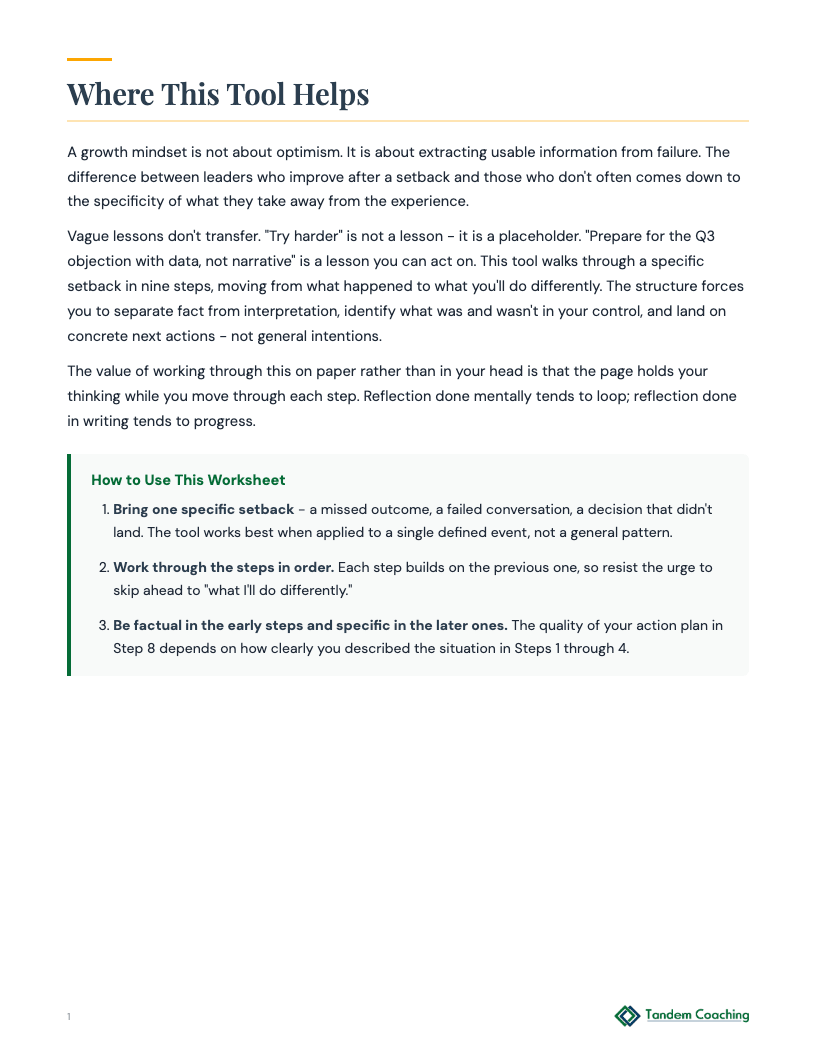
Growth Mindset Action Plan - preview
When to Use This Tool
I tend to shut down after setbacks rather than learning from them
I want to develop a more consistent way of processing failure so it doesn't derail me
I know growth mindset matters but I don't know how to apply it when things actually go wrong
How to Introduce This Tool Plus

Some clients find it useful to have a structured process for analyzing setbacks - moving through what happened, what they can control, and what they'd do differently - would working through that kind of framework be useful for something you're carrying right now?

Browse All Pages
Interactive Preview Worksheet · 30 min
Tool Classification
Domain
Life Coaching
Type
Worksheet
Phase
Action Reflection
Details
30 min Mid session As-needed
Topics
Mindset Resilience Accountability

For the Coaching Practitioner

Plus
Coaching Scenarios Plus
1 Senior director who narrativizes setbacks rather than analyzing them
Context

A senior director of product at a software company experienced a significant setback when a major product launch fell short of adoption targets and received critical feedback from the executive team. In the two sessions since, she has described the experience in polished, narrative form - coherent, emotionally articulate, and largely unchanged. She has named what went wrong, assigned responsibility clearly (including to herself), and expressed the lesson she took away. Her coach notices the narrative has not changed in two sessions. It is finished rather than open. The worksheet has not been used.

How to Introduce

The structured format is the entry point for a client who has already told the story. 'You've described this clearly - I understand what happened and how it landed. What we haven't done is work through the nine steps on paper. The tool does something different from conversation: it separates the factual from the interpretive, and it forces specificity on what was and wasn't in your control. The step where this typically produces something new is Step 6 - what was within your control that you didn't execute well. That is where most polished narratives have the least detail.' The distinction between narrating and analyzing is the resistance this client needs named.

What to Watch For

Step 6 is the diagnostic. Watch whether she writes at the same level of specificity she used in Steps 1-4, or whether it becomes more general ('I should have pushed back earlier'). Also watch Steps 3 and 8 together: if Step 3 (what worked) is sparse and Step 8 (what I'll do differently) reads as general intentions rather than specific actions, the worksheet has produced another polished narrative rather than an actionable analysis. The 'I will...' framing in Step 8 should be evaluable after the next attempt.

Debrief

Start with Step 9. 'You've named the next opportunity to apply this. What specifically will you do differently in that situation - using the language from Step 8, not the summary?' If she restates the general lesson rather than the specific action, the analysis hasn't fully transferred into behavior. Then: 'Looking at Step 6 - what is on that page that wasn't in the story you told me two sessions ago?' The gap between what the narrative contained and what the worksheet surfaces is where the session goes next.

Flags

If Step 6 remains at the same level of generality as her verbal narrative despite working through it in session - if she genuinely cannot identify specific controllable failure points beyond what she has already named - the setback may be more emotionally active than the polished narrative suggests. Severity: low. The articulate narrative is sometimes protective. A direct question - 'Is there a version of Step 6 that you haven't said out loud yet?' - can open that without requiring her to dismantle the narrative she has built.

2 High-potential manager who processes failure through externalizing rather than learning
Context

A manager at a consulting firm recently lost a client engagement he had been leading for eight months. The client chose a competitor. In the debrief session, he named four external factors: the client's budget cycle, a competitor's pricing advantage, a scope change that created confusion, and a key stakeholder who had already made the decision before the final presentation. All four factors are real. His coach has heard him explain setbacks in similar terms before - accurate external attribution, minimal internal accounting. His colleagues describe him as someone who doesn't learn from losses in the same way he learns from wins.

How to Introduce

The tool's structure disrupts the external attribution pattern without naming it directly. 'This tool works through the setback in nine steps, and the first several are just factual - what happened, what the strategy was. The section I want us to pay particular attention to is Step 6: what was within your control that you didn't execute well. That step is intentionally narrow - it only asks about your controllable execution, not about the factors you've already identified. I want to see what's there before we move to Step 8.' Positioning Step 6 as the target step focuses the client before he starts.

What to Watch For

Watch whether Step 5 (outside my control) and Step 6 (within my control) are proportionate or heavily imbalanced. A worksheet where Step 5 is densely filled and Step 6 has one line, or is left vague, is diagnostically useful - the imbalance on paper is more visible than the verbal pattern. Also watch whether Step 7 (what I learned) contains genuine new information or a restatement of what he already knew. 'I learned that relationships matter in procurement decisions' is not a lesson from this setback; it is a general principle used to conclude the analysis.

Debrief

Start with Step 6 read aloud. 'What you wrote here - read it back to me.' Hearing his own words often produces additional specificity that the written version compressed. Then: 'If you ran this engagement again with everything else identical - same client, same competitor, same budget cycle - what would you do differently in the areas you named in Step 6?' This isolates the controllable from the external without dismissing the external factors he correctly identified. The question is not 'was the client fair' but 'what could you have done better given the actual conditions?'

Flags

If Step 6 is genuinely sparse after working through it in session - if he cannot identify more than one or two controllable execution points across an eight-month engagement - the self-assessment may be functioning as protection rather than reflection. Severity: low to moderate. Name the pattern directly: 'You've been thorough in every step except this one. What's making Step 6 harder to fill in?' If the answer is 'I genuinely don't know what I could have done differently,' that is worth exploring as a developmental gap, not an accurate self-assessment.

3 Executive who treats every setback as unique rather than applying cumulative learning
Context

A VP of sales has experienced three significant setbacks in the past 18 months: a failed territory expansion, a key account loss, and a missed quota in Q3. She is thoughtful and self-aware. She processed each one in coaching as it occurred - using it as a session entry point, reflecting on it, extracting a lesson. Her coach has noticed that the lessons from each setback have not compounded. The territorial expansion lesson did not improve her approach to the account loss. The account loss analysis did not prevent the Q3 miss. Each setback is treated as its own contained event rather than as data in a developing pattern.

How to Introduce

Frame the tool as a third-pass analysis rather than a first one. 'You've worked through each of these individually in our sessions. What we haven't done is use the same structured format across all three to look for the pattern that crosses them. This worksheet applies to one setback at a time - so we'll work through the most recent one in full. But I want us to compare Steps 4 and 6 across all three when you're done, because if the same failure points appear in more than one, that is different information than if each setback had a unique cause.' The cross-setback comparison is the value proposition for a client who has already reflected on each event.

What to Watch For

When she completes Step 4 (what didn't work) and Step 6 (what was within my control), watch for convergence with what emerged in the previous coaching conversations about the two prior setbacks. If the same themes appear - preparation depth, relationship mapping, early warning recognition - note it without naming the pattern immediately. Save the cross-comparison for the debrief. Also watch Step 9 (next opportunity): if she names a situation that closely resembles the conditions of one of the prior setbacks, the specificity of what she'll do differently there is the key measure.

Debrief

After completing all nine steps, pull out Steps 4 and 6 specifically. 'Looking at what you've written for this setback - and comparing it to what you identified in the territory expansion and the account loss - what shows up in more than one? Name it specifically.' If a theme crosses two or three setbacks, it is a pattern, not a situational factor. Then: 'What would it mean for your development plan if that pattern is the most important thing to address in the next six months - not just the most recent setback?' This converts the setback analysis into a development priority.

Flags

If all three setbacks produce distinct, non-overlapping failure points - if the analysis genuinely shows different execution gaps in each case - consider whether the pattern is not in the failures themselves but in how she is recognizing and responding to early signals across different situations. Severity: low. The absence of overlap in Step 6 across three significant setbacks may be accurate, or may indicate that the controllable elements are being described at a level of specificity that masks an underlying common thread. Ask: 'What is the earliest moment in each of these where you had a signal that something wasn't on track?'

Tool Flow Plus
Requires
  • specific recent setback or missed outcome to analyze
  • basic growth mindset orientation
Produces
  • nine-step factual setback analysis
  • specific controllable failure points identified
  • concrete do-differently action statements with next opportunity

Pairs Well With

Executive

Barrier Resolution Planner

A client knows what they need to do but keeps hitting the same wall

30 min Planner
Life

Goal Obstacles Planner

Client sets goals with confidence in session but has not prepared for the obstacles that will appear

30 min Worksheet
Life

WOOP Goal Setting

Client keeps setting goals but stalls when obstacles appear

15 min Worksheet

This tool is part of a coaching pathway

Step 5 of 6 in A client acts on digital impulses before they've had a chance to notice and choose

Next: Barrier Resolution Planner → Explore all pathways →

Related Articles

Psychological Safety - On Taking Chances

Psychological Safety - On Taking Chances

Read article →
How to Develop Executive Presence: A Diagnostic Framework

How to Develop Executive Presence: A Diagnostic Framework

Read article →

10 Best Executive Coaches You Need to Know

Read article →

Loops and Knots - Amplifying Your Coaching Impact

Read article →

5 Strategic Steps to Establish an Effective Engagement Plan for Agile Leadership Teams

5 Strategic Steps to Establish an Effective Engagement Plan for Agile Leadership Teams

Read article →
Definition of Done – More Than a Checklist

Definition of Done – More Than a Checklist

Read article →