Gratitude Reflection Worksheet
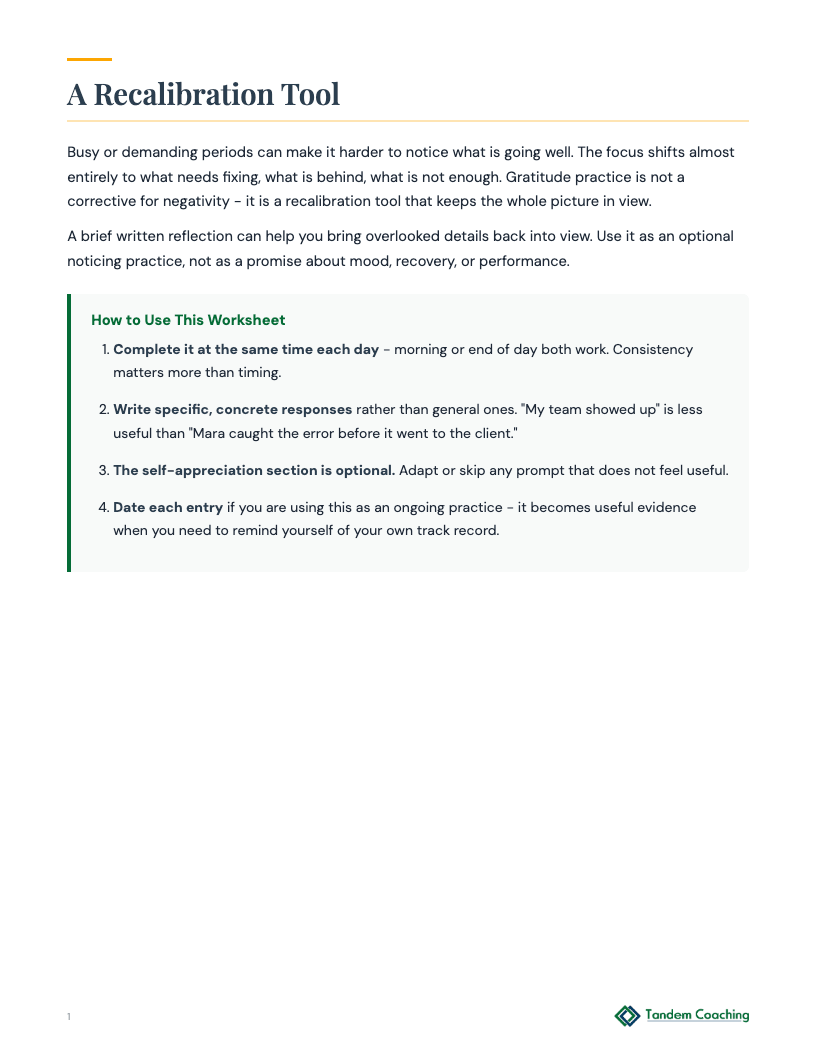
A guided worksheet to help high performers notice what’s working, using evidence-based gratitude reflection to reduce problem-focused tunnel vision.
Get This Tool
Free, print-ready PDF.
When to Use This Tool
A client is high-performing but has lost the ability to recognize what is going well amid constant problem-solving
A client wants a short daily practice that shifts their attention without requiring significant time investment
A client who intellectually values gratitude but has never built a structured practice around it and wants a simple entry point
How to Introduce This Tool Plus
Before we dive in, take a moment with this sheet. Three minutes of structured reflection changes what you notice for the rest of the day.
Browse All Pages
Tool Classification
Domain
Life Coaching
Type
Worksheet
Phase
Reflection
Details
5 min
Between sessions
As-needed
Topics
Mindset
Resilience
Self-Care
For the Coaching Practitioner
Plus
Coaching Scenarios
Plus
1 High-performing professional who tracks problems, not progress ▶
Context
A director of engineering manages a large distributed team and spends most of his mental energy on what's broken, what's behind, and what's at risk. He is effective and well-regarded, but in sessions he consistently describes his week through a problem-first lens. When asked what went well, he answers briefly and pivots back to the difficulties.
How to Introduce
Don't frame this as a positivity exercise - that framing will produce dismissal. 'This is a three-minute written practice that changes what you scan for during the day. It's not mood management - it's a calibration. You're a problem-spotter by profession. This adds a second sensor.' That reframe matters for engineers and operators who distrust anything that sounds like it's trying to make them feel better.
What to Watch For
Entries in the 'grateful for today' section that are entirely external and circumstantial ('my team delivered on time,' 'the meeting was short'). Watch for the self-appreciation section to produce thin or deflective responses - 'I suppose I kept things moving.' The self-appreciation section is the diagnostic one; how he responds to it tells you something about his relationship with his own performance.
Debrief
After he's been doing it for a week: 'Read me two or three specific entries from your gratitude section - not the categories, the specific things.' Specificity is the quality signal. Vague entries ('my family, my health') signal the practice isn't landing yet. Then: 'What did you write in the self-appreciation section that surprised you?' That question locates the entries that didn't come easily.
Flags
A client who completes the worksheet for several weeks but whose entries do not change in specificity or depth - he continues to write generic items in all three sections - may be going through the motions of the practice without genuine engagement. Severity: low. Return to the tool in session and complete one entry together, out loud. The shift from private writing to spoken articulation usually reveals whether the engagement issue is avoidance or confusion about what 'specific' means.
2 Client building a daily practice after a period of sustained difficulty ▶
Context
A founder who went through a difficult business contraction twelve months ago has stabilized but hasn't recovered her sense of forward momentum. She describes herself as functioning but flat. She's not in crisis - she's in a low-grade recovery that is taking longer than she expected.
How to Introduce
Introduce this as a lightweight daily anchor, not as a therapeutic tool. 'This takes three minutes. You fill three fields - what you're grateful for, three things you appreciate about yourself, and what you can appreciate right now. The consistency matters more than any single entry. It's a data collection practice, not a performance.' The lightness of the commitment lowers the barrier.
What to Watch For
Self-appreciation entries that are entirely role-based ('I kept my commitments,' 'I showed up professionally') with nothing personal. For clients in a recovery period, the self-appreciation section often reflects exactly how narrow their self-concept has become. Watch also for the 'what can you appreciate right now' section to produce entries that are future-oriented ('things will improve') rather than present-specific - those entries indicate she's struggling to find something real in the current moment.
Debrief
After two weeks: 'Looking back at what you wrote in the self-appreciation section across the past two weeks - what's the most consistent thing that shows up?' Patterns in that section are often more informative than single entries. Then: 'Is there anything you wrote that you wouldn't have believed before the contraction?' That question connects the practice to her recovery narrative.
Flags
A client who consistently cannot complete the self-appreciation section - not rushing through it, but genuinely unable to name three things - may have a self-regard deficit that is more significant than a practice-level intervention can address. Severity: moderate. Note the pattern over multiple weeks before surfacing it. When you do: 'I've noticed that section consistently comes up empty. What makes it hard?' Not as a diagnosis, but as a question.
3 Executive who values gratitude conceptually but has no practice ▶
Context
A managing director at a consulting firm believes in gratitude as a concept - she's read the research, she knows it matters, she recommends it to direct reports. She has never built a consistent personal practice. Her self-awareness about this gap is accompanied by mild embarrassment and a history of starting practices and not maintaining them.
How to Introduce
Acknowledge the pattern directly without dwelling on it. 'You've started practices before and stepped away. This one is designed to be so short that there's almost no bar - three minutes, three fields, done. The question isn't whether you believe in it. You do. The question is whether three minutes a day is something you can actually commit to without a system around it.' Name the minimum: this is not a journaling practice, it's a fill-in-the-blanks practice.
What to Watch For
Initial entries that are high-quality and specific, followed by increasing vagueness over the first two weeks. That pattern - strong start, declining precision - is common for executives who are initially engaged but revert to efficiency mode. Watch for the date field to start being skipped, which usually means she's completing multiple days at once. Batch completion defeats the daily calibration effect.
Debrief
Don't evaluate the quality of individual entries in early sessions - that makes it feel like homework to be graded. Ask instead: 'What's the entry that surprised you most, across the whole period?' Then: 'The self-appreciation section - was that easier or harder than you expected?' Her answer will tell you something about where the practice is landing and where it isn't.
Flags
A client who maintains the practice but reports it having no effect - she's completing it but notices nothing shifting - may be approaching it as a compliance task rather than an attention exercise. Severity: low. The fix is to change how she's doing it, not whether: 'Before you fill in the section, pause for 30 seconds and actually look for the answer rather than writing the first thing that comes to mind. The waiting is part of the practice.'
Tool Flow
Plus
Requires
- None - standalone tool
→
Produces
- written daily gratitude entries
- named self-appreciation items
- documented current positives list
Pairs Well With
ADHD
Feeling Context and Support Notes
Use this framework to structure a conversation about emotions and mindset while keeping interpretation with the client.
Why it pairsWhen the worksheet shows gratitude feels hardest on high-stress days, this framework helps name the emotional state blocking access.
WellnessOptional Wellbeing Intentions
Use this worksheet to explore self care and values and turn the client’s observations into one optional next step.
Why it pairsAfter the worksheet shows what a client appreciates, the assessment spots which domains never appear - a signal of where depletion is hiding.
WellnessDaily Gratitude Reflection
A client wants to use Daily Gratitude Reflection as an optional reflection
Why it pairsOnce the worksheet generates a client's first entries, the journal template creates the daily structure that keeps the practice going between sessions.
This tool is part of a coaching pathway
Step 1 of 6 in A client is high-performing but has lost the ability to recognize what is going well amid constant problem-solving
Continue with Weakness Reframing if that next job fits.
Next: Weakness Reframing → Explore all pathways →Related Articles

High-Performing Teams: An Organizational Coaching Perspective
Read article →
Leadership Team Development: How to Build a High-Performing Team
Read article →
The Room Has No Chaos - And You Can't Figure Out Why That's the Problem
Read article →
Building Resilience Amid Change: The Power of Coaching
Read article →