Rebuild daily gratitude when high demands dull your appreciation, using coach-guided prompts and evidence-based reflection exercises.
Free, print-ready PDF.
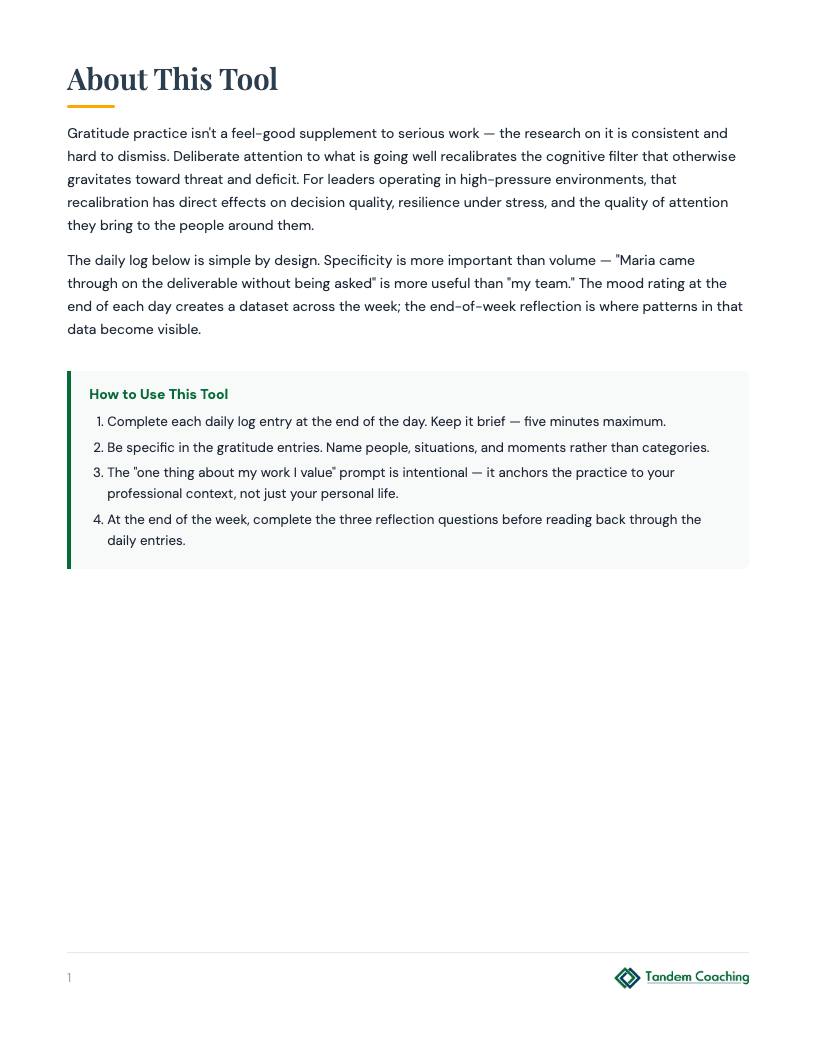
The research on gratitude practice is worth knowing before we start: specificity matters more than volume. One precise observation is more effective than a long list of general ones.
A senior leader whose team feedback has surfaced a pattern: the leader notices and responds to problems quickly but rarely acknowledges what's going well. Direct reports describe feeling that their work only registers when something's wrong. The leader doesn't dispute the feedback. They describe their orientation as 'that's just how I think - I solve problems.' They want to change the cultural impact without feeling like they're pretending everything is fine.
Frame this as a data-collection exercise, not a positivity retraining. 'You're not being asked to pretend things are better than they are. You're being asked to run a 7-day experiment to find out whether your attention is actually calibrated to reality or whether it's filtering out some of the data.' The daily mood 1-5 rating creates the longitudinal pattern that makes the case analytically - some leaders will engage with the practice more readily once they see it produces data rather than just feelings. The person appreciated field is the highest-leverage daily element for a leader with team culture impact.
Watch the person appreciated column. If the same person appears multiple times in the first week, or if the entries are exclusively about family members rather than colleagues, the practice isn't yet touching the professional domain where the culture problem lives. Gently redirect: 'For the next three days, write someone from your team in this column.' Also watch the mood ratings. If the client rates their mood lower on days when they wrote team-member appreciations, explore that correlation - the practice may be surfacing a disconnect between their values and their daily experience that's worth examining.
Start with the end-of-week pattern section. 'What pattern showed up across these seven days that you didn't expect?' Leaders with a negativity bias often discover their mood ratings don't match what they expected - they assumed their mood was driven by problem volume, but the data often shows it's driven by relational quality. The person appreciated column is where to spend most of the debrief: 'Who did you write here, and what happened when you noticed that about them? Did you tell them?' That second question - whether the noticing translated into communication - connects the internal practice to the team culture problem.
If the leader's week-end reflection on 'what I'm carrying into next week' is entirely task or problem-oriented with no relational or appreciative element, the practice has produced data without yet shifting orientation. Severity: low. Continue for a second week and revisit. If the leader's team culture issues are severe enough that direct reports have escalated or are at risk of departure, a 7-day gratitude practice is not sufficient intervention on its own. Severity: moderate. The practice is useful as a complementary tool, but direct behavioral coaching and feedback conversation work need to run in parallel.
A client who has read about gratitude research, is intellectually persuaded by it, and wants to build the practice correctly from the start. They're disciplined enough to sustain it but want to understand what they're building toward - they want more than a habit, they want a tool that produces genuine self-knowledge. They're articulate about what they don't want: a rote daily list that doesn't mean anything.
Open with what separates this tracker from a generic gratitude journal: specificity and mood correlation. 'The research on gratitude practice that actually shifts psychological state is consistently pointing to two things: specificity - one precise observation versus five general ones - and the mood rating, which creates longitudinal data you can analyze rather than just a record of feelings.' Set the expectation that the most valuable output is the end-of-week reflection, not the daily entries. The daily entries are inputs; the weekly synthesis is where the insight lives.
Watch the work value column. Many clients initially write abstract values - 'doing meaningful work,' 'learning' - rather than specific moments: 'the moment in the product review when I realized the team had solved a problem I couldn't have solved alone.' The abstract entries don't produce pattern recognition; the specific ones do. If the client is writing abstractions, probe in session: 'On Thursday, what specific moment at work made you write that entry?' The answer is what should have gone in the column.
Start with the mood data plotted across the 7 days. 'Your highest mood days were Monday and Thursday. What was happening on those days? Your lowest was Wednesday. What was different?' Some clients are surprised to discover the mood variation has nothing to do with workload and everything to do with connection or autonomy. The end-of-week 'what matters most' field often contains the most honest statement of values the client has articulated in sessions. Ask them to read it back. Then ask: 'Is what you wrote there reflected in how you actually spend your time right now?'
If the client's 7-day mood data shows consistently low ratings (1-2) across all seven days despite genuine engagement with the practice, the practice is documenting distress, not building gratitude. Severity: moderate. Don't continue pushing the tool forward. Pause and assess what's driving the persistent low mood ratings before framing what happens next. If the client treats the work value column as a performance log - writing deliverables, completed tasks, output metrics - they may be conflating gratitude practice with professional self-monitoring. Severity: low. The distinction matters: one surfaces values, the other reinforces productivity identity.
A mid-level leader living through a significant organizational disruption - a merger, a restructuring, a leadership change that has left their team uncertain and their own role ambiguous. They're maintaining external composure but internally they're running a constant threat assessment. They can describe with precision every risk and uncertainty. They cannot describe what's still stable, still going well, or still worth protecting.
Frame this as a calibration tool, not a coping tool. 'You're doing good threat detection right now because that's what the situation requires. This tool adds the other half of the picture - what's stable, what's still working, what hasn't been disrupted - so you're working from a complete map, not just the risk layer.' The person appreciated field is particularly useful in organizational chaos because it anchors the client in relationships that persist regardless of structural changes. The 'what I'm carrying into next week' closing field should be framed as a stability anchor: what one thing from this week is solid enough to build from.
Watch for a client who fills the tool in with entries about their family and personal life only, with nothing from work. This may indicate they've mentally written off the professional domain as entirely unstable - which may be an accurate read of the situation or may be a catastrophizing response that's cutting them off from real professional resources. Ask directly: 'Is there anything in your work right now that's still going well or still in your control?' The answer reveals how much professional ground the client believes they still hold. Also watch the mood ratings in weeks with specific organizational news - the data may reveal how the client is actually being affected versus how they present externally.
Start with the end-of-week 'pattern I noticed' field. In chaos, pattern recognition is the primary value of the practice: the client needs to see what's consistent when everything else is shifting. 'What showed up consistently across these seven days that you didn't expect to still be there?' The answer is often the stability anchor the coaching work should be building from. The 'what matters most' field in the weekly reflection sometimes produces a clarifying statement about what the client wants to protect - which often becomes the organizing principle for decisions they need to make in the disruption.
If the client is completing the tracker but their mood ratings are declining across the seven days rather than stabilizing, the organizational situation may be genuinely worsening rather than merely feeling destabilizing. Severity: moderate. Don't keep pushing the practice forward if the client's environment is actively deteriorating. Address the situation first. If the client's entries are entirely about protecting others - their team, their family - with nothing about their own needs or wellbeing, explore whether the caregiving orientation is leaving them without resources for themselves. Severity: low.
I want to build a self-care routine but I need something to tell me what to do each day
WellnessClient has a vague sense of needing to take better care of themselves but hasn't defined what that means across different dimensions
WellnessA client knows they need to take better care of themselves but doesn't know where to start
Step 1 of 6 in A client operating in a high-demand environment who notices they've lost the ability to appreciate what's going well
Next: Opposite Actions Worksheet → Explore all pathways →