A guided 30-day plan with daily, evidence-based self-care prompts for clients who want to feel better but don’t know where to start.
Free, print-ready PDF.
What does self-care actually look like for you when you do it — and what gets in the way of doing it consistently?
A director who is rigorous about project management, team accountability, and strategic planning describes their personal recovery practices as ad hoc. They sleep inconsistently, exercise when they happen to have time, and have no regular practice that recharges them. They don't resist the idea of structure for recovery - they've simply never applied the same discipline they use professionally to this domain. They're performing but not sustainable.
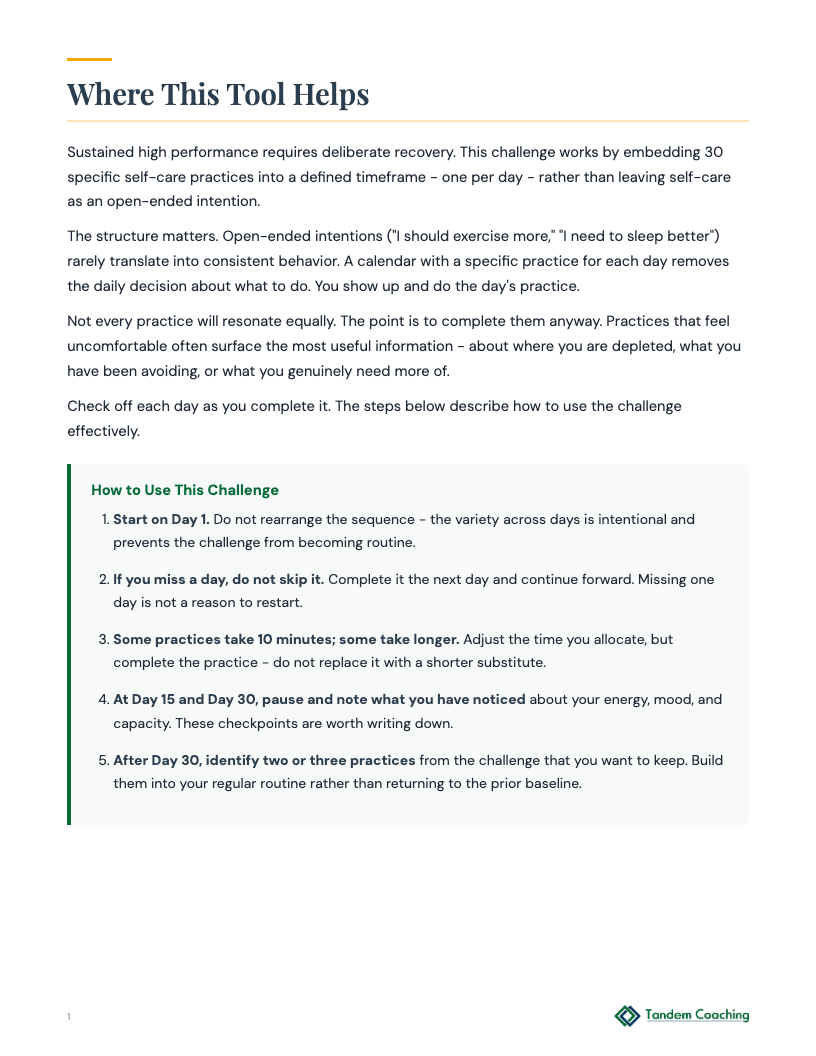
Position this as a structured experiment, not a wellness program. 'You bring project rigor to everything at work. This is thirty days of applying the same approach to a different performance variable - your capacity for the month after this one.' The pre-set daily practices in the calendar remove the planning burden that often prevents clients from starting: 'You don't design this. You execute it. Each day has a practice already assigned. Your job is to do it and note whether it worked.' Some clients will push back on specific practices in the calendar. Acknowledge that in advance: 'If a practice doesn't fit your situation, substitute one of equivalent scope - the structure matters more than the specific practice.'
Watch what the client does with the consistency question. Clients who are high performers in work contexts often bring a compliance mindset to this exercise - doing every practice regardless of benefit. Ask: 'Which days this week did the practice actually work, versus which ones did you complete but feel nothing?' The answer reveals where investment is producing return. Also watch whether the client is treating the calendar as something to complete or as something to learn from. If they're completing without noticing, the data the thirty days produces will be lost.
At the midpoint or close: 'Of the practices you've done so far, which two have produced the most noticeable difference in how you function the next day?' Those two are the inventory that survives the thirty days. Then ask: 'Which ones felt like obligation rather than recovery?' Those are candidates for replacement. Close with a forward question: 'After thirty days, what's the smallest sustainable version of this that you'd actually maintain beyond the challenge?' The goal is not thirty days of compliance but a permanent practice inventory.
If the client's starting point is significant depletion - sleep disruption, consecutive high-intensity weeks, visible performance degradation - thirty days of daily practices may be insufficient to address the underlying deficit. Severity: low. Acknowledge the gap and explore whether there are structural changes in workload or schedule that need to accompany the practices. A self-care challenge that adds thirty obligations to an already overloaded schedule can compound rather than address the problem.
A professional describes a prior period of strong routines - exercise, sleep discipline, social engagement - that were disrupted eighteen months ago by a significant life event (relocation, health issue, job change, or family demand). The disruption has passed but the routines haven't returned. They miss the structure and recognize its contribution to how they function, but can't find an entry point that doesn't feel like rebuilding from scratch.
Position the thirty-day calendar as an external scaffold rather than a personal practice design exercise. 'You don't need to design the routines right now - you need to re-engage the discipline muscle that generates them. This calendar gives you the structure for thirty days without requiring you to design it. At the end, you'll know which practices you want to keep and which ones to replace with your own.' Some clients feel that using a pre-set calendar is somehow less meaningful than practices they've designed themselves. Name it: 'The discipline of showing up daily is what this rebuilds. The specific practices can be customized once the showing-up muscle is working again.'
Watch whether the client is comparing current experience to their prior best state. 'Before everything happened, I used to...' as a reference point for evaluating whether current practices are adequate is worth interrupting: 'We're building from where you are now, not from where you were. What does adequate look like at the end of week one, not the end of the thirty days?' Also watch for the client skipping practices on difficult days and then abandoning the calendar rather than continuing imperfectly. Name this in advance: 'Missing a day is not a reason to stop. What's your plan for the day after a missed practice?'
Start with: 'Which practices from the calendar are you carrying forward and which ones you'd replace with something better for you?' That question converts the thirty days from a compliance exercise to a design research phase. Then ask: 'At the start, what felt impossible that now feels ordinary?' That question surfaces what rebuilding the discipline muscle actually accomplished. Close by naming one practice as a non-negotiable that stays regardless of what changes in the schedule - the one that, if it's the only thing, is still worth having.
If the original disruption was a health event and the client is still in a recovery phase, thirty days of structured practices may need to be calibrated to their current capacity rather than to their pre-disruption baseline. Severity: low. Ask early: 'Are there any practices in the calendar that you know are not available to you right now, given where you are physically?' Remove those without comment and ensure the remaining thirty days is a realistic ask, not an aspirational one.
A senior individual contributor describes recovery practices as conditional on performance - exercise when the project is done, adequate sleep when the deadline passes, downtime once the quarter closes. The conditioning is explicit: they have articulated a belief that recovery is a reward structure rather than an input to performance. The result is a chronic deficit that is beginning to affect cognitive clarity and their own assessment of their best work.
Position the reframe first, before introducing the calendar. 'The framing you've described treats recovery as a reward. This worksheet operates on a different premise: recovery is an input, not an output. The thirty days tests that premise. You're not earning the practices by completing deliverables - you're running the practices as a performance variable and watching what changes.' Some clients need this stated directly before the calendar is useful: if they approach the calendar with the same conditional framing, they'll postpone it until they've 'earned' day one. 'Day one starts tomorrow, regardless of where the project is.'
Watch whether the client finds reasons to delay starting the calendar ('once this project is over, I'll start') or to pause it ('I need to focus on the deliverable this week'). These are the conditional pattern in operation. Name them when they appear: 'That's the same pattern we're trying to interrupt. What would it take to do today's practice despite the project?' Also watch whether the client is using the calendar to negotiate with themselves - doing half the practices on high-work days and doubling up on low-work days. That pattern preserves the conditional framing while appearing to comply.
Start with a comparison question: 'How did your output on the days you did the practice compare to days you didn't?' This frames recovery as a performance instrument, which is the framing most accessible to this client. Then ask: 'What did you notice about the quality of your thinking on days when sleep or physical practice happened versus days when it didn't?' Close by asking the client to describe recovery practices not as a self-care vocabulary but as a performance vocabulary - what does the practice produce, specifically, that the work requires? That reframe, if the client can generate it themselves, is more durable than one provided by the coach.
If the performance-as-reward pattern has been in place for an extended period and the current cognitive and physical deficit is significant, the thirty-day calendar may not be sufficient to reverse the underlying load issue. Severity: low to moderate. Assess whether the client's current workload is sustainable even with consistent recovery practices, or whether the load itself needs attention. A recovery practice that restores 80% of what an unsustainable load removes doesn't change the trajectory.
I know I should be taking better care of myself but I keep deprioritizing it
WellnessI want to track my mental wellness habits across a full week and see where I'm dropping the ball
WellnessI want to see whether there are patterns in my emotional states across the week
Step 1 of 6 in A client knows they need to take better care of themselves but doesn't know where to start
Next: WOOP Goal Exercise → Explore all pathways →