Define what success looks like 5 years from now with guided prompts and a structured framework used in life coaching.
Free, print-ready PDF.
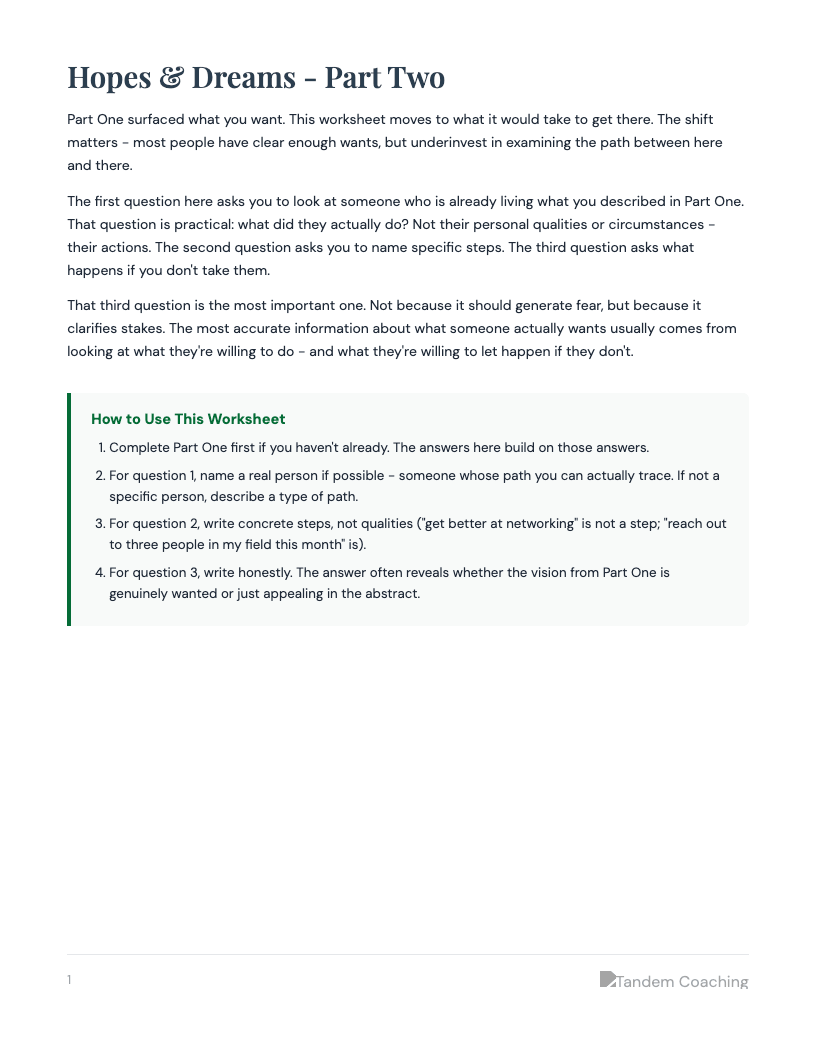
What does your life look like if nothing changes from today — and what would it look like if it changed in exactly the way you hope?
Client is competent, professionally stable, and has quietly stopped projecting a future they want. They manage well, perform well, and have internalized the next step on an established path — promotion, another role in the same sector — without examining whether it is a path they chose or one they fell into. The 'who's living your dream' question is designed to restore imaginative permission.
Frame this as a reference point exercise, not vision work. 'I want to borrow someone else's life for a few minutes — not to copy it, but to use it as a mirror. Who do you look at and think: that is what I want? It doesn't have to be rational or realistic. Just someone who has something you want.' Clients at this career stage often resist because naming admiration feels like dissatisfaction, which feels like ingratitude. Name the resistance: 'Noticing what you want doesn't mean rejecting what you have. It means giving yourself full information.'
If the client cannot name anyone — 'I don't really compare myself to others' — watch whether this is genuine equanimity or defended contentment. The distinction shows up in other answers: genuine equanimity tends to coexist with clear forward direction; defended contentment tends to coexist with vagueness about what comes next. Also watch the five-year cost of inaction section: clients who minimize or skip the cost are signaling that the status quo feels safer than the dream, regardless of what they have written above.
Start with the model they identified. 'What specifically does [person] have that you want? Not their life — the specific thing.' Force precision here because admiration is often bundled: the client admires three different things about the same person and confuses them. Once specific, ask: 'Which of these steps have you already taken and stopped? Which haven't you started?' The debrief centers on the gap between the model and the client's current path.
Array
Client has a clear picture of what they wanted before each major life stage — before children, before the career pivot, before the relocation — and has been progressively deferring it. The dream is not gone; it is in a holding pattern with increasingly distant timelines. The cost of inaction question is the intervention that makes deferral visible.
Frame this as an inventory, not a plan. 'I want to understand what you've been carrying forward — the things you've told yourself you'll do when the timing is better. Not to pressure you, but to get a clear picture of the cost of waiting.' Clients in this pattern often resist by listing the legitimate reasons why now is not the right time. Acknowledge them, then redirect: 'Those reasons are real. The question I'm asking is separate from them — what has waiting cost you so far?'
Watch the five-year cost of inaction section. Clients who are genuinely at peace with deferral write low-stakes costs — 'I might miss the optimal timing.' Clients who are not at peace write high-stakes costs — 'I will have spent another five years on something I don't care about.' The emotional charge in the language is diagnostic. Also watch for clients who fill in the steps section with the same steps they wrote five years ago and have not taken.
Start with the cost of inaction they wrote. Read it back to them: 'You wrote [exact words]. Is that accurate?' If they confirm it, ask: 'How much longer is that cost acceptable?' That question puts a timeline on a decision the client has been treating as open-ended. The answer — even a vague one — creates an accountability that was not previously present.
Array
Client describes a compelling future picture — significant success in a particular domain, specific lifestyle markers — but when examined, the picture was assembled from external sources: a parent's expectation, an industry's definition of success, a peer group's visible aspirations. The tool's question 'who is living your dream?' surfaces the borrowed nature of the dream when the client names someone they have been told to admire rather than someone they genuinely do.
Frame this as a source check before a goal check. 'Before we plan toward this, I want to understand where it came from. Not whether it's the right goal, but whose voice is loudest when you imagine it.' This is a delicate introduction — clients who have been working toward an externally defined dream often feel implicitly criticized when the source is named. Frame it as curiosity, not diagnosis: 'I ask because goals rooted in someone else's picture are harder to sustain through the difficult parts.'
The person the client identifies as living their dream is diagnostic. If they name a parent, a mentor, or a figure explicitly endorsed by their family or culture — rather than someone they discovered independently — the borrowed quality of the dream is more likely. Also watch the steps section: steps the client finds genuinely energizing tend to be described with specificity; steps they feel they should take are often described in the passive voice or with hedging language.
After completing the tool, ask: 'If no one who matters to you would ever know whether you pursued this, would you still want it?' The answer to that question tells you more than anything written on the worksheet. The debrief then moves from whether the goal is theirs to what happens if it is partially theirs — which elements are authentic and which are borrowed.
Array
Client can recognize what's unresolved but hasn't acted on it yet
LifeClient sets goals but never writes down what success would actually look like
LifeClient can list strengths easily but struggles to see what others actually observe in them