Clarify what you’re saying yes, no, or maybe to, and turn unresolved issues into next steps using a structured coaching assessment.
Free, print-ready PDF.
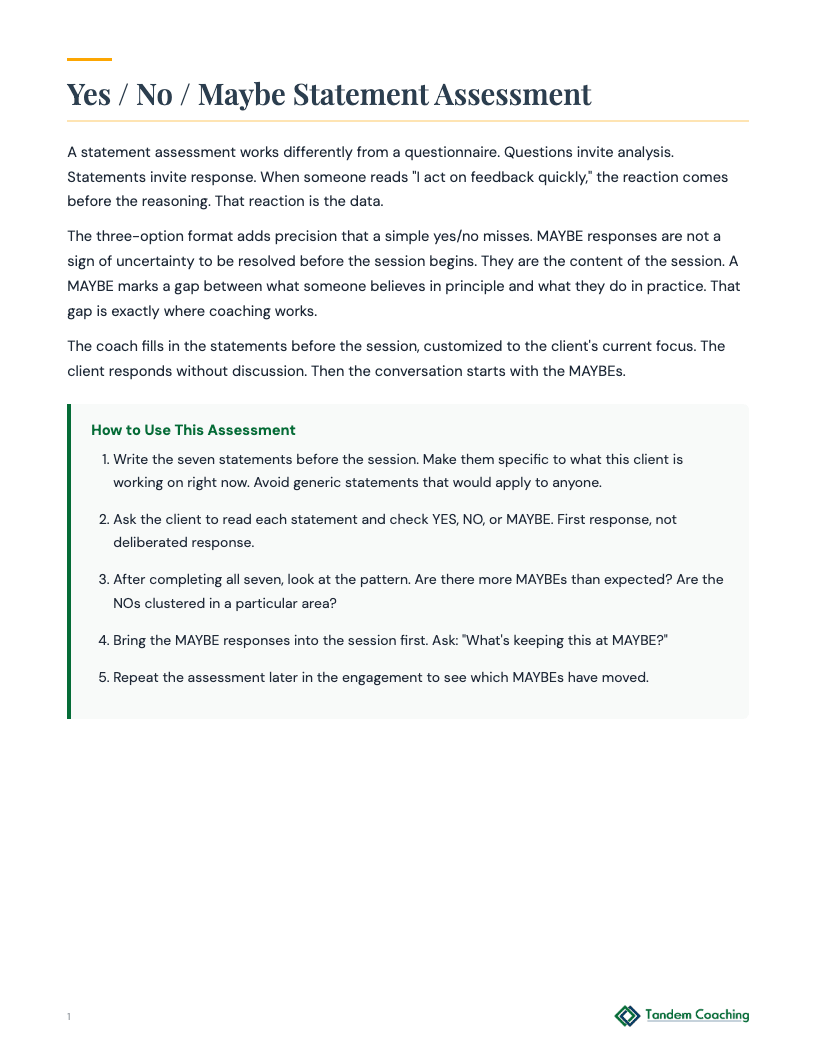
There's a statement-based format where you mark Yes, No, or Maybe — and the areas that are still Maybe become the compass for where we focus. Would you like to try it on something specific?
A principal software engineer just promoted to engineering manager after 8 years as an individual contributor. Their skip-level manager referred them to coaching because they're still writing code 60% of the time and their team's velocity has dropped. The client believes they need better time management skills.
Frame this as a leadership transition diagnostic, not a performance review. 'Before we work on time management, let's see where you stand on the core leadership behaviors your role requires.' Expect resistance to statements about delegation - many new technical managers see letting go of code as abandoning their expertise. Position delegation statements as leveraging team capability, not losing technical credibility.
Speed through technical leadership statements but slow deliberation on people management ones signals the comfort zone boundary. Watch for explanatory comments during rating - 'Well, it depends on the project' or 'I do this sometimes' - which indicates they're negotiating with the statement rather than rating their consistent behavior. Multiple MAYBE responses on delegation and feedback statements is typical.
Start with the YES responses to establish current strengths, then move to the pattern across people-focused statements. Ask: 'Looking at statements 3, 5, and 7 together, what do you notice about where the MAYBEs cluster?' The question that typically opens this up: 'What would need to change for statement 5 to move from MAYBE to YES?' This moves from self-assessment to action planning.
If all people management statements are NO rather than MAYBE, the client may be overwhelmed by the role transition or fundamentally resistant to management responsibilities. Severity: moderate. Response: explore whether the promotion was wanted or imposed, and whether the client sees management as a career path or a temporary assignment.
A marketing director at a B2B SaaS company, three months into the role after the previous director was terminated. The CEO wants them to 'be more strategic' but hasn't defined what that means. The client requested coaching to 'level up their strategic thinking' and believes they need frameworks and planning tools.
Present this as a strategic leadership baseline, not a skills assessment. 'Your CEO wants more strategic thinking. Before we build new capabilities, let's see where you already operate strategically.' Expect the client to contextualize every statement - 'In this market, that's complicated because...' This is deflection disguised as thoroughness. Set the boundary upfront: 'Rate based on your typical behavior, not ideal conditions.'
The client will want to explain their rating for each statement as they go. This turns assessment into justification. If they spend more than 30 seconds per statement, they're performing analysis rather than self-assessment. Watch for statements where they ask for clarification - usually indicates an area where they lack confidence but don't want to admit it directly.
Don't start with their explanations - start with the pattern. 'You have six MAYBE responses and one YES. What does that tell you about where you are right now?' Then ask: 'Which of these MAYBE statements, if it moved to YES, would be most visible to your CEO?' This connects self-assessment to the external expectation driving the coaching request.
If the client cannot complete the assessment without extensive explanation for each response, they may be using intellectual processing to avoid emotional reality of their situation. Severity: low. Response: note the pattern and return to it - the need to justify every response may be the core issue with 'strategic thinking.'
A VP of Operations at a manufacturing company, 18 months in role, referred by HR after a 360 review showed significant gaps between self-perception and team feedback. The client was surprised by the feedback and believes their team doesn't understand the complexity of their decisions. They want coaching to 'improve team communication.'
Position this as a leadership impact check, not a skills inventory. 'The 360 showed some gaps between your view and your team's view. This assessment looks at leadership behaviors from your perspective first.' Don't mention the 360 results during the assessment - let them rate themselves without that data influencing their responses. The surprise will come in the debrief comparison.
Clients with inflated self-perception typically complete this quickly with mostly YES responses. They're rating their intentions, not their impact. Watch for statements about team engagement or communication effectiveness - if these are all YES but the 360 showed problems in these areas, the gap is significant. Note any statements they skip or return to multiple times.
Start with their YES responses, then introduce the 360 data. 'You rated yourself YES on communicating decisions clearly. Your team rated you 2.1 out of 5 on the same behavior. What do you make of that gap?' The conversation opener: 'What would your team need to see differently for their ratings to match yours?' This shifts from defending self-perception to closing impact gaps.
If the client has mostly YES responses but significant negative 360 feedback, there may be a fundamental disconnect between intention and impact that goes beyond skill gaps. Severity: moderate. Response: focus on one specific behavior gap rather than trying to address the overall pattern - the client needs evidence of change before they'll accept the broader feedback.
Executive director of a mid-size nonprofit, two years in role, struggling to balance board expectations, staff needs, and donor relationships. Recent board meeting included criticism about 'lack of strategic focus.' The client feels pulled in multiple directions and wants coaching to help prioritize and say no more effectively.
Frame this as a leadership clarity assessment, not a prioritization exercise. 'Before we work on saying no, let's see where you have clear leadership positions and where you're still finding your footing.' Nonprofit leaders often struggle with statements about decisive action because they're used to consensus-building. Position decisive leadership as serving the mission, not abandoning collaboration.
Multiple MAYBE responses across all categories suggests the client is genuinely uncertain about their leadership approach, not just overwhelmed by tasks. Watch for hesitation on statements about stakeholder communication - if they can't rate themselves clearly on basic leadership behaviors, the 'prioritization' problem may actually be a role clarity problem. Note any statements about boundaries or expectations.
Start with the distribution: 'You have five MAYBE responses out of seven. That suggests you're still defining what leadership looks like in this role.' Then focus on stakeholder management statements: 'Looking at your MAYBE responses about communication and expectations, what would need to be true for those to become YES?' The key question: 'Who would you need to disappoint to get clear on these?'
If most responses are MAYBE, especially on basic leadership behaviors, the client may be experiencing role ambiguity or imposter syndrome rather than skill gaps. Severity: moderate. Response: focus on role definition and stakeholder alignment before addressing tactical leadership skills - the uncertainty may be structural, not personal.
Client sets goals but never writes down what success would actually look like
LifeClient writes goals that sound good but stall as soon as specificity is required
LifeClient can list strengths easily but struggles to see what others actually observe in them