Compare your self-identified strengths with real feedback from others to see what stands out, backed by structured reflection prompts.
Free, print-ready PDF.
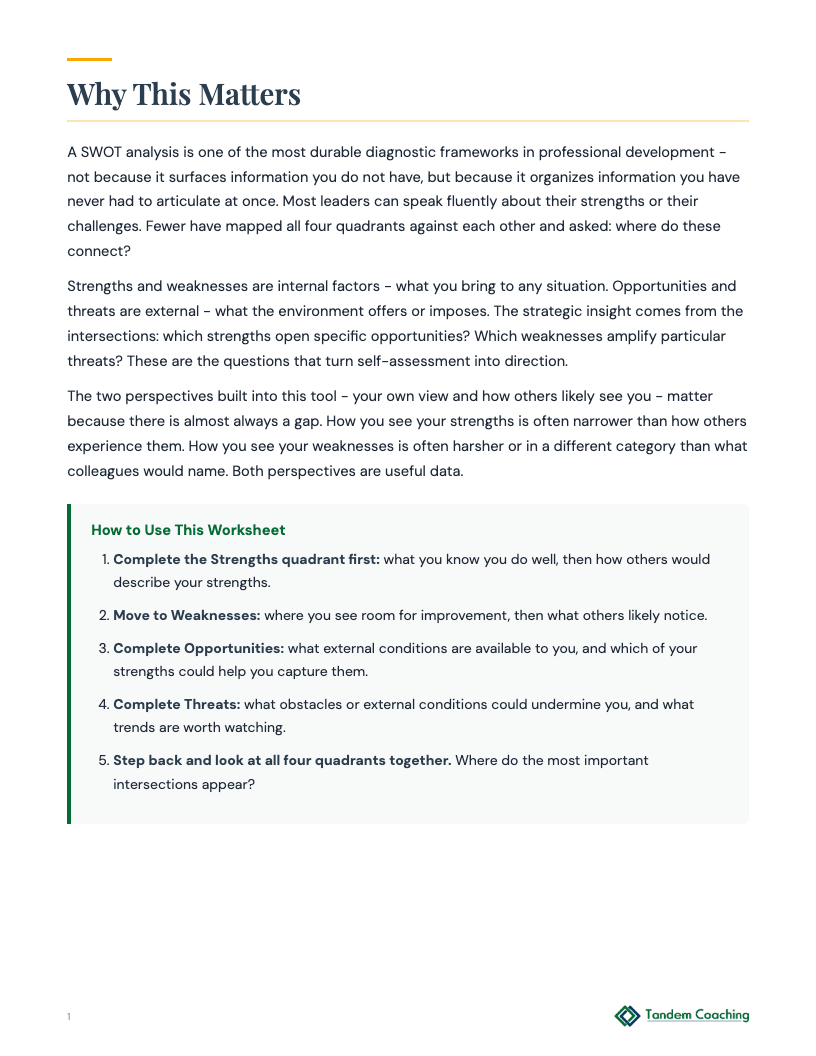
This SWOT maps both how you see yourself and how you believe others see you - would you be open to working through both perspectives side by side?
A client who is a director of customer experience at a retail company has received informal feedback that she is 'difficult to work with' from two peers, which contradicts her self-assessment as collaborative and relationship-oriented. She is confused and somewhat defensive. The dual-perspective SWOT - which asks the client to map both how they see themselves and how they believe others see them - creates a structured comparison that surfaces the self-to-other perception gap without requiring the coach to deliver the external view directly. The client produces both perspectives and can then examine the divergence.
Frame the dual-perspective structure as the tool's key feature: 'This worksheet has two layers - your view of yourself and what you think others observe. Most tools only ask for one. The second layer is the more useful one for what you're working through, because it asks you to construct the external perspective accurately rather than defensively. Fill in how you see your own strengths and weaknesses first, then fill in what you believe your peers would say about the same dimensions. Bring it in and we'll look at whether the two versions tell the same story.' Assigning the self-view first and other-view second prevents the client from anchoring the self-view to the anticipated external one.
Watch for the 'how others see me' quadrants being filled with idealized perceptions rather than accurate ones - 'others see me as collaborative and creative' from a client who just described receiving feedback that she is difficult to work with. The 'how others see me' section should include the difficult feedback, not a hoped-for version of it. Ask: 'What would the two peers who gave that feedback write in this box?' Also watch for the weaknesses quadrant being left sparse on both self and other views - a client who cannot name any weaknesses in the external view quadrant is not doing the exercise honestly.
Compare the self-view strengths with the others-view strengths: 'Where do these two lists overlap, and where do they diverge?' Overlap confirms strengths that are observable. Divergence in strengths - things the client claims others don't see - produces a visibility question: the strength may be real but not deployed in contexts where it is visible. Then compare the weaknesses quadrants: 'The 'how others see me' weaknesses section - how close is that to what the actual feedback said?' If the client's constructed external view doesn't include the difficult feedback, naming that gap is the coaching work.
Array
A client who is a senior manager of business development at a professional services firm is beginning his first coaching engagement. He arrives with a stated goal - 'improve my leadership presence' - that is too vague to anchor a focused engagement. Before building a coaching contract, his coach needs a complete picture of his self-assessment across strengths, weaknesses, and external factors. The dual-perspective SWOT serves as an intake tool that is more specific and actionable than a general goal conversation - it produces four quadrants of concrete content that can be sorted into coaching priorities.
Position it explicitly as the foundation for the engagement's direction: 'Before we build any focus for our work together, I want a complete picture of how you see yourself and how you believe others see you. This SWOT gives us both internal and external dimensions in one place. Complete all four quadrants honestly - including the weaknesses and threats, which most people rush through. Bring it in and we'll use it to define specifically what we're working on, rather than starting with a vague goal that we'll have to narrow down anyway.' The framing that skipping the difficult quadrants wastes time is accurate and motivating.
Watch for the internal weaknesses and external threats quadrants being substantially shorter than the strengths and opportunities - this is the most common failure mode of self-administered SWOT exercises. Ask specifically about the weaknesses: 'Tell me about a time in the last six months when something went differently than you wanted. What does that reveal about this quadrant?' The behavioral incident often produces weakness-quadrant content that the abstract question didn't. Also watch for the external factors (opportunities and threats) being populated with generic market conditions rather than specific conditions relevant to his career and development.
After reviewing all four quadrants: 'If you had to pick the two items from across this entire SWOT that most deserve attention in a coaching engagement, which would they be and why?' The client's selection of priority items from their own SWOT produces a coaching contract that the client owns rather than one the coach imposed. Then ask: 'Is there anything in the weaknesses or threats quadrant that you didn't write down but were thinking about?' The unwritten content is often the most important.
Array
A client who is a VP of strategy at a healthcare company has been promoted once in six years and is concerned about being outpaced by colleagues who are advancing faster. She has done internal self-assessments before but has never mapped her strengths and weaknesses against external factors. The dual-perspective SWOT's strength-opportunity intersection analysis - which asks the client to cross-reference internal assets with external possibilities - produces the specific career move hypothesis that generic goal-setting conversations cannot. The analysis also identifies which weaknesses expose her to specific external threats, which focuses development priorities.
Frame the external quadrants as the differentiator: 'You've assessed yourself before, so the internal quadrants will move quickly. The value here is in the external quadrants and the cross-referencing. I want you to spend most of your time on this question: which of your strengths position you to take advantage of a specific external opportunity? And which of your weaknesses make you vulnerable to a specific threat you can see coming? The intersection is where the coaching focus comes from.' Directing her attention to the cross-reference moves the tool beyond self-assessment and into strategic planning.
Watch for the opportunities quadrant being populated with aspirational possibilities rather than observable current conditions ('the market for strategy talent is good'). Opportunities in a career SWOT should be specific and time-bounded: a specific role opening, a known organizational restructuring, a mentor relationship that could be leveraged. Ask: 'What specific opportunity do you actually see right now that you could act on in the next ninety days?' Also watch for the strength-opportunity cross-reference being completed in session with the first answer that comes to mind rather than the most strategically useful one - the cross-reference deserves deliberate thought.
After reviewing the completed cross-reference: 'Which strength-opportunity pair is the most actionable right now - meaning, you could take a specific step toward it this week?' That question converts the strategic analysis into an immediate action item. Then look at the weakness-threat pairs: 'Which of these is most likely to actually materialize in the next six months, and what would closing that specific weakness require?' The realistic threat window focuses development energy on prevention rather than general improvement.
Array
Client writes goals that sound good but stall as soon as specificity is required
LifeClient can recognize what's unresolved but hasn't acted on it yet
LifeClient sets goals but never writes down what success would actually look like