A structured executive reflection to counter year-end negativity bias, grounded in evidence-based gratitude and performance psychology.
Free, print-ready PDF.
Of everything on your list from Section 1, what's the one you almost didn't write down — and why do you think you nearly left it out?
A results-oriented executive arrives at year-end with a crisp account of missed targets, stalled initiatives, and gaps not closed. When asked what went well, the answer is brief, hedged, or redirected back to the shortfalls. The year has become, in their telling, the sum of its failures. The gratitude practice's structure — list first, distill second, move forward third — forces an accurate accounting before the failures get to set the whole frame.
Name the sequence explicitly before handing off the tool. 'We're going to look at what this year actually produced before we do any forward planning. Section 1 is a list — whatever comes up, business-focused, write it down. You don't evaluate while you write. That's the only rule for the first section.' For executives who default to critical self-assessment, the 'no evaluation while you write' instruction prevents the filter from running before the list is complete.
Watch for length and specificity in Section 1. A client who produces two or three entries with hedged language ('managed to...' 'at least...') is still running the filter despite instructions. Ask what else they'd add if they were writing this list for someone they respected rather than for their own review. The perspective shift sometimes loosens the filter. Also watch for what's absent: a client who achieved significant results but names only process items ('kept the team together') may be discounting outcomes.
Start with the post-tool question: 'What on your Section 1 list surprised you?' For executives whose default is self-critique, the surprise entry is often the most important thing on the list — the accomplishment or relationship they almost didn't name. Then move to Section 2: 'Why that one above everything else?' The 'why' often surfaces what the client actually values, which may not match what they thought they valued going into the year.
If the client completes Section 1 with exclusively tactical items — shipped projects, closed deals, managed headcount — and nothing that reflects on relationships, leadership, or what they learned, the grateful-for list may be operating as a performance report rather than a genuine accounting. Severity: low. Ask what they'd add to the list that isn't captured by 'delivered results.' The answer often surfaces something the client values but doesn't yet count as worth acknowledging.
A leader who has been in execution mode for most of the year — head down, delivering against commitments — has lost a clear sense of what the year produced and what they're building toward. They want to set next year's goals but feel unmoored. The practice's three-section sequence offers them a recalibration point: what was produced, what mattered most, and what comes next based on those two answers.
Frame as the foundation for the planning conversation, not a separate exercise. 'Before we work on next year, I want to understand what this year gave you to build on. Section 1 is a broad list — give me ten minutes on that section without filtering. What you distill in Section 2 will shape what I want to ask you in Section 3.' The leader who has been in execution mode often needs explicit permission to step back and acknowledge what was produced before they're asked to plan.
Watch the relationship between Section 2 (the primary thing) and Section 3 (next steps). If these two sections are disconnected — the thing the client named as most meaningful in Section 2 doesn't appear anywhere in the next steps of Section 3 — the planning isn't flowing from the accounting. This is common among leaders who value different things than they prioritize. Point to the gap: 'You said this was the most meaningful thing of the year. It doesn't appear in your next steps. What would it look like if it did?'
Use the third post-tool prompt: 'Of the next steps in Section 3, which one has been waiting the longest?' For leaders in recalibration mode, the answer is often a pattern or decision they've been deferring, and the end-of-year moment creates an unusual opening to address it. Then: 'What's kept it waiting? Not logistically — actually kept it waiting.' The answer to that question is usually the real coaching work for the next quarter.
If Section 3 (next steps) is populated with activity-based items ('attend more industry events,' 'read more leadership books') rather than specific decisions or commitments the client controls, the forward section hasn't yet engaged with what the year actually surfaced. Severity: low. Push for one specific, concrete next action — not a category of effort but a named decision or conversation — that follows directly from what they named in Section 2.
A high-execution leader has spent the year moving from deliverable to deliverable without building any consistent practice of review or reflection. They are effective by outcome measures and largely disconnected from their own experience of the work. The end of the year is the natural moment to introduce a structured taking-stock practice — brief enough to complete, specific enough to produce something real.
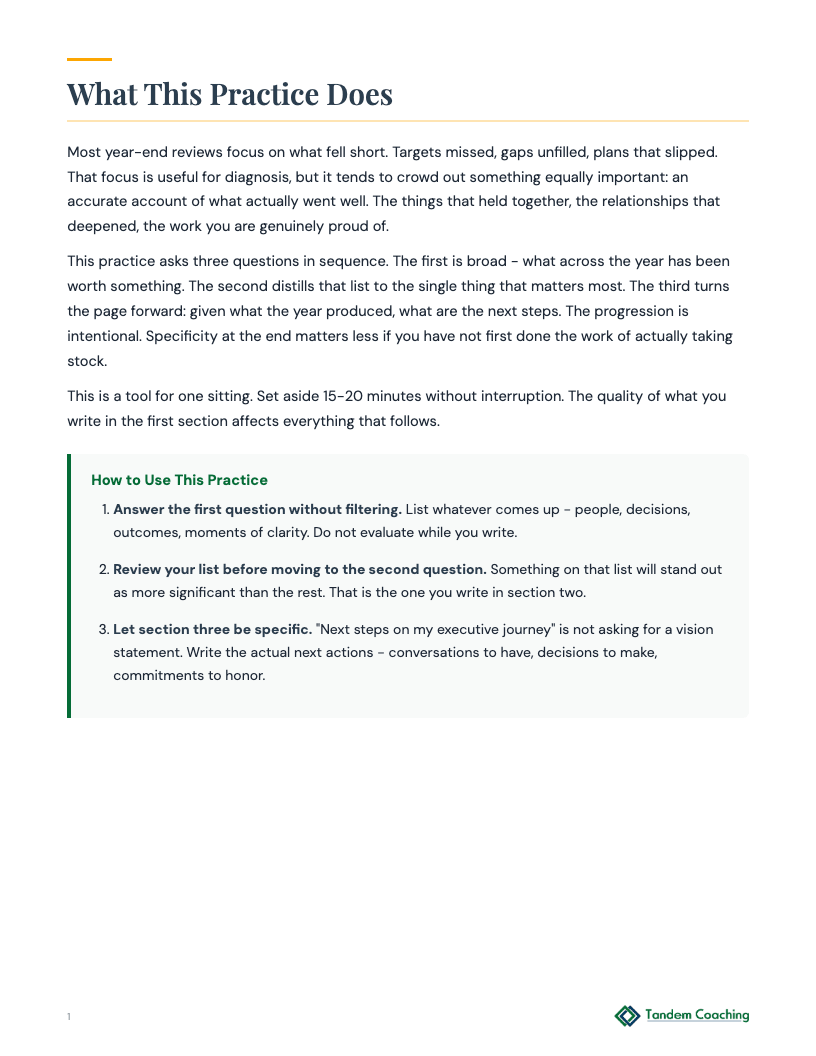
Position as a single-sitting practice rather than a reflection exercise. 'This takes 15-20 minutes. Three questions in sequence, the first one broad, the second specific, the third forward. What I'm asking you to do is write what actually comes up, not what sounds like a good year-end summary.' Leaders who execute without reflection often engage more readily with a time-bounded format than with open-ended reflection prompts.
Watch for the quality of what the client writes in Section 1 before they move to Section 2. A list that is too short (three or four items) may indicate the client moved through Section 1 too quickly. A list that reads like a performance summary may indicate the filter ran despite instructions. The post-tool prompt — 'what surprised you?' — is designed to surface what almost wasn't written: the thing the client noticed but nearly didn't name because it didn't seem significant enough.
Start with the surprise question. 'What on your list almost didn't make it?' Then: 'What does it say that you almost didn't include that?' The answer often reveals something about what the client counts as worth acknowledging — and what they've trained themselves to discount. Then move to Section 2: 'You landed on this as the primary one. Is that the thing you would have predicted coming into this exercise, or did the list change your answer?'
If a client who executes consistently and produces real results cannot generate more than three or four items in Section 1 of a year-end review — and the items listed are sparse and unelaborated — the inability to access what the year produced may go beyond habit. Severity: low. This can indicate burnout (the year doesn't feel like it produced anything meaningful despite objective results), or a more persistent pattern of non-registration that is worth naming directly and exploring.
My client says they know what they value but their choices don't reflect it
LifeI want to reflect on my behavior and understand where I'm owning my part and where I'm deflecting
LifeClient is achieving goals but feels disconnected from any larger sense of meaning
Step 1 of 6 in A client is in year-end review mode and keeps focusing only on what went wrong
Next: Month-End Review Template → Explore all pathways →