Month-End Review Template

Review last month in minutes so you don’t repeat the same patterns. Coach-built prompts turn wins, misses, and lessons into next steps.

Worksheet · 30 min · Print-ready PDF · Free download

Get This Tool

Free PDF - professionally formatted, ready to print or fill digitally

Preview Worksheet · 30 min
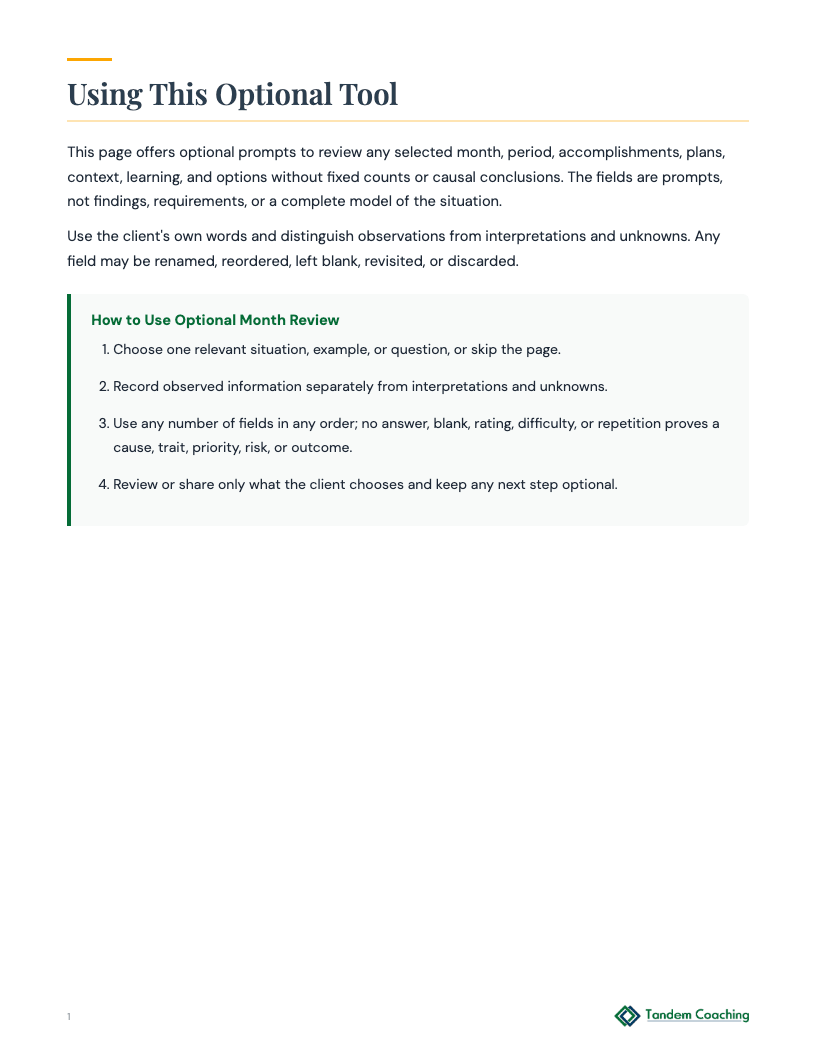
Month-End Review Template - preview
When to Use This Tool
A client moves into the next month without ever taking stock of what the last one held
Someone closing a month by naming accomplishments, lessons, what worked, what needs to change, and next priorities
Building a monthly reflection practice that's substantial enough to be useful but short enough to actually do
How to Introduce This Tool Plus

As you close out this month — what's the one word that captures it, and what's the insight you don't want to leave behind when you move into the next one?

Browse All Pages
Interactive Preview Worksheet · 30 min
Tool Classification
Domain
Life Coaching
Type
Worksheet
Phase
Review
Details
30 min Opener Monthly
Topics
Accountability Habits

For the Coaching Practitioner

Plus
Coaching Scenarios Plus
1 VP of Product who is too close to her team's output to evaluate her own contribution
Context

A VP of Product at a SaaS company is six months into a new role. She came in with ambitious goals and has spent the first two quarters building relationships, stabilizing a struggling team, and stabilizing cross-functional processes. When her coach asks what she has accomplished in the last month, she describes what the team accomplished and cannot cleanly separate her own contribution from the team's output. Her coach suspects her self-assessment is significantly undervaluing her individual leadership work.

How to Introduce

Frame this as a separation exercise. 'The top three accomplishments field is specifically about what you did - not what the team shipped, not what the organization delivered. Your job this month, at your level, is not the same as the team's job. I want to know what changed because you were in the room, made a decision, or redirected something. If the team would have gotten to the same outcome without your specific judgment or intervention, it doesn't count here.' The resistance: 'This distinction feels uncomfortable for a leader who identifies with their team's success. Notice that discomfort and fill in the fields anyway.'

What to Watch For

Watch whether the top three accomplishments are stated at the team level ('we shipped X') or the leadership level ('I made the call to descope Y when the team was headed toward a late delivery, which protected Q3 commitments'). If the accomplishments read as a sprint report rather than a leadership ledger, she has not yet made the separation. Watch the 'what didn't happen + why' field - this is often the most revealing. If she describes team failures without examining her own role in them (what she could have done differently, what she did or didn't see), the self-assessment is still filtered through a protective lens. The lesson field is where the month's real learning usually lives.

Debrief

Start with the accomplishments. Read them back and ask: 'Which of these required your specific judgment - something a less experienced leader or someone who didn't know this team as well wouldn't have done the same way?' That question surfaces the leadership-specific contribution. Then go to 'what didn't happen': 'What's on this list that you had more control over than the framing suggests?' That question gently challenges the tendency to externalize failures while internalizing successes at the wrong level. Finally, the one-word intention: 'Why that word? What does it mean for how you want to lead in the next month?'

Flags

If the top three accomplishments, the lesson, and the priorities for next month all read in a consistent voice of external attribution - things happened to her, team executed or didn't, external factors constrained - with no first-person ownership of direction or decision, the review has not yet engaged the level where her leadership actually operates. Severity: low. This is common in the first six months of a new VP role when the work has been primarily stabilizing rather than building. Name the pattern and ask: 'When you look at this review, whose story does it tell?'

2 Chief of Staff who tracks deliverables obsessively but has never asked what the work is for
Context

A chief of staff at a healthcare organization has been in coaching for two months. He is extremely organized and can report on every active initiative with precision. When his coach asks what the work has built over the last month, he returns to the deliverable list. When asked what he wants the year to look like by December, he describes what will be completed, not what will be different. He has no practice of asking himself what the work is in service of.

How to Introduce

Frame this as a different altitude than his usual tracking. 'You have excellent granular visibility into what's happening week to week. This review operates at a different altitude - it asks about the month as a whole, what mattered, what it produced in terms of lessons and direction rather than deliverables. The top three accomplishments field isn't a task list - it's the question of what you actually built or changed that wasn't true on the first of the month.' Name the resistance: 'The fields in here may feel less precise than what you're used to working with. That is intentional. The imprecision asks you to make a judgment about what mattered, not just what happened.'

What to Watch For

Watch whether the top three accomplishments are outcome statements ('cleared the backlog of decisions the executive team had been deferring for three weeks') or activity statements ('completed six working sessions'). Activity statements mean he is still in deliverable mode. The 'what's working' field is diagnostic: if it contains process descriptions (my system, my tracking approach) rather than leadership observations (how I managed up this month, what I did when the CEO changed direction), he hasn't examined his own practice. The one-word intention field often produces something revealing for someone who doesn't usually think at that level of abstraction.

Debrief

Start with the biggest lesson. 'What would you have done differently in the month if you had known this earlier?' That question tests whether the lesson is genuine or nominal - a real lesson implies a decision point where the learning would have changed the action. Then look at the priorities for next month: 'Why those three? What are they in service of?' That question is the one he never asks himself, and the discomfort with it is useful material. If he can answer it easily, ask: 'And what's that in service of?' The level of abstraction at which he loses footing is the level where the coaching work lives.

Flags

If the 'what needs to change' field is blank or contains one sentence, and the rest of the review is detailed and thorough, he may be doing the review as a reporting exercise rather than an evaluative one - he can describe what happened but is not examining whether it should change. Severity: low. Ask directly: 'If you were advising a chief of staff whose month looked exactly like yours, what would you tell them needs to change?' The third-person distance often allows access to what first-person self-assessment has blocked.

3 Nonprofit program director who works continuously without examining what the effort is producing
Context

A program director at a youth services nonprofit has been in coaching for three months. She works long hours and cares deeply about the mission. When her coach asks how the month went, she gives a chronological account of events: what happened, who needed what, what crises arose. She has no habit of stepping back and asking what the month produced. She experiences coaching questions about reflection as a luxury she cannot afford given the workload.

How to Introduce

Frame this as a professional tool, not a personal practice. 'This review has seven fields. The whole thing takes thirty minutes once a month. What it produces is a picture of whether the work you're doing is actually the work that matters - not whether you were busy, but whether the month moved anything that needed to move. The biggest lesson field is the one I most want you to take seriously: in a role like yours, the lessons from one month are the only way to work smarter in the next one.' Name the resistance: 'I know thirty minutes feels like a lot. The alternative is another month where what you learned in June doesn't inform what you do in July.'

What to Watch For

Watch whether the top three accomplishments are things she did or things that happened to her ('survived the grant deadline' is not an accomplishment - 'restructured the grant narrative to match the new program theory' is). The 'what didn't happen + why' field is where her honest assessment of her own capacity will show up - or not. If it is empty or describes only external constraints, she is protecting herself from examining where her own bandwidth or attention contributed to what didn't get done. The 'what's working' field is the one most likely to produce something genuinely useful for the coaching work: what in her current approach is actually reliable.

Debrief

Start with the biggest lesson. 'What decision would you have made differently if you had known this on the first of the month?' Then look at the one-word intention: 'Say more about that word. What does it mean for how you're going to show up in the next month?' That question connects the intention to specific decisions and behaviors rather than leaving it as an aspiration. If she has written a month-end review for the first time, also ask: 'What did you notice about the month that you wouldn't have noticed if you hadn't done this?' That question surfaces what the structure of the review accessed that the day-to-day did not.

Flags

If she completes the review but every field describes external events and constraints without any first-person examination of her choices or decisions, she may be using the tool as a narrative record rather than a self-assessment. Severity: low. This is common in direct-service roles where the work is genuinely reactive. Name it: 'I notice this review describes a lot of what happened to you and around you. I'm curious what the version would look like where you were the main character.' That reframe does not require her to be self-critical - it asks her to locate her own agency in the month.

Tool Flow Plus
Requires
  • active month of work or goal pursuit
Produces
  • top three monthly accomplishments named
  • gap analysis with root cause identification
  • single biggest lesson from the month
  • three prioritized intentions for next month

Pairs Well With

Life

Habit Tracker

A client wants to build consistency but keeps losing momentum after week one

15 min Tracker
Life

Daily Action Checklist

I know what I need to do but I keep dropping things by end of day

5 min Checklist
Life

Weekly Reflection Planner

I plan my weeks but never reflect on how they actually went

15 min Planner

This tool is part of a coaching pathway

Step 2 of 6 in A leader who wants to learn from experience rather than just accumulate it

Next: ADHD Letter to Myself → Explore all pathways →

Related Articles

Change Management in Project Management: Closing the Adoption Gap

Change Management in Project Management: Closing the Adoption Gap

Read article →
When Technical Credibility Stops Being Enough

When Technical Credibility Stops Being Enough

Read article →
ADKAR Change Management Model: What to Do When You Find the Gap

ADKAR Change Management Model: What to Do When You Find the Gap

Read article →
Benefits of Leadership Development Programs - Unveiled for Corporates

Benefits of Leadership Development Programs - Unveiled for Corporates

Read article →
Executive Transition Runway Calculator | How Long Can You Really Last?

Executive Transition Runway Calculator | How Long Can You Really Last?

Read article →
Building Resilience Amid Change: The Power of Coaching

Building Resilience Amid Change: The Power of Coaching

Read article →